
拆除基于互联网的耳鸣认知行为疗法。应用放松的作用:一项随机对照试验。
Dismantling internet-based cognitive behavioral therapy for tinnitus. The contribution of applied relaxation: A randomized controlled trial.
作者信息
Beukes Eldré W, Andersson Gerhard, Fagelson Marc A, Manchaiah Vinaya
机构信息
Department of Speech and Hearing Sciences, Lamar University, Beaumont, TX, USA.
Vision and Hearing Sciences Research Group, School of Psychology and Sports Sciences, Anglia Ruskin University, Cambridge, United Kingdom.
出版信息
Internet Interv. 2021 May 12;25:100402. doi: 10.1016/j.invent.2021.100402. eCollection 2021 Sep.
BACKGROUND
Internet-based cognitive behavioral therapy (ICBT) for tinnitus is an evidence-based intervention. The components of ICBT for tinnitus have, however, not been dismantled and thus the effectiveness of the different therapeutic components is unknown. It is, furthermore, not known if heterogeneous tinnitus subgroups respond differently to ICBT.
AIMS
This dismantling study aimed to explore the contribution of applied relaxation within ICBT for reducing tinnitus distress and comorbidities associated with tinnitus. A secondary aim was to assess whether outcomes varied for three tinnitus subgroups, namely those with significant tinnitus severity, those with low tinnitus severity, and those with significant depression.
METHODS
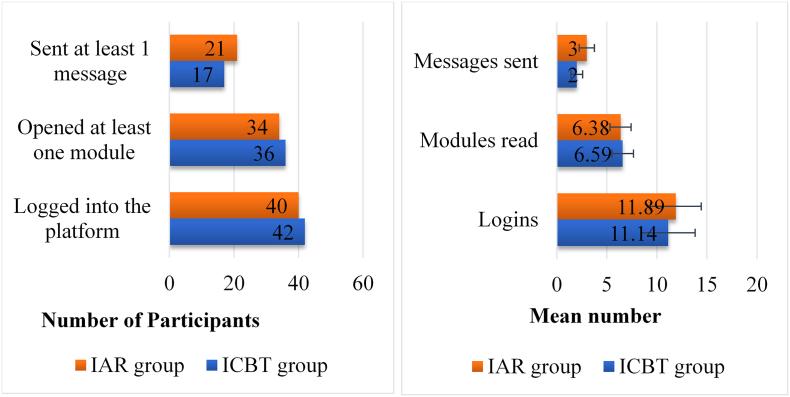
A parallel randomized controlled trial design ( = 126) was used to compare audiologist-guided applied relaxation with the full ICBT intervention. Recruitment was online and via the intervention platform. Assessments were completed at four-time points including a 2-month follow-up period. The primary outcome was tinnitus severity as measured by the Tinnitus Functional Index. Secondary outcomes were included for anxiety, depression, insomnia, negative tinnitus cognitions, health-related quality of life, hearing disability, and hyperacusis. Treatment engagement variables including the number of logins, number of modules opened, and the number of messages sent. Both an intention-to-treat analysis and completer's only analysis were undertaken.
RESULTS
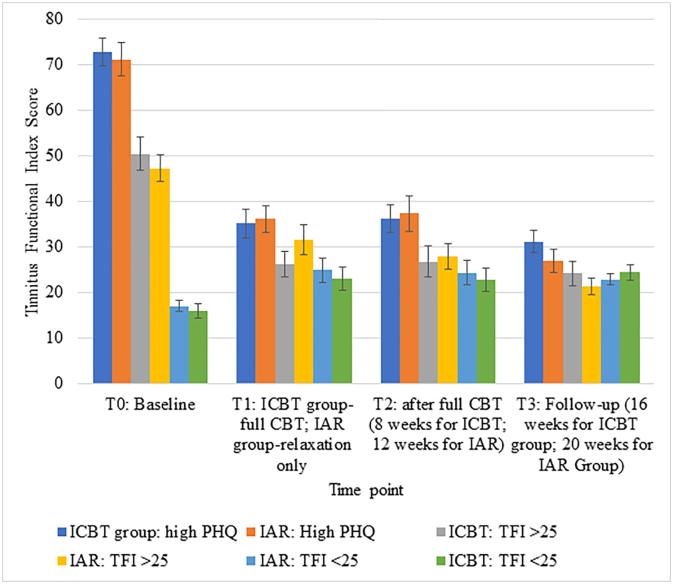
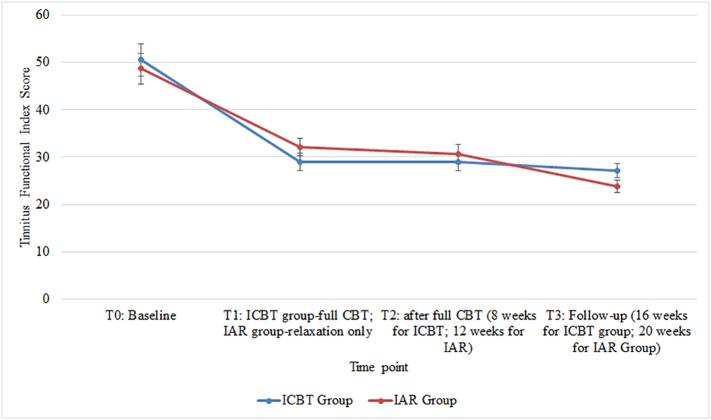
Engagement was low which compromised results as the full intervention was undertaken by few participants. Both the ICBT and applied relaxation resulted in large reduction of tinnitus severity (within-group effect sizes = 0.87 and 0.68, respectively for completers only analysis), which were maintained, or further improved at follow-up. These reductions in tinnitus distress were greater for the ICBT group, with a small effect size differences (between-group = 0.15 in favor of ICBT for completers only analysis). Tinnitus distress decreased the most at post-intervention for those with significant depression at baseline. Both ICBT and applied relaxation contributed to significant reductions on most secondary outcome measures, with no group differences, except for a greater reduction of hyperacusis in the ICBT group.
CONCLUSION
Due to poor compliance partly attributed to the COVID-19 pandemic results were compromised. Further studies employing strategies to improve compliance and engagement are required. The intervention's effectiveness increased with initial level of tinnitus distress; those with the highest scores at intake experienced the most substantial changes on the outcome measures. This may suggest tailoring of interventions according to tinnitus severity. Larger samples are needed to confirm this.
背景
基于互联网的耳鸣认知行为疗法(ICBT)是一种循证干预方法。然而,ICBT治疗耳鸣的各个组成部分尚未被拆解,因此不同治疗成分的有效性尚不清楚。此外,不同的耳鸣亚组对ICBT的反应是否不同也不清楚。
目的
本拆解研究旨在探讨ICBT中应用放松疗法对减轻耳鸣困扰及与耳鸣相关的合并症的作用。次要目的是评估三个耳鸣亚组(即耳鸣严重程度高的患者、耳鸣严重程度低的患者和有明显抑郁症状的患者)的治疗结果是否存在差异。
方法
采用平行随机对照试验设计(n = 126),比较听力学家指导的应用放松疗法与完整的ICBT干预。通过网络和干预平台进行招募。在包括2个月随访期在内的四个时间点完成评估。主要结局是用耳鸣功能指数测量的耳鸣严重程度。次要结局包括焦虑、抑郁、失眠、负面耳鸣认知、健康相关生活质量、听力残疾和听觉过敏。治疗参与变量包括登录次数、打开的模块数量和发送的消息数量。进行了意向性分析和仅针对完成者的分析。
结果
参与度较低,由于很少有参与者完成完整干预,影响了研究结果。ICBT和应用放松疗法均使耳鸣严重程度大幅降低(仅针对完成者的分析中,组内效应量分别为0.87和0.68),且在随访时得以维持或进一步改善。ICBT组耳鸣困扰的减轻幅度更大,效应量差异较小(仅针对完成者的分析中,组间效应量为0.15,有利于ICBT)。基线时有明显抑郁症状的患者在干预后耳鸣困扰下降幅度最大。ICBT和应用放松疗法在大多数次要结局指标上均有显著降低,除ICBT组听觉过敏的降低幅度更大外,两组间无差异。
结论
部分归因于新冠疫情导致的依从性差影响了研究结果。需要进一步开展采用提高依从性和参与度策略的研究。干预的有效性随耳鸣困扰的初始水平而增加;入组时得分最高的患者在结局指标上的变化最大。这可能表明应根据耳鸣严重程度调整干预措施。需要更大样本量来证实这一点。


 Zotero 插件