
青少年特发性脊柱侧凸手术融合节段的选择:选择性融合与术后失代偿
Selection of Fusion Level for Adolescent Idiopathic Scoliosis Surgery : Selective Fusion versus Postoperative Decompensation.
作者信息
Kim Do-Hyoung, Hyun Seung-Jae, Kim Ki-Jeong
机构信息
Department of Neurosurgery, Spine Center, Seoul National University Bundang Hospital, Seoul National University College of Medicine, Seongnam, Korea.
出版信息
J Korean Neurosurg Soc. 2021 Jul;64(4):473-485. doi: 10.3340/jkns.2020.0258. Epub 2021 May 28.
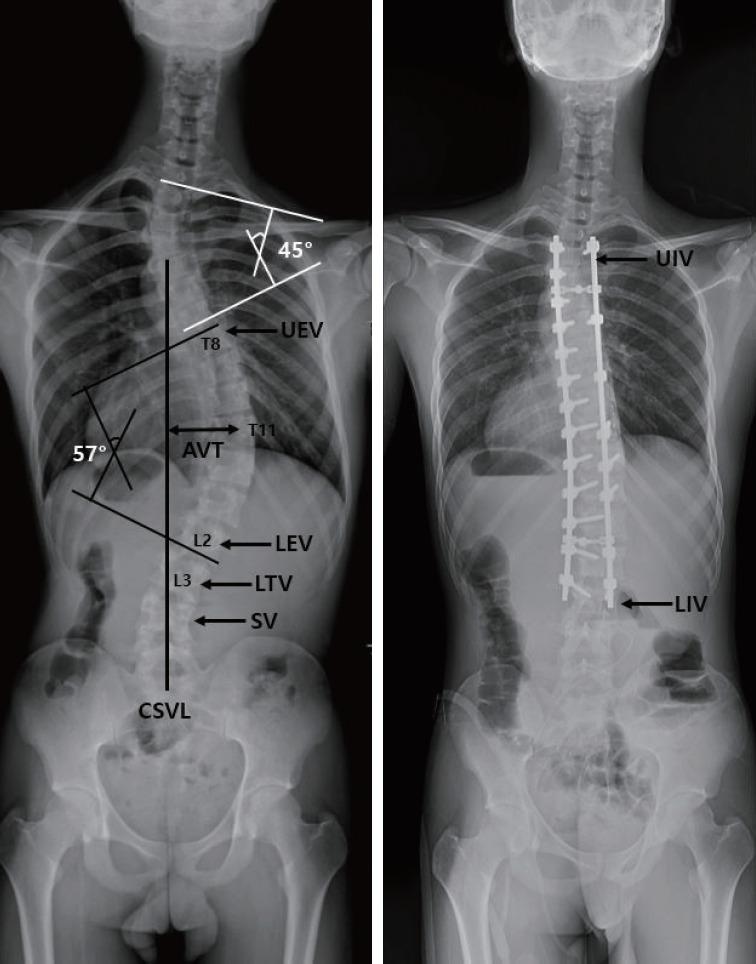
Adolescent idiopathic scoliosis (AIS), which is associated with an extensive range of clinical and radiological presentations, is the one of the most challenging spinal disorders. The goals of surgery are to correct the deformity in 3 dimensions and to preserve motion segments while avoiding complications. Despite the ongoing evolution of classification systems and algorithms for the surgical treatment of AIS, there has been considerable debate regarding the selection of an appropriate fusion level in AIS. In addition, there is no consensus regarding the exact description, relationship, and risk factors of coronal decompensation following selective fusion. In this review, we summarize the current concepts of selection of the fusion level for AIS and review the available information about postoperative coronal decompensation.
青少年特发性脊柱侧凸(AIS)与广泛的临床和放射学表现相关,是最具挑战性的脊柱疾病之一。手术的目标是在三维空间上矫正畸形,并保留活动节段同时避免并发症。尽管用于AIS手术治疗的分类系统和算法不断发展,但关于AIS中合适融合节段的选择仍存在相当大的争议。此外,对于选择性融合后冠状面失代偿的确切描述、关系及危险因素尚无共识。在本综述中,我们总结了目前关于AIS融合节段选择的概念,并回顾了有关术后冠状面失代偿的现有信息。

 Zotero 插件