
诊断副蛋白血症性角膜病变:一例报告
Diagnosing Paraproteinemic Keratopathy: A Case Report.
作者信息
Mok Eugenie, Kam Ka Wai, Aldave Anthony J, Young Alvin L
机构信息
Department of Ophthalmology & Visual Sciences, The Chinese University of Hong Kong, New Territories, Hong Kong, Hong Kong, China.
Department of Ophthalmology & Visual Sciences, Prince of Wales Hospital, Hong Kong, Hong Kong, China.
出版信息
Case Rep Ophthalmol. 2021 May 7;12(2):337-343. doi: 10.1159/000514375. eCollection 2021 May-Aug.
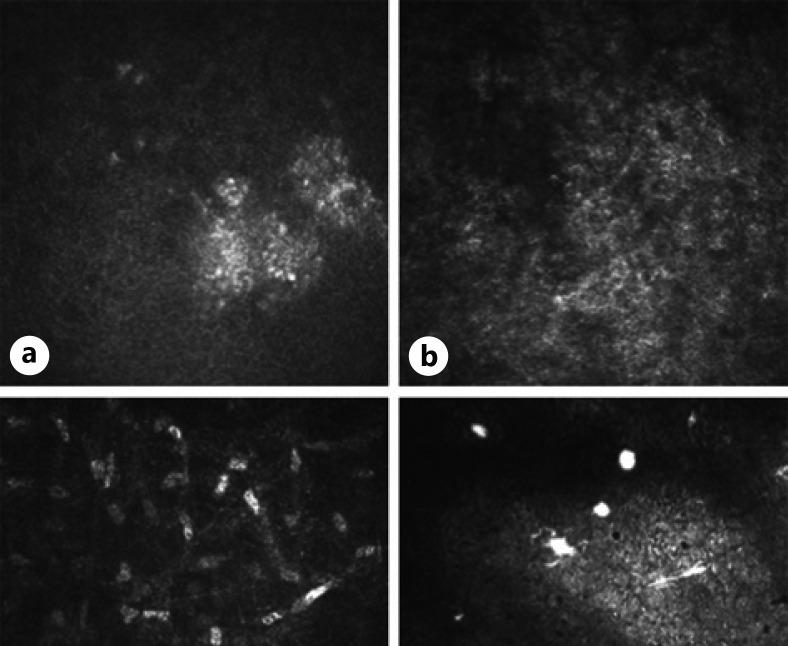
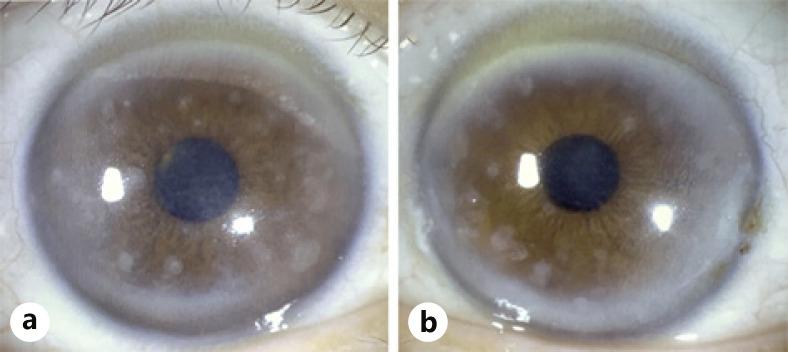
A 65-year-old man presented with bilateral, painless, progressive blurring of vision over 9 years. Slit-lamp examination revealed bilateral subepithelial corneal opacities in clusters located at the mid-periphery. Anterior segment optical coherence tomography, in vivo confocal microscopy (IVCM), serum protein electrophoresis, and molecular genetic testing were performed to evaluate the cause of corneal opacities. Anterior segment optical coherence tomography revealed a band-like, hyperreflective lesion in the Bowman layer and anterior stroma of both corneas. IVCM revealed hyperreflective deposits in the epithelium, anterior stroma, and endothelium. Serum protein electrophoresis identified the presence of paraproteins (immunoglobulin kappa), and molecular genetic testing revealed absence of mutations in the transforming growth factor beta-induced gene () and collagen type XVII alpha 1 gene (). The ocular diagnosis of paraproteinemic keratopathy eventually led to a systemic diagnosis of monoclonal gammopathy of undetermined significance by our hematologist/oncologist. Paraproteinemic keratopathy is a rare differential diagnosis in patients with bilateral corneal opacities and therefore may be misdiagnosed as corneal dystrophy or neglected as scars. In patients with bilateral corneal opacities of unknown cause, serological examination, adjunct anterior segment imaging, and molecular genetic testing play a role in establishing the diagnosis.
一名65岁男性,9年来双眼出现无痛性、进行性视力模糊。裂隙灯检查发现双眼角膜上皮下有簇状混浊,位于角膜中周边部。进行了眼前段光学相干断层扫描、活体共聚焦显微镜检查(IVCM)、血清蛋白电泳和分子基因检测,以评估角膜混浊的原因。眼前段光学相干断层扫描显示双眼角膜Bowman层和前基质中有带状高反射性病变。IVCM显示上皮、前基质和内皮中有高反射性沉积物。血清蛋白电泳确定存在副蛋白(免疫球蛋白κ),分子基因检测显示转化生长因子β诱导基因()和 XVII型胶原α1基因()无突变。眼部诊断为副蛋白血症性角膜病变,最终经血液科医生/肿瘤学家诊断为意义未明的单克隆丙种球蛋白病。副蛋白血症性角膜病变在双侧角膜混浊患者中是一种罕见的鉴别诊断,因此可能被误诊为角膜营养不良或被当作瘢痕而被忽视。在病因不明的双侧角膜混浊患者中,血清学检查、辅助眼前段成像和分子基因检测在确立诊断方面发挥作用。

 Zotero 插件