
宿主因素在 SARS-CoV-2 进入中的作用。
Role of host factors in SARS-CoV-2 entry.
机构信息
Center for Retrovirus Research, The Ohio State University, Columbus, Ohio, USA; Department of Veterinary Biosciences, The Ohio State University, Columbus, Ohio, USA; Molecular, Cellular and Developmental Biology Program, The Ohio State University, Columbus, Ohio, USA.
Center for Retrovirus Research, The Ohio State University, Columbus, Ohio, USA; Department of Veterinary Biosciences, The Ohio State University, Columbus, Ohio, USA; Department of Microbial Infection and Immunity, The Ohio State University, Columbus, Ohio, USA; Viruses and Emerging Pathogens Program, Infectious Diseases Institute, The Ohio State University, Columbus, Ohio, USA.
出版信息
J Biol Chem. 2021 Jul;297(1):100847. doi: 10.1016/j.jbc.2021.100847. Epub 2021 May 28.
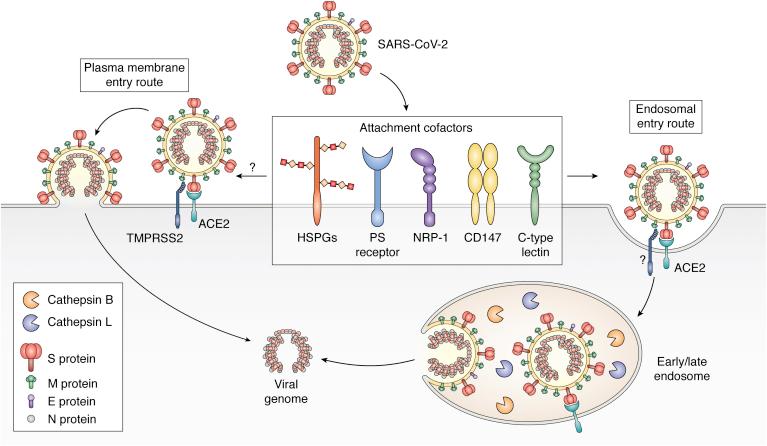
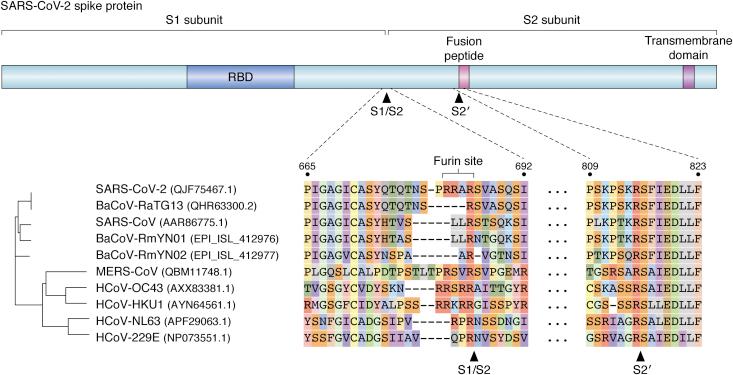
The zoonotic transmission of highly pathogenic coronaviruses into the human population is a pressing concern highlighted by the ongoing SARS-CoV-2 pandemic. Recent work has helped to illuminate much about the mechanisms of SARS-CoV-2 entry into the cell, which determines host- and tissue-specific tropism, pathogenicity, and zoonotic transmission. Here we discuss current findings on the factors governing SARS-CoV-2 entry. We first reviewed key features of the viral spike protein (S) mediating fusion of the viral envelope and host cell membrane through binding to the SARS-CoV-2 receptor, angiotensin-converting enzyme 2. We then examined the roles of host proteases including transmembrane protease serine 2 and cathepsins in processing S for virus entry and the impact of this processing on endosomal and plasma membrane virus entry routes. We further discussed recent work on several host cofactors that enhance SARS-CoV-2 entry including Neuropilin-1, CD147, phosphatidylserine receptors, heparan sulfate proteoglycans, sialic acids, and C-type lectins. Finally, we discussed two key host restriction factors, i.e., interferon-induced transmembrane proteins and lymphocyte antigen 6 complex locus E, which can disrupt SARS-CoV-2 entry. The features of SARS-CoV-2 are presented in the context of other human coronaviruses, highlighting unique aspects. In addition, we identify the gaps in understanding of SARS-CoV-2 entry that will need to be addressed by future studies.
高致病性冠状病毒向人类种群的动物源传播是当前 SARS-CoV-2 大流行所突显的一个紧迫问题。最近的研究工作有助于阐明 SARS-CoV-2 进入细胞的机制,这决定了宿主和组织的特异性趋向性、致病性和动物源传播性。在这里,我们讨论了目前关于控制 SARS-CoV-2 进入的因素的发现。我们首先回顾了介导病毒包膜与宿主细胞膜融合的病毒刺突蛋白(S)的关键特征,该融合通过与 SARS-CoV-2 受体血管紧张素转换酶 2 结合来实现。然后,我们研究了宿主蛋白酶(包括跨膜丝氨酸蛋白酶 2 和组织蛋白酶)在 S 加工以促进病毒进入以及这种加工对内体和质膜病毒进入途径的影响。我们进一步讨论了最近关于几种增强 SARS-CoV-2 进入的宿主辅助因子的工作,包括神经纤毛蛋白 1、CD147、磷脂酰丝氨酸受体、硫酸乙酰肝素蛋白聚糖、唾液酸和 C 型凝集素。最后,我们讨论了两种关键的宿主限制因子,即干扰素诱导的跨膜蛋白和淋巴细胞抗原 6 复合物基因座 E,它们可以破坏 SARS-CoV-2 的进入。我们根据其他人类冠状病毒呈现了 SARS-CoV-2 的特征,突出了独特的方面。此外,我们确定了需要未来研究解决的 SARS-CoV-2 进入理解方面的差距。
 Zotero 插件