
重症肌无力:流行病学、病理生理学及临床表现
Myasthenia Gravis: Epidemiology, Pathophysiology and Clinical Manifestations.
作者信息
Dresser Laura, Wlodarski Richard, Rezania Kourosh, Soliven Betty
机构信息
Department of Neurology, University of Chicago, Chicago, IL 60637, USA.
出版信息
J Clin Med. 2021 May 21;10(11):2235. doi: 10.3390/jcm10112235.
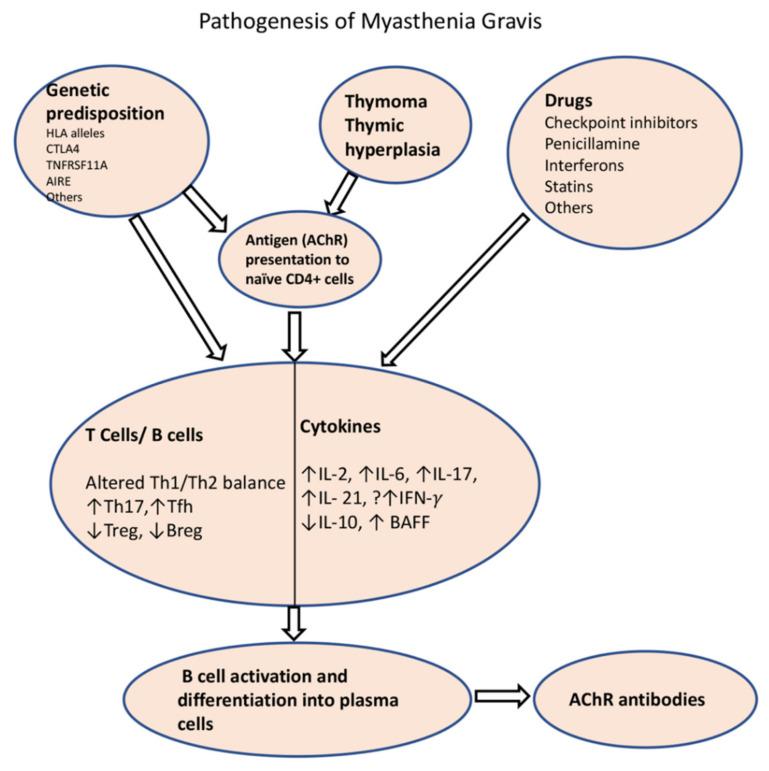
Myasthenia gravis (MG) is an autoimmune neurological disorder characterized by defective transmission at the neuromuscular junction. The incidence of the disease is 4.1 to 30 cases per million person-years, and the prevalence rate ranges from 150 to 200 cases per million. MG is considered a classic example of antibody-mediated autoimmune disease. Most patients with MG have autoantibodies against the acetylcholine receptors (AChRs). Less commonly identified autoantibodies include those targeted to muscle-specific kinase (MuSK), low-density lipoprotein receptor-related protein 4 (Lrp4), and agrin. These autoantibodies disrupt cholinergic transmission between nerve terminals and muscle fibers by causing downregulation, destruction, functional blocking of AChRs, or disrupting the clustering of AChRs in the postsynaptic membrane. The core clinical manifestation of MG is fatigable muscle weakness, which may affect ocular, bulbar, respiratory and limb muscles. Clinical manifestations vary according to the type of autoantibody, and whether a thymoma is present.
重症肌无力(MG)是一种自身免疫性神经疾病,其特征是神经肌肉接头处传递功能缺陷。该病的发病率为每百万人口年4.1至30例,患病率为每百万150至200例。MG被认为是抗体介导的自身免疫性疾病的经典例子。大多数MG患者具有抗乙酰胆碱受体(AChR)的自身抗体。较少见的自身抗体包括针对肌肉特异性激酶(MuSK)、低密度脂蛋白受体相关蛋白4(Lrp4)和聚集蛋白的抗体。这些自身抗体通过导致AChR的下调、破坏、功能阻断或破坏突触后膜中AChR的聚集,干扰神经末梢与肌纤维之间的胆碱能传递。MG的核心临床表现是易疲劳性肌无力,可累及眼肌、延髓肌、呼吸肌和肢体肌肉。临床表现因自身抗体类型以及是否存在胸腺瘤而异。


 Zotero 插件