
膳食纤维对2型糖尿病患者肠道微生物群、血脂谱及炎症标志物的影响:一项随机对照试验的系统评价和荟萃分析
The Effect of Dietary Fibre on Gut Microbiota, Lipid Profile, and Inflammatory Markers in Patients with Type 2 Diabetes: A Systematic Review and Meta-Analysis of Randomised Controlled Trials.
作者信息
Ojo Omorogieva, Ojo Osarhumwese Osaretin, Zand Nazanin, Wang Xiaohua
机构信息
School of Health Sciences, University of Greenwich, Avery Hill Campus, Avery Hill Road, London SE9 2UG, UK.
South London and Maudsley NHS Foundation Trust, University Hospital, Lewisham High Street, London SE13 6LH, UK.
出版信息
Nutrients. 2021 May 26;13(6):1805. doi: 10.3390/nu13061805.
BACKGROUND
A disequilibrium of the gut microbial community has been closely associated with systemic inflammation and metabolic syndromes including type 2 diabetes. While low fibre and high fat diets may lead to dysbiosis of the gut microbiome as a result of the loss of useful microbes, it has been reported that a high fibre diet may prevent the fermentation of protein and may promote eubiosis of gut microbiota.
AIM
This review aims to evaluate the effect of dietary fibre (DF) on gut microbiota, lipid profile, and inflammatory markers in patients with type 2 diabetes.
METHODS
The PRISMA framework was relied on to conduct this systematic review and meta-analysis. Searches were carried out using electronic databases and reference list of articles.
RESULTS
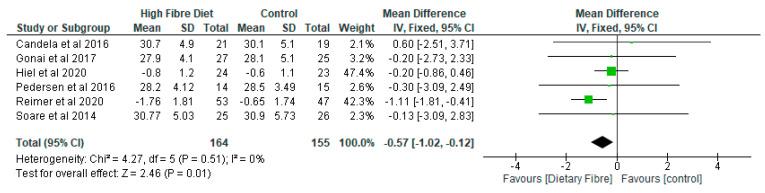
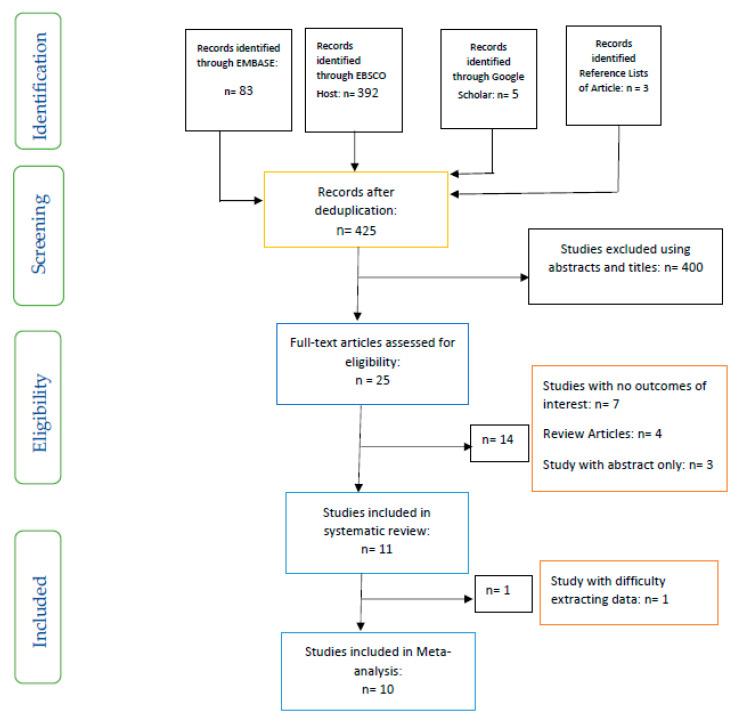
Eleven studies were included in the systematic review, while ten studies were included in the meta-analysis. The findings revealed five distinct areas including the effects of DF on (a) gut microbiota (122 participants); (b) lipopolysaccharides (LPS, 79 participants) and lipopolysaccharides binding protein (LBP, 81 participants); (c) lipid profile; (d) inflammatory markers; and (e) body mass index (BMI, 319 participants). The relative abundance of increased by 0.73 (95% CI: 0.57, 0.89) in the DF group in contrast to the control ( < 0.05). With respect to LPS, the level was lower in the DF group than the control and the difference was significant ( < 0.05). The standardised mean difference for LPS was -0.45 (95% CI: -0.90, -0.01) although the difference between the two groups in relation to LBP was not significant ( = 0.08) and the mean difference was 0.92 (95% CI: -0.12, 1.95). While there was a decrease of -1.05 (95% CI: -2.07, -0.02) with respect to total cholesterol (356 participants) in the DF group as compared with the control ( < 0.05), both groups were not significantly different ( > 0.05) in the other lipid parameters. The difference between the groups was significant ( < 0.05) in relation to C-reactive protein, and the mean difference was 0.43 (95% CI: 0.02, 0.84). This could be due to the short duration of the included studies and differences in participants' diets including the amount of dietary fibre supplements. However, the groups were not significantly different ( > 0.05) with respect to the other inflammatory markers. The meta-analysis of the BMI showed that the DF group decreased by -0.57 (95% CI: -1.02, -0.12) as compared with the control and this was significant ( < 0.01).
CONCLUSION
DF significantly ( < 0.05) increased the relative abundance of and significantly decreased ( < 0.05) LPS, total cholesterol, and BMI as compared with the control. However, DF did not seem to have an effect that was significant on LBP, triglyceride, HDL cholesterol, LDL cholesterol, IL-6, TNF-α, adiponectin, and leptin. These findings have implications for public health in relation to the use of dietary fibre in nutritional interventions and as strategies for managing type 2 diabetes.
背景
肠道微生物群落失衡与全身炎症及包括2型糖尿病在内的代谢综合征密切相关。虽然低纤维和高脂肪饮食可能因有益微生物的丧失导致肠道微生物群失调,但据报道,高纤维饮食可能会抑制蛋白质发酵,并促进肠道微生物群的健康状态。
目的
本综述旨在评估膳食纤维(DF)对2型糖尿病患者肠道微生物群、血脂谱和炎症标志物的影响。
方法
依靠PRISMA框架进行这项系统评价和荟萃分析。使用电子数据库和文章参考文献列表进行检索。
结果
系统评价纳入了11项研究,荟萃分析纳入了10项研究。研究结果揭示了五个不同领域,包括DF对(a)肠道微生物群(122名参与者);(b)脂多糖(LPS,79名参与者)和脂多糖结合蛋白(LBP,81名参与者);(c)血脂谱;(d)炎症标志物;以及(e)体重指数(BMI,319名参与者)的影响。与对照组相比,DF组中 的相对丰度增加了0.73(95%置信区间:0.57,0.89)(P<0.05)。关于LPS,DF组的水平低于对照组,差异显著(P<0.05)。LPS的标准化平均差为-0.45(95%置信区间:-0.90,-0.01),尽管两组在LBP方面的差异不显著(P = 0.08),平均差为0.92(95%置信区间:-0.12,1.95)。与对照组相比,DF组的总胆固醇(356名参与者)降低了-1.05(95%置信区间:-2.07,-0.02)(P<0.05),但两组在其他血脂参数方面无显著差异(P>0.05)。两组在C反应蛋白方面的差异显著(P<0.05),平均差为0.43(95%置信区间:0.02,0.84)。这可能是由于纳入研究的持续时间较短以及参与者饮食的差异,包括膳食纤维补充剂的量。然而,两组在其他炎症标志物方面无显著差异(P>0.05)。BMI的荟萃分析表明,与对照组相比,DF组降低了-0.57(95%置信区间:-1.02,-0.12),且差异显著(P<0.01)。
结论
与对照组相比,DF显著(P<0.05)增加了 的相对丰度,并显著降低(P<0.05)了LPS、总胆固醇和BMI。然而,DF似乎对LBP、甘油三酯、高密度脂蛋白胆固醇、低密度脂蛋白胆固醇、白细胞介素-6、肿瘤坏死因子-α、脂联素和瘦素没有显著影响。这些发现对于膳食纤维在营养干预中的应用以及作为管理2型糖尿病的策略对公共卫生具有重要意义。


 Zotero 插件