
光激发的钯(II)助剂可实现C(sp)-H键官能化的光诱导控制。
Photoexcited Pd(ii) auxiliaries enable light-induced control in C(sp)-H bond functionalisation.
作者信息
Czyz Milena L, Weragoda Geethika K, Horngren Tyra H, Connell Timothy U, Gomez Daniel, O'Hair Richard A J, Polyzos Anastasios
机构信息
School of Chemistry, The University of Melbourne Parkville 3010 Victoria Australia
CSIRO Manufacturing Research Way Clayton VIC 3168 Australia.
出版信息
Chem Sci. 2020 Jan 23;11(9):2455-2463. doi: 10.1039/c9sc05722f.
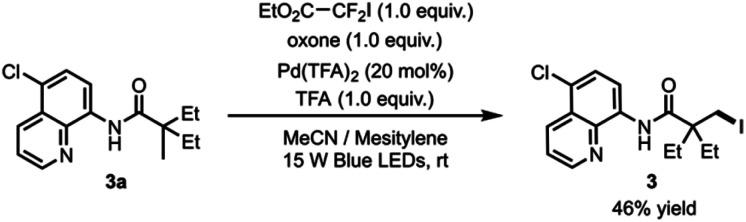
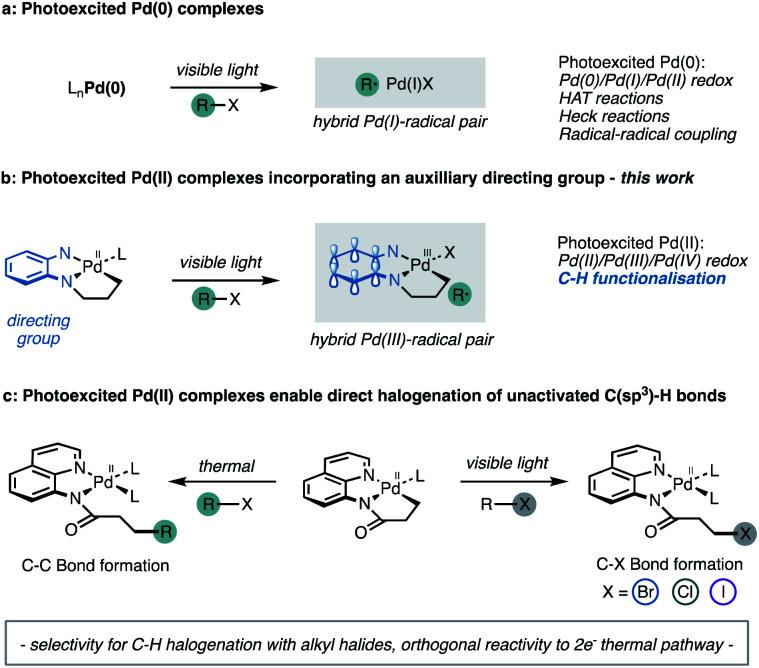
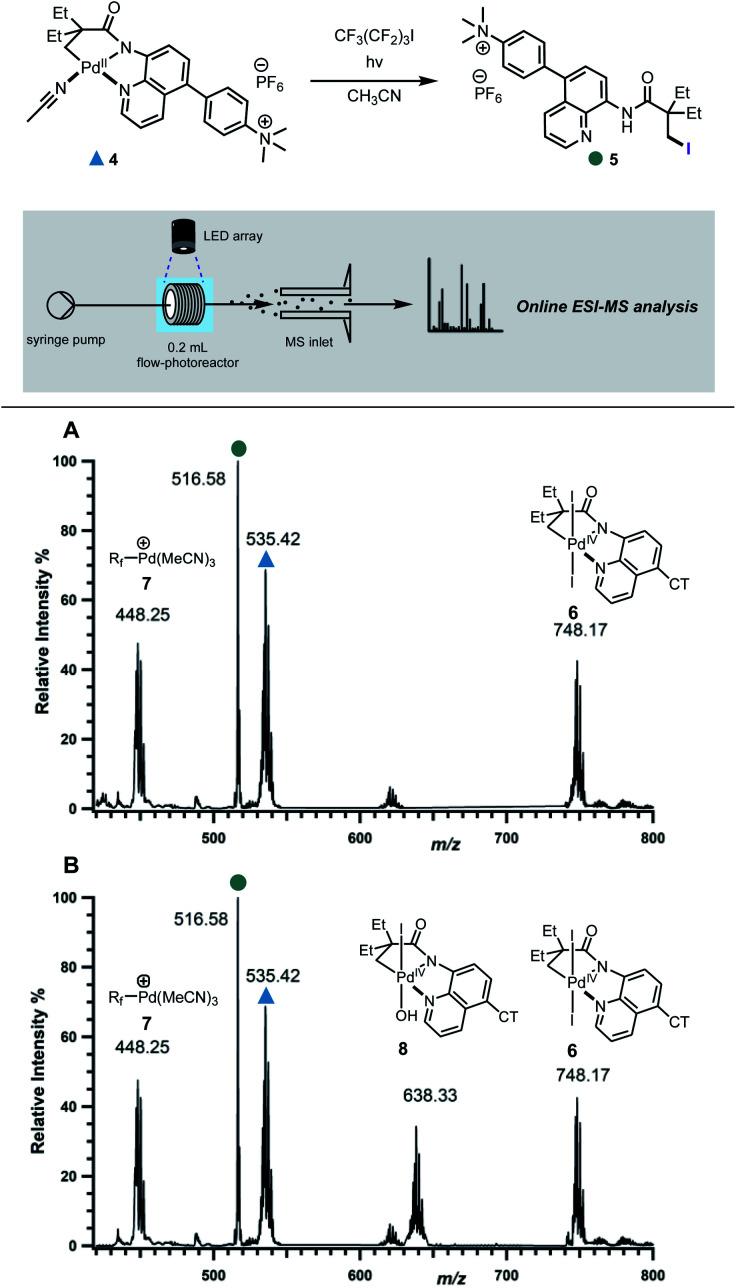
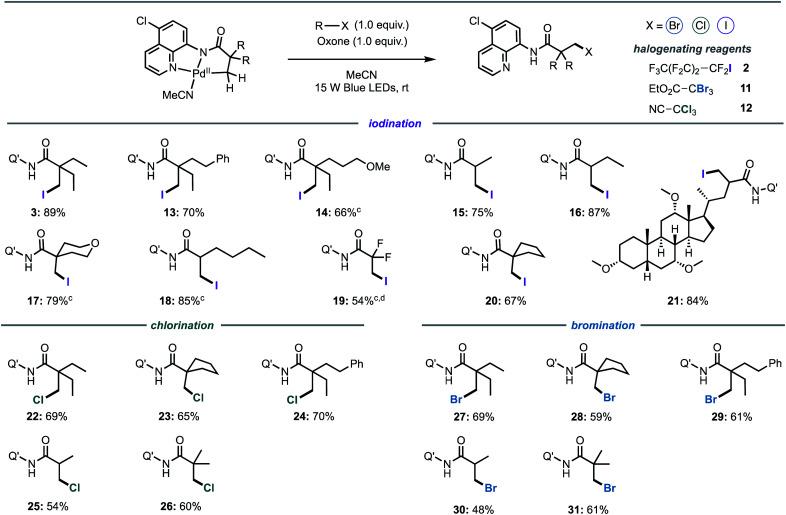
Herein we report the photophysical and photochemical properties of palladacycle complexes derived from 8-aminoquinoline ligands, commonly used auxiliaries in C-H activation. Spectroscopic, electrochemical and computational studies reveal that visible light irradiation induces a mixed LLCT/MLCT charge transfer providing access to synthetically relevant Pd(iii)/Pd(iv) redox couples. The Pd(ii) complex undergoes photoinduced electron transfer with alkyl halides generating C(sp)-H halogenation products rather than C-C bond adducts. Online photochemical ESI-MS analysis implicates participation of a mononuclear Pd(iii) species which promotes C-X bond formation a distinct Pd(iii)/Pd(iv) pathway. To demonstrate the synthetic utility, we developed a general method for inert C(sp)-H bond bromination, chlorination and iodination with alkyl halides. This new strategy in auxiliary-directed C-H activation provides predictable and controllable access to distinct reactivity pathways proceeding Pd(iii)/Pd(iv) redox couples induced by visible light irradiation.
在此,我们报道了源自8-氨基喹啉配体的钯环配合物的光物理和光化学性质,8-氨基喹啉配体是C-H活化中常用的助剂。光谱、电化学和计算研究表明,可见光照射会引发混合的配体-配体电荷转移/金属-配体电荷转移,从而提供了合成相关的Pd(III)/Pd(IV)氧化还原对的途径。Pd(II)配合物与卤代烃发生光诱导电子转移,生成C(sp)-H卤化产物而非C-C键加合物。在线光化学电喷雾电离质谱分析表明单核Pd(III)物种参与其中,该物种促进C-X键形成——这是一条独特的Pd(III)/Pd(IV)途径。为了证明其合成实用性,我们开发了一种用卤代烃对惰性C(sp)-H键进行溴化、氯化和碘化的通用方法。这种在助剂导向的C-H活化中的新策略提供了可预测和可控的途径,以进入由可见光照射诱导的通过Pd(III)/Pd(IV)氧化还原对进行的不同反应途径。


 Zotero 插件