
衰弱与老年男性心力衰竭的发生:英国区域性心脏研究。
Frailty and incident heart failure in older men: the British Regional Heart Study.
机构信息
Department of Primary Care and Population Health, University College London, London, UK
Department of Primary Care and Population Health, University College London, London, UK.
出版信息
Open Heart. 2021 Jun;8(1). doi: 10.1136/openhrt-2021-001571.
OBJECTIVE
Frailty and heart failure (HF) are cross-sectionally associated. Published longitudinal data are very limited. We sought to investigate associations between frailty and incident HF.
METHODS
Prospective study of 1722 men, examined at age 72-91 years. Scores based on the Fried phenotype, Gill index and a novel frailty score, based on the Health Ageing and Body Composition Battery, incorporating slow walking speed, low chair-stand time and subjective difficulty with balance, were calculated. Associations between these scores and incident HF were analysed with Cox proportional hazard modelling.
RESULTS
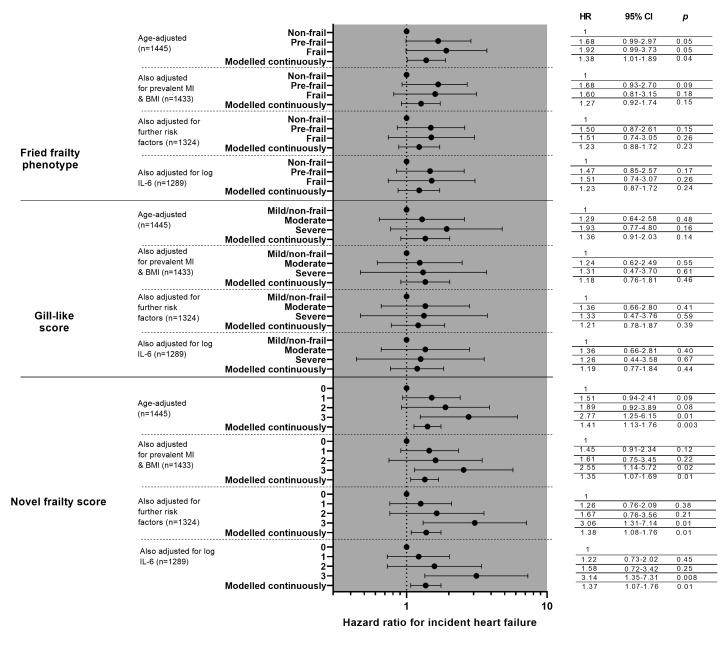
1445 men with frailty data and without prevalent HF were included. 99 developed HF (mean follow-up 6.1 years). Men scoring 3/3 on our novel frailty score had elevated risk of incident HF (HR 2.77, 95% CI 1.25 to 6.15), which persisted after adjustment for established risk factors and interleukin-6 (HR 3.14, 95% CI 1.35 to 7.31). This risk remained increased, although attenuated, after excluding HF events within 2 years of baseline (HR 2.05, 95% CI 0.61 to 6.92). The frailty phenotype showed a non-significant association with HF (age-adjusted HR 1.92, 95% CI 0.99 to 3.73), which was further attenuated after adjustment for prevalent coronary heart disease and Body mass index (HR 1.60, 95% CI 0.81 to 3.15). Gill-type scores were weakly associated with HF risk after these adjustments (HR 1.31, 95% CI 0.47 to 3.70).
CONCLUSION
In these older men, the combination of slow walk speed, low sit-stand time and balance problems were associated with high risk of incident HF, independent of established risk factors and inflammatory markers. However, undiagnosed HF at baseline may still be a confounder. There is a differential association between aspects of the frailty phenotype and incident HF.
目的
虚弱和心力衰竭(HF)是横向相关的。已发表的纵向数据非常有限。我们试图研究虚弱与新发 HF 之间的关联。
方法
前瞻性研究了 1722 名男性,年龄在 72-91 岁之间进行了检查。根据 Fried 表型、Gill 指数和基于健康老龄化和身体成分电池的新虚弱评分计算得分,该评分包含缓慢的步行速度、低坐站时间和平衡困难的主观感受。使用 Cox 比例风险模型分析这些评分与新发 HF 之间的关系。
结果
共纳入 1445 名有虚弱数据且无现患 HF 的男性。99 名男性发生 HF(平均随访 6.1 年)。在我们的新虚弱评分中得分为 3/3 的男性发生新发 HF 的风险较高(HR 2.77,95%CI 1.25 至 6.15),调整既定风险因素和白细胞介素-6 后仍然持续(HR 3.14,95%CI 1.35 至 7.31)。排除基线后 2 年内 HF 事件后,这种风险仍然增加,但有所减弱(HR 2.05,95%CI 0.61 至 6.92)。虚弱表型与 HF 无显著相关性(年龄调整 HR 1.92,95%CI 0.99 至 3.73),在调整现患冠心病和体重指数后进一步减弱(HR 1.60,95%CI 0.81 至 3.15)。在进行这些调整后,Gill 型评分与 HF 风险呈弱相关(HR 1.31,95%CI 0.47 至 3.70)。
结论
在这些老年男性中,步行速度缓慢、坐站时间短和平衡问题与新发 HF 的高风险相关,与既定风险因素和炎症标志物无关。然而,基线时未诊断的 HF 可能仍然是一个混杂因素。虚弱表型的各个方面与新发 HF 之间存在不同的关联。

 Zotero 插件