
身体虚弱、遗传易感性与新发心力衰竭
Physical Frailty, Genetic Predisposition, and Incident Heart Failure.
作者信息
Shi Qifan, Huang Jian, Wan Jiuxuan, Zhong Zhimei, Sun Ying, Zhou Yinuo, Li Jiang, Tan Xiao, Yu Bowei, Lu Yingli, Wang Ningjian
机构信息
Institute and Department of Endocrinology and Metabolism, Shanghai Ninth People's Hospital, Shanghai JiaoTong University School of Medicine, Shanghai, China.
School of Public Health, Zhejiang University, Hangzhou, China.
出版信息
JACC Asia. 2024 May 14;4(7):547-556. doi: 10.1016/j.jacasi.2024.03.005. eCollection 2024 Jul.
BACKGROUND
There is growing interest in the intersection of frailty and heart failure (HF); however, large-sample longitudinal studies in the general population are lacking.
OBJECTIVES
The goal of this study was to examine the longitudinal relationship between frailty and incident HF, and whether age and genetic predisposition could modify this association.
METHODS
This prospective cohort study included 340,541 participants (45.7% male; mean age 55.9 ± 8.1 years) free of HF at baseline in the UK Biobank. Frailty was assessed by using the Fried frailty phenotype and included weight loss, exhaustion, low physical activity, slow gait speed, and low grip strength. The weighted polygenetic risk score was calculated. Cox models were used to estimate these associations and the interaction between the 2 factors.
RESULTS
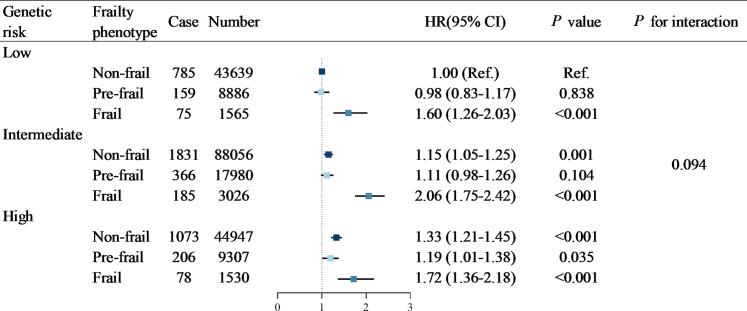
During a median 14.1 years of follow-up, 7,590 patients with HF were documented. Compared with nonfrail participants, both prefrail and frail participants had a positive association with the risk of incident HF (prefrail HR: 1.40 [95% CI: 1.17-1.67]; frail HR: 2.07 [95% CI: 1.67-2.57]). Exhaustion (HR: 1.21; 95% CI: 1.03-1.43), slow gait speed (HR: 1.62; 95% CI: 1.39-1.90), and low grip strength (HR: 1.31; 95% CI: 1.14-1.51) were associated with a greater risk of incident HF. Furthermore, genetic susceptibility did not significantly modify the associations ( = 0.094), and the association was significantly strengthened in younger participants ( = 0.008).
CONCLUSIONS
Frailty status was associated with a higher risk of incident HF independent of genetic risk. A younger population may be more susceptible to HF when exposed to frailty. Whether the modification of frailty status represents another avenue for preventing HF warrants further investigation.
背景
衰弱与心力衰竭(HF)之间的交叉领域越来越受到关注;然而,在一般人群中缺乏大样本纵向研究。
目的
本研究的目的是探讨衰弱与新发HF之间的纵向关系,以及年龄和遗传易感性是否会改变这种关联。
方法
这项前瞻性队列研究纳入了英国生物银行中340,541名基线时无HF的参与者(男性占45.7%;平均年龄55.9±8.1岁)。使用Fried衰弱表型评估衰弱,包括体重减轻、疲惫、体力活动少、步速慢和握力低。计算加权多基因风险评分。使用Cox模型估计这些关联以及两个因素之间的相互作用。
结果
在中位14.1年的随访期间,记录了7590例HF患者。与非衰弱参与者相比,衰弱前期和衰弱参与者与新发HF风险均呈正相关(衰弱前期HR:1.40[95%CI:1.17-1.67];衰弱HR:2.07[95%CI:1.67-2.57])。疲惫(HR:1.21;95%CI:1.03-1.43)、步速慢(HR:1.62;95%CI:1.39-1.90)和握力低(HR:1.31;95%CI:1.14-1.51)与新发HF风险增加相关。此外,遗传易感性并未显著改变这些关联(P = 0.094),且在年轻参与者中这种关联显著增强(P = 0.008)。
结论
衰弱状态与新发HF风险较高相关,与遗传风险无关。年轻人群在面临衰弱时可能更容易患HF。改变衰弱状态是否代表预防HF的另一条途径值得进一步研究。


 Zotero 插件