
基于转录组的基因共表达分析鉴定金花忍冬中异黄酮生物合成相关的R2R3-MYB转录因子
Identification of Isoflavonoid Biosynthesis-Related R2R3-MYB Transcription Factors in (Champ. ex Benth.) Schot Using Transcriptome-Based Gene Coexpression Analysis.
作者信息
Yu Linchan, Huang Ding, Gu Jinyuan, Pan Dongjin, Tan Yong, Huang Rongshao, Yao Shaochang
机构信息
College of Pharmacy, Guangxi University of Chinese Medicine, Nanning, Guangxi, China.
Institute of Marine Drugs, Guangxi University of Chinese Medicine, Nanning, Guangxi, China.
出版信息
Int J Genomics. 2021 May 25;2021:9939403. doi: 10.1155/2021/9939403. eCollection 2021.
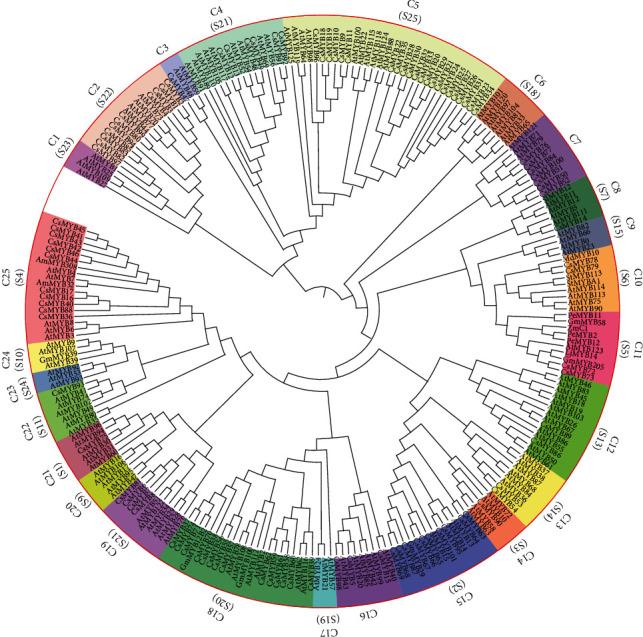
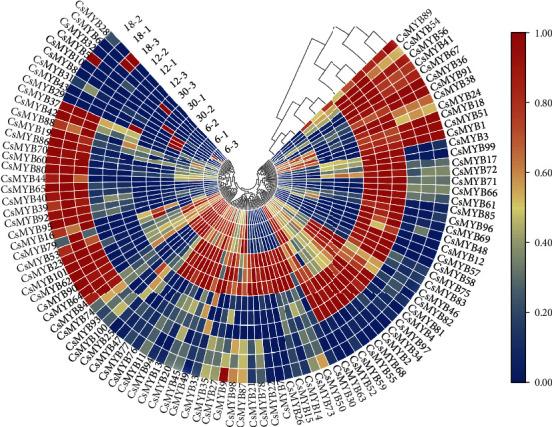
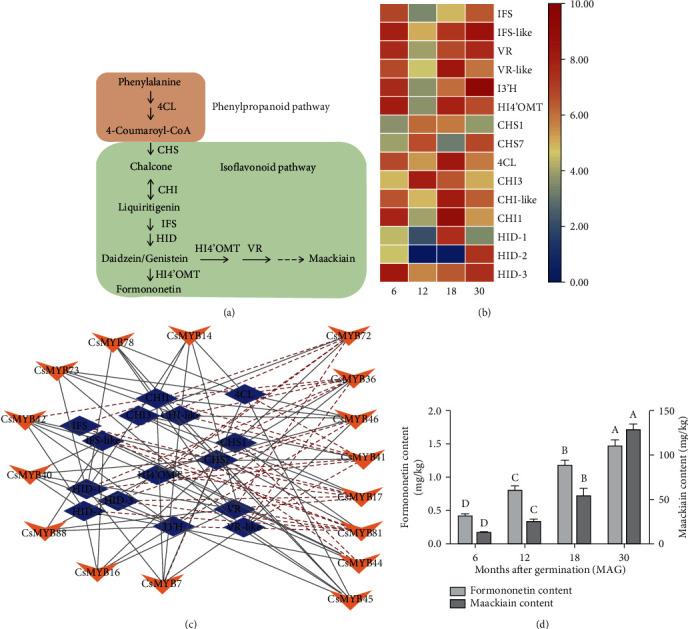
The R2R3-MYB family is one of the largest plant transcription factor (TF) families playing vital roles in defense, plant growth, and secondary metabolism biosynthesis. Although this gene family has been studied in many species, isoflavonoid biosynthesis-related R2R3-MYB TFs in (Champ. ex Benth.) Schot, a traditional Chinese medicinal herb, are poorly understood. Here, a total of 101 R2R3-MYB TFs were identified from transcriptome dataset. 25 clades divided into five functional groups were clustered based on the sequence similarity and phylogenetic tree. Conserved motifs and domain distribution, expression patterns, and coexpression networks were also employed to identify the potential R2R3-MYB TFs in the regulation of isoflavonoid biosynthesis. evaluation showed that the deduced R2R3-CsMYB proteins contain highly conserved R2R3 repeat domain at the N-terminal region, that is the signature motif of R2R3-type MYB TFs. Eight potential TFs (, , , , , , , and ) had high degrees of coexpression with four key isoflavonoid biosynthetic genes (, , , and ), in which as a potential regulator possessed the highest degree. HPLC analysis showed that formononetin and maackiain contents were significantly increased during the development of tuberous roots, which might be controlled by both related R2R3-CsMYBs and structural genes involved in the isoflavonoid biosynthesis pathway. The transcriptome data were further validated by reverse transcription real-time PCR (RT-qPCR) analysis, and similar expression profiles between TFs and key structural genes were identified. This study was the first step toward the understanding of the R2R3-MYB TFs regulating isoflavonoid biosynthesis in . The results will provide information for further functional analysis and quality improvement through genetic manipulation of these potential R2R3-CsMYB genes in .
R2R3-MYB家族是最大的植物转录因子(TF)家族之一,在防御、植物生长和次生代谢生物合成中发挥着至关重要的作用。尽管该基因家族已在许多物种中得到研究,但对于传统中草药射干(学名:Belamcanda chinensis (L.) Redouté)中与异黄酮生物合成相关的R2R3-MYB转录因子却知之甚少。在此,从射干转录组数据集中共鉴定出101个R2R3-MYB转录因子。基于序列相似性和系统发育树,将其分为25个进化枝,这些进化枝又分为五个功能组。还利用保守基序和结构域分布、表达模式以及共表达网络来鉴定参与异黄酮生物合成调控的潜在R2R3-MYB转录因子。评估显示推导的R2R3-CsMYB蛋白在N端区域含有高度保守的R2R3重复结构域, 这是R2R3型MYB转录因子的特征基序。八个潜在转录因子(CsMYB1、CsMYB3、CsMYB4、CsMYB5、CsMYB6、CsMYB7、CsMYB8和CsMYB9)与四个关键异黄酮生物合成基因(CHS、CHI、F3H和FLS)具有高度共表达,其中CsMYB5作为潜在调控因子具有最高共表达程度。高效液相色谱分析表明,在块根发育过程中芒柄花素和紫铆因含量显著增加,这可能受相关R2R3-CsMYB和参与异黄酮生物合成途径的结构基因共同控制。通过逆转录实时定量PCR(RT-qPCR)分析进一步验证了转录组数据,并鉴定出转录因子和关键结构基因之间相似的表达谱。本研究是了解射干中R2R3-MYB转录因子调控异黄酮生物合成的第一步。研究结果将为通过对射干中这些潜在R2R3-CsMYB基因进行遗传操作来进一步开展功能分析和品质改良提供信息。



 Zotero 插件