
药物使用障碍识别测试及其简版DUDIT-C在德国青少年精神病患者中的诊断准确性
Diagnostic Accuracy of the Drug Use Disorder Identification Test and Its Short Form, the DUDIT-C, in German Adolescent Psychiatric Patients.
作者信息
Basedow Lukas A, Kuitunen-Paul Sören, Eichler Anna, Roessner Veit, Golub Yulia
机构信息
Department of Child and Adolescent Psychiatry, Faculty of Medicine, Technische Universität Dresden, Dresden, Germany.
Department of Child and Adolescent Mental Health, University Hospital Erlangen, Friedrich-Alexander University Erlangen-Nürnberg, Erlangen, Germany.
出版信息
Front Psychol. 2021 Jun 4;12:678819. doi: 10.3389/fpsyg.2021.678819. eCollection 2021.
BACKGROUND
A common screening instrument for substance use disorders (SUDs) is the Drug Use Disorders Identification Test (DUDIT) which includes a short form regarding only drug consumption (DUDIT-C). We aim to assess if a German version of the DUDIT, adapted for adolescents, is a suitable screening instrument in a sample of adolescent psychiatric patients.
METHODS
= 124 (54 female) German adolescent ( = 15.6 + 1.5 years) psychiatric patients completed the DUDIT and received a diagnostic interview (MINI-KID) assessing DSM-5 SUD criteria. A confirmatory factor analysis (CFA), receiver operating characteristic (ROC) curves, the area under the curve (AUC), and Youden's Index were calculated.
RESULTS
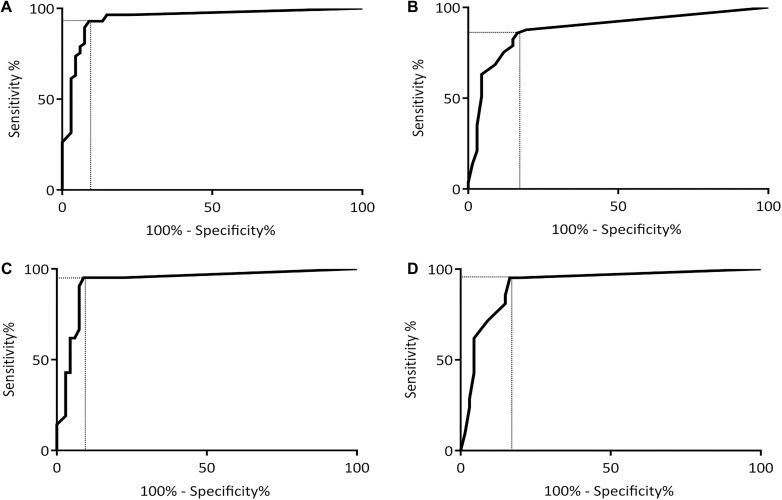
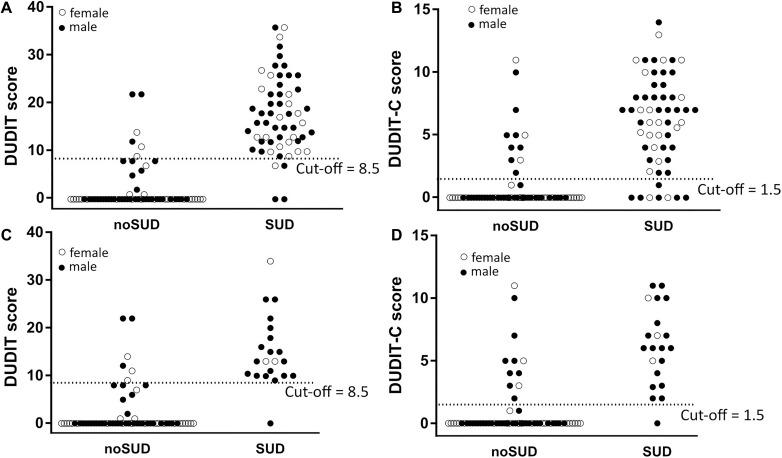
A two-factor model of the DUDIT shows the best model fit (CFI = 0.995, SRMR = 0.055, RMSEA = 0.059, WRMR = 0.603). The DUDIT as well as the DUDIT-C show high diagnostic accuracy, with AUC = 0.95 and AUC = 0.88, respectively. For the DUDIT a cut-off value of 8.5 was optimal (sensitivity = 0.93, specificity = 0.91, = 0.84), while for the DUDIT-C the optimal cut-off value was at 1.5 (sensitivity = 0.86, specificity = 0.84, = 0.70).
CONCLUSION
This is the first psychometric evaluation of the DUDIT in German, adolescent psychiatric outpatients, using the DSM-5 diagnostic criteria. The DUDIT as well as the DUDIT-C are well suited for use in this population. Since in our sample only few patients presented with a mild or moderate SUD, our results need to be replicated in a sample of adolescents with mild SUD.
背景
物质使用障碍(SUDs)的一种常见筛查工具是药物使用障碍识别测试(DUDIT),它包括一个仅关于药物消费的简短形式(DUDIT-C)。我们旨在评估一种针对青少年改编的德语版DUDIT在青少年精神病患者样本中是否是一种合适的筛查工具。
方法
124名(54名女性)德国青少年(平均年龄15.6±1.5岁)精神病患者完成了DUDIT,并接受了评估DSM-5物质使用障碍标准的诊断访谈(MINI-KID)。计算了验证性因素分析(CFA)、接受者操作特征(ROC)曲线、曲线下面积(AUC)和尤登指数。
结果
DUDIT的双因素模型显示出最佳的模型拟合度(CFI = 0.995,SRMR = 0.055,RMSEA = 0.059,WRMR = 0.603)。DUDIT以及DUDIT-C显示出较高的诊断准确性,AUC分别为0.95和0.88。对于DUDIT,最佳临界值为8.5(敏感性 = 0.93,特异性 = 0.91,尤登指数 = 0.84),而对于DUDIT-C,最佳临界值为1.5(敏感性 = 0.86,特异性 = 0.84,尤登指数 = 0.70)。
结论
这是首次使用DSM-5诊断标准对德语版DUDIT在德国青少年精神病门诊患者中的心理测量学评估。DUDIT以及DUDIT-C非常适合在该人群中使用。由于在我们的样本中只有少数患者表现为轻度或中度物质使用障碍,我们的结果需要在轻度物质使用障碍的青少年样本中进行重复验证。
 Zotero 插件