
区分酒精使用障碍中的社会奖励学习与行为。
Dissociating social reward learning and behavior in alcohol use disorder.
作者信息
Jangard Simon, Lindström Björn, Khemiri Lotfi, Jayaram-Lindström Nitya, Olsson Andreas
机构信息
Centre for Psychiatry Research, Department of Clinical Neuroscience, Karolinska Institutet & Stockholm Health Care Services, Region Stockholm, Stockholm, Sweden.
Division of Psychology, Department of Clinical Neuroscience, Karolinska Institutet, Stockholm, Sweden.
出版信息
Transl Psychiatry. 2025 Jan 25;15(1):30. doi: 10.1038/s41398-025-03236-3.
BACKGROUND
Alcohol use disorder (AUD) is associated with deficits in social cognition and behavior, but why these deficits are acquired is unknown. We hypothesized that a reduced association between actions and outcomes for others, i.e., social reward learning, would explain prevalent social deficiencies in AUD.
METHODS
We conducted one laboratory study (n = 234) and one confirmatory online study (n = 258), comparing young adults with AUD to age-, gender-, and education-matched healthy controls on a standardized reward learning task. In the task, participants learned to maximize reward for another person and for oneself. To elucidate the potential relation between reward learning and social behavior in AUD, we administered two measures: a dictator game task and a self-report measure. Finally, we applied reinforcement learning models to examine the computational properties of learning.
RESULTS
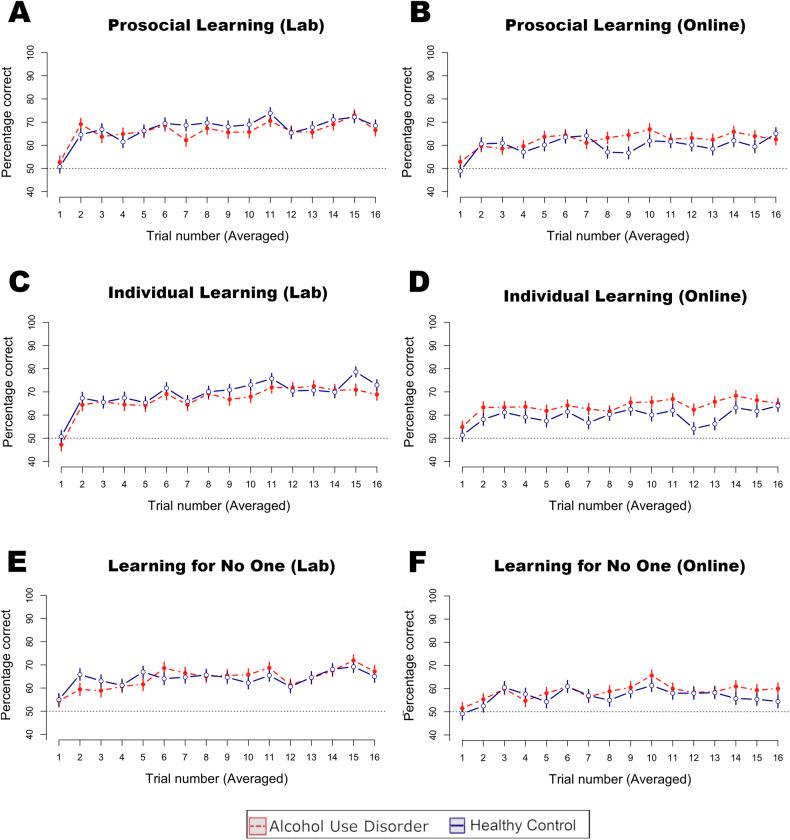
Social and individual learning, expressed in choice behavior, were comparable in individuals with AUD and healthy controls. Individual differences in learning were not associated with reduced social behavior in AUD. Computational modeling suggested that the learning mechanisms are comparable in AUD and healthy controls and indifferent to whether learning maximizes reward for another person or oneself.
CONCLUSIONS
Individuals with AUD demonstrated preserved reward learning abilities that do not vary with social behavior. Together, these results indicate that reward processes may not be relevant for understanding compromised social behavior in AUD.
背景
酒精使用障碍(AUD)与社会认知和行为缺陷有关,但这些缺陷为何会出现尚不清楚。我们假设他人行为与结果之间的关联减弱,即社会奖励学习,能够解释AUD中普遍存在的社会缺陷。
方法
我们进行了一项实验室研究(n = 234)和一项验证性在线研究(n = 258),将患有AUD的年轻人与年龄、性别和教育程度相匹配的健康对照组在一项标准化奖励学习任务上进行比较。在该任务中,参与者学习如何为他人和自己最大化奖励。为了阐明奖励学习与AUD中社会行为之间的潜在关系,我们采用了两项测量:独裁者游戏任务和自我报告测量。最后,我们应用强化学习模型来检验学习的计算特性。
结果
AUD患者和健康对照组在选择行为中表现出的社会和个体学习能力相当。学习中的个体差异与AUD中社会行为的减少无关。计算建模表明,AUD患者和健康对照组的学习机制相当,且与学习是为他人还是自己最大化奖励无关。
结论
AUD患者表现出保留的奖励学习能力,且这种能力不随社会行为而变化。总之,这些结果表明奖励过程可能与理解AUD中受损的社会行为无关。



 Zotero 插件