
韩国新冠肺炎疫情后胃肠道感染发生率的变化
Changes in the Occurrence of Gastrointestinal Infections after COVID-19 in Korea.
作者信息
Ahn So Yun, Park Ji Young, Lim In Seok, Chae Soo Ahn, Yun Sin Weon, Lee Na Mi, Kim Su Yeong, Choi Byung Sun, Yi Dae Yong
机构信息
Department of Pediatrics, Chung-Ang University Hospital, Seoul, Korea.
College of Medicine, Chung-Ang University, Seoul, Korea.
出版信息
J Korean Med Sci. 2021 Jun 21;36(24):e180. doi: 10.3346/jkms.2021.36.e180.
BACKGROUND
After the global epidemic of coronavirus disease 2019 (COVID-19), lifestyle changes to curb the spread of COVID-19 (e.g., wearing a mask, hand washing, and social distancing) have also affected the outbreak of other infectious diseases. However, few studies have been conducted on whether the incidence of gastrointestinal infections has changed over the past year with COVID-19. In this study, we examined how the incidence of gastrointestinal infections has changed since COVID-19 outbreak through open data.
METHODS
We summarized the data on the several viruses and bacteria that cause gastrointestinal infections from the open data of the Korea Disease Control and Prevention Agency for 3 years from March 2018 to February 2021 (from Spring 2018 to Winter 2020). Moreover, we confirmed three most common legal gastrointestinal infectious pathogens from March 2016.
RESULTS
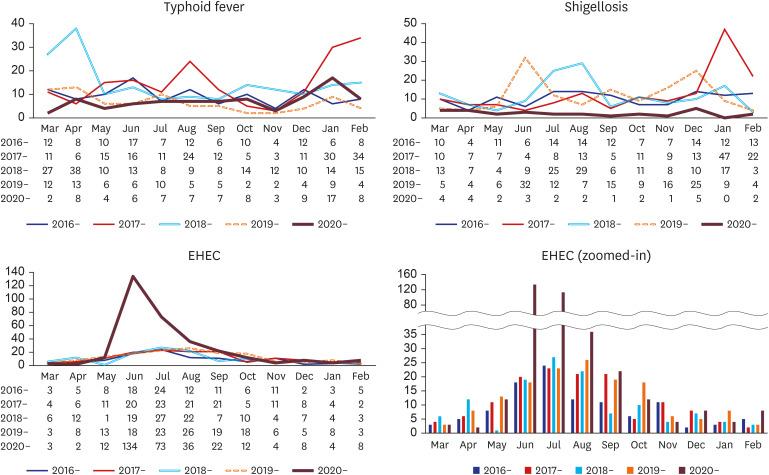
From March 2020, when the COVID-19 epidemic was in full swing and social distancing and personal hygiene management were heavily emphasized, the incidence of infection from each virus was drastically decreased. The reduction rates compared to the averages of the last 2 years were as follows: total viruses 31.9%, norovirus 40.2%, group A rotavirus 31.8%, enteric adenovirus 13.4%, astrovirus 7.0%, and sapovirus 12.2%. Among bacterial pathogens, the infection rates of and did not decrease but rather increased in some periods when compared to the average of the last two years. The incidence of nontyphoidal , , or enteropathogenic somewhat decreased but not significantly compared to the previous two years.
CONCLUSION
The incidence of infection from gastrointestinal viruses, which are mainly caused by the fecal-to-oral route and require direct contact among people, was significantly reduced, whereas the incidence of bacterial pathogens, which have food-mediated transmission as the main cause of infection, did not decrease significantly.
背景
2019年冠状病毒病(COVID-19)全球大流行后,为遏制COVID-19传播而做出的生活方式改变(如戴口罩、洗手和保持社交距离)也影响了其他传染病的爆发。然而,关于过去一年胃肠道感染发病率是否因COVID-19而发生变化的研究较少。在本研究中,我们通过公开数据研究了自COVID-19疫情爆发以来胃肠道感染发病率的变化情况。
方法
我们汇总了韩国疾病控制与预防机构2018年3月至2021年2月(2018年春季至2020年冬季)3年公开数据中导致胃肠道感染的几种病毒和细菌的数据。此外,我们还确认了2016年3月以来三种最常见的法定胃肠道感染病原体。
结果
2020年3月,COVID-19疫情全面爆发,社交距离和个人卫生管理受到高度重视,每种病毒的感染发病率急剧下降。与过去两年的平均水平相比,下降率如下:总病毒31.9%,诺如病毒40.2%,A组轮状病毒31.8%,肠道腺病毒13.4%,星状病毒7.0%,札如病毒12.2%。在细菌病原体中,与过去两年的平均水平相比,某些时期的 和 的感染率没有下降,反而有所上升。非伤寒性 、 或肠致病性 的发病率与前两年相比有所下降,但不显著。
结论
主要通过粪口途径传播且需要人与人直接接触的胃肠道病毒感染发病率显著降低,而以食物介导传播为主要感染原因的细菌病原体发病率没有显著下降。


 Zotero 插件