
新西兰全国新冠疫情封锁对急性冠状动脉综合征住院情况的影响(澳新心血管学会质量改进项目55)
The impact of a national COVID-19 lockdown on acute coronary syndrome hospitalisations in New Zealand (ANZACS-QI 55).
作者信息
Chan Daniel Zl, Stewart Ralph Ah, Kerr Andrew J, Dicker Bridget, Kyle Campbell V, Adamson Philip D, Devlin Gerry, Edmond John, El-Jack Seif, Elliott John M, Fisher Nick, Flynn Charmaine, Lee Mildred, Liao Yi-Wen Becky, Rhodes Maxine, Scott Tony, Smith Tony, Stiles Martin K, Swain Andrew H, Todd Verity F, Webster Mark Wi, Williams Michael Ja, White Harvey D, Somaratne Jithendra B
机构信息
Greenlane Cardiovascular Service, Auckland City Hospital, Auckland, New Zealand.
Department of Cardiology, Middlemore Hospital, Private Bag 93311, Otahuhu, Auckland 1640, New Zealand.
出版信息
Lancet Reg Health West Pac. 2020 Dec;5:100056. doi: 10.1016/j.lanwpc.2020.100056. Epub 2020 Nov 20.
BACKGROUND
Countries with a high incidence of coronavirus 2019 (COVID-19) reported reduced hospitalisations for acute coronary syndromes (ACS) during the pandemic. This study describes the impact of a nationwide lockdown on ACS hospitalisations in New Zealand (NZ), a country with a low incidence of COVID-19.
METHODS
All patients admitted to a NZ Hospital with ACS who underwent coronary angiography in the All NZ ACS Quality Improvement registry during the lockdown (23 March - 26 April 2020) were compared with equivalent weeks in 2015-2019. Ambulance attendances and regional community troponin-I testing were compared for lockdown and non-lockdown (1 July 2019 to 16 February 2020) periods.
FINDINGS
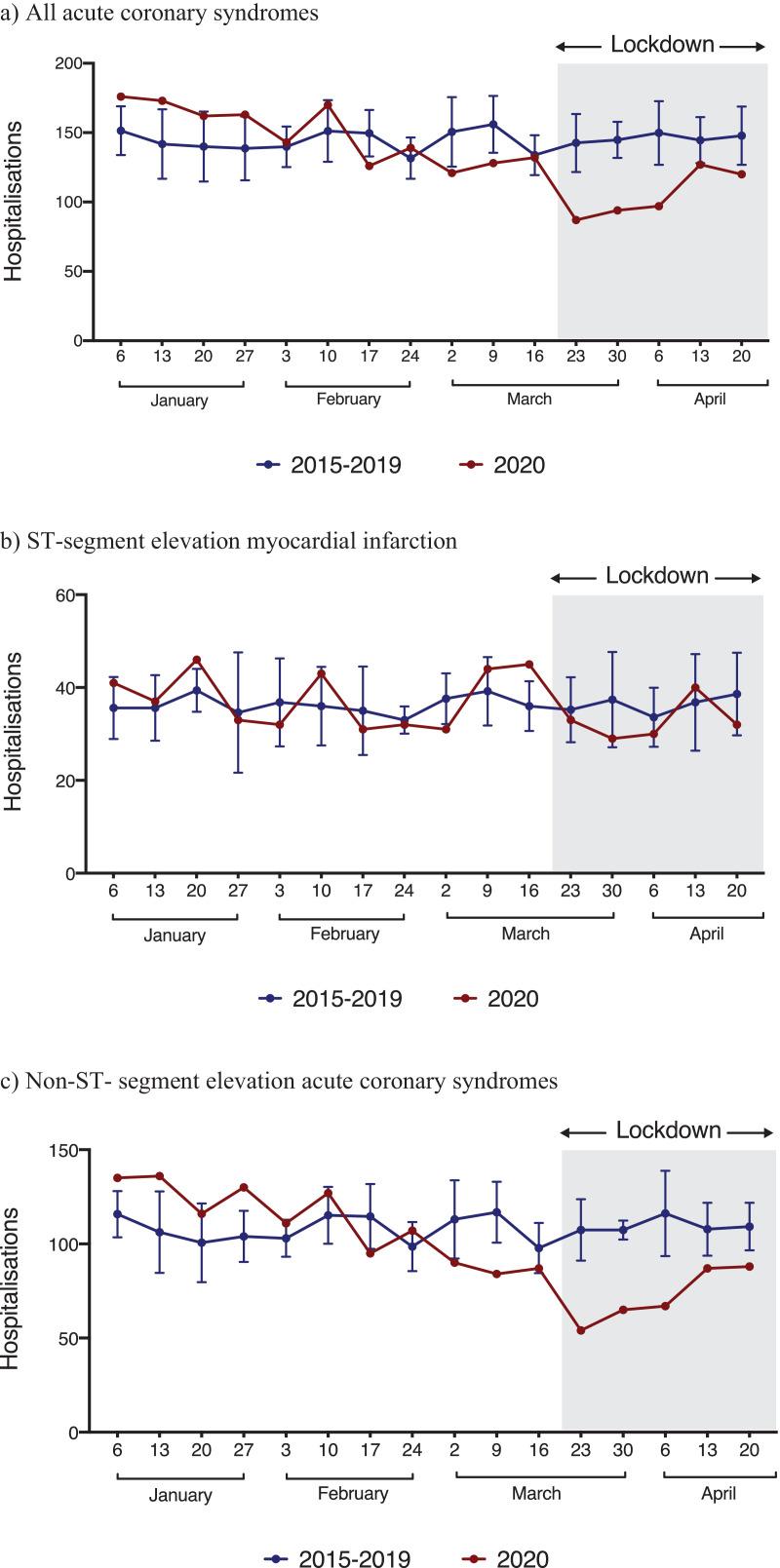
Hospitalisation for ACS was lower during the 5-week lockdown (105 vs. 146 per-week, rate ratio 0•72 [95% CI 0•61-0•83], = 0.003). This was explained by fewer admissions for non-ST-segment elevation ACS (NSTE-ACS; = 0•002) but not ST-segment elevation myocardial infarction (STEMI; = 0•31). Patient characteristics and in-hospital mortality were similar. For STEMI, door-to-balloon times were similar (70 vs. 72 min, = 0•52). For NSTE-ACS, there was an increase in percutaneous revascularisation (59% vs. 49%, <0•001) and reduction in surgical revascularisation (9% vs. 15%, = 0•005). There were fewer ambulance attendances for cardiac arrests (98 vs. 110 per-week, = 0•04) but no difference for suspected ACS (408 vs. 420 per-week, = 0•44). Community troponin testing was lower throughout the lockdown (182 vs. 394 per-week, <0•001).
INTERPRETATION
Despite the low incidence of COVID-19, there was a nationwide decrease in ACS hospitalisations during the lockdown. These findings have important implications for future pandemic planning.
FUNDING
The ANZACS-QI registry receives funding from the New Zealand Ministry of Health.
背景
2019冠状病毒病(COVID-19)高发病率国家报告称,疫情期间急性冠脉综合征(ACS)住院人数减少。本研究描述了在COVID-19低发病率国家新西兰(NZ),全国范围封锁对ACS住院情况的影响。
方法
将在封锁期间(2020年3月23日至4月26日)在全新西兰ACS质量改进登记处接受冠状动脉造影的所有入住新西兰医院的ACS患者与2015 - 2019年同期周数据进行比较。比较封锁期间和非封锁期间(2019年7月1日至2020年2月16日)的救护车出诊情况及区域社区肌钙蛋白I检测情况。
结果
在为期5周的封锁期间,ACS住院人数较低(每周105例对146例,率比0.72 [95% CI 0.61 - 0.83],P = 0.003)。这是由于非ST段抬高型ACS(NSTE-ACS)入院人数减少(P = 0.002),而ST段抬高型心肌梗死(STEMI)入院人数未减少(P = 0.31)。患者特征和院内死亡率相似。对于STEMI,门球时间相似(70分钟对72分钟,P = 0.52)。对于NSTE-ACS,经皮血管重建术有所增加(59%对49%,P < 0.001),外科血管重建术有所减少(9%对15%,P = 0.005)。心脏骤停的救护车出诊次数减少(每周98次对110次,P = 0.04),但疑似ACS的出诊次数无差异(每周408次对420次,P = 0.44)。在整个封锁期间,社区肌钙蛋白检测次数较低(每周182次对394次,P < 0.001)。
解读
尽管COVID-19发病率较低,但在封锁期间全国范围内ACS住院人数有所下降。这些发现对未来的疫情规划具有重要意义。
资助
澳新ACS质量改进登记处接受新西兰卫生部的资助。


 Zotero 插件