
快、慢生长型鸭肌肉纤维特性对肉质的影响。
Effect of muscle fiber characteristics on meat quality in fast- and slow-growing ducks.
作者信息
Huo Weiran, Weng Kaiqi, Gu Tiantian, Zhang Yu, Zhang Yang, Chen Guohong, Xu Qi
机构信息
Jiangsu Key Laboratory for Animal Genetic, Breeding and Molecular Design, Yangzhou University, Yangzhou, Jiangsu, China.
Jiangsu Key Laboratory for Animal Genetic, Breeding and Molecular Design, Yangzhou University, Yangzhou, Jiangsu, China; Joint International Research Laboratory of Agriculture and Agri-Product Safety, the Ministry of Education of China, Yangzhou University, Yangzhou, Jiangsu, China.
出版信息
Poult Sci. 2021 Aug;100(8):101264. doi: 10.1016/j.psj.2021.101264. Epub 2021 May 20.
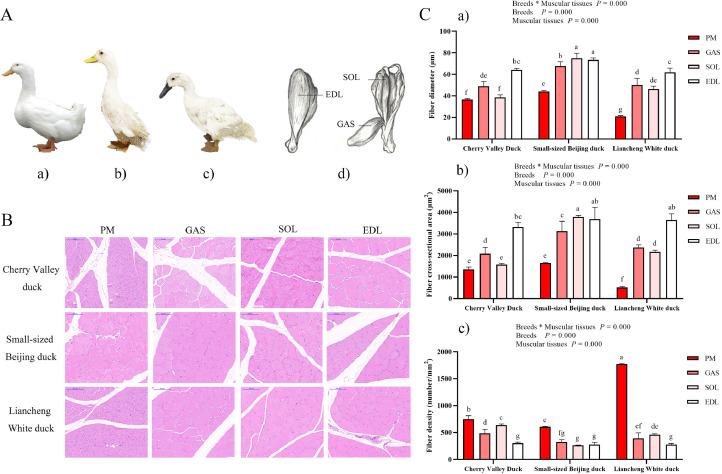
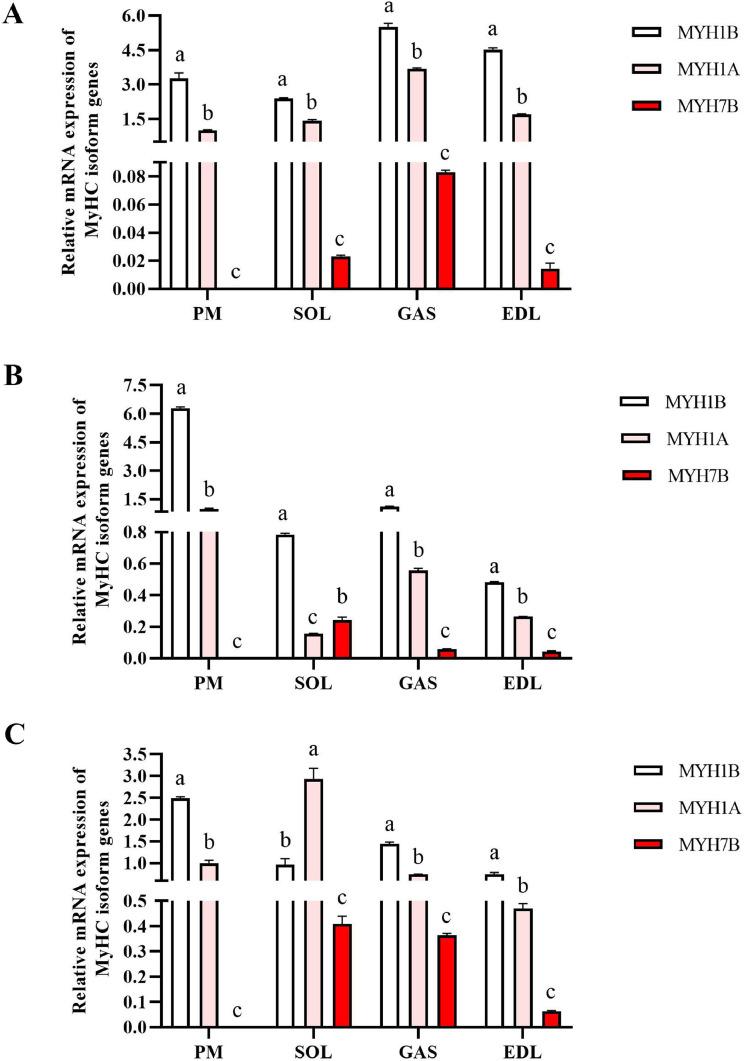
This study evaluated the effects of muscle fiber characteristics on meat quality traits in 45 female fast- and slow-growing ducks. Three duck breeds at typical market ages were selected and slaughtered, including fast-growing ducks (Cherry Valley duck) and slow-growing ducks (Small-sized Beijing duck and Liancheng White duck). M. pectoralis major (PM), m. soleus (SOL), m. gastrocnemius (GAS) and m. extensor digitorum longus (EDL) were used to assess muscle fiber characteristics as well as meat quality properties. The results showed that the fiber compositions in PM, GAS, and EDL muscles only consisted of fast-twitch fibers irrespective of the breeds, while a low percentage of slow-twitch fibers were observed in slow-growing ducks (17.03% and 29.14%). The significant clear differences of fiber diameter, fiber density and fiber cross-sectional area (CSA) was observed among three duck breeds. Small-sized Beijing ducks had the highest diameter and cross-sectional fiber area coupled with a dramatically lowest fiber density when compared to other 2 breeds both in breast and leg muscles. In addition, the meat quality traits such as moisture content, release water, and intramuscular fat content were significantly affected by the breeds. Slow-growing ducks, especially Liancheng White ducks, exhibited higher release water, intramuscular fat content, as well as lower moisture content (P < 0.05) compared to the fast-growing ducks. The lower pH value and shear force tended to be present in breast of Liancheng White ducks (P < 0.05). The higher protein content and collagen content were detected in breast of Liancheng White ducks and the leg muscle of Small-sized Beijing ducks (P < 0.05), respectively. Finally, the correlation coefficients between muscle fiber characteristics and meat quality showed that the diameter, density and CSA of fibers had a moderate or significant correlation with pH, shear force value, moisture content, and protein content of meat in fast-growing ducks. In slow-growing ducks, muscle fiber characteristics had a moderate or significant correlation with pH, shear force value, release water, protein content, and intramuscular fat content of meat. These results indicated that muscle fiber characteristics is a useful parameter to explain in parts the variation of meat quality including pH, shear force value, and protein content of meat, both in slow-growing ducks and fast-growing ducks.
本研究评估了45只快、慢生长雌性鸭的肌纤维特性对肉质性状的影响。选取了三个处于典型上市年龄的鸭品种并进行屠宰,包括快生长鸭(樱桃谷鸭)和慢生长鸭(小型北京鸭和连城白鸭)。使用胸大肌(PM)、比目鱼肌(SOL)、腓肠肌(GAS)和趾长伸肌(EDL)来评估肌纤维特性以及肉质特性。结果表明,无论品种如何,PM、GAS和EDL肌肉中的纤维组成仅由快肌纤维构成,而在慢生长鸭中观察到低比例的慢肌纤维(分别为17.03%和29.14%)。在三个鸭品种之间观察到纤维直径、纤维密度和纤维横截面积(CSA)存在显著的明显差异。与其他两个品种相比,小型北京鸭在胸肌和腿肌中的纤维直径和横截面积最大,而纤维密度显著最低。此外,品种对水分含量、失水率和肌内脂肪含量等肉质性状有显著影响。与快生长鸭相比,慢生长鸭,尤其是连城白鸭表现出更高的失水率、肌内脂肪含量以及更低的水分含量(P<0.05)。连城白鸭胸肉中的pH值和剪切力往往较低(P<0.05)。分别在连城白鸭的胸肉和小型北京鸭的腿肌中检测到较高的蛋白质含量和胶原蛋白含量(P<0.05)。最后,肌纤维特性与肉质之间的相关系数表明,快生长鸭中纤维的直径、密度和CSA与肉的pH值、剪切力值、水分含量和蛋白质含量具有中等或显著相关性。在慢生长鸭中,肌纤维特性与肉的pH值、剪切力值、失水率、蛋白质含量和肌内脂肪含量具有中等或显著相关性。这些结果表明,肌纤维特性是部分解释慢生长鸭和快生长鸭肉品质变化(包括肉的pH值、剪切力值和蛋白质含量)的一个有用参数。

 Zotero 插件