
基于吲哚菁绿血管造影术的颅外-颅内动脉搭桥术中血流的自动定量分析
Automated Quantitative Analysis of Blood Flow in Extracranial-Intracranial Arterial Bypass Based on Indocyanine Green Angiography.
作者信息
Jiang Zhuoyun, Lei Yu, Zhang Liqiong, Ni Wei, Gao Chao, Gao Xinjie, Yang Heng, Su Jiabin, Xiao Weiping, Yu Jinhua, Gu Yuxiang
机构信息
School of Information Science and Technology, Fudan University, Shanghai, China.
Department of Neurosurgery, Huashan Hospital, Fudan University, Shanghai, China.
出版信息
Front Surg. 2021 Jun 11;8:649719. doi: 10.3389/fsurg.2021.649719. eCollection 2021.
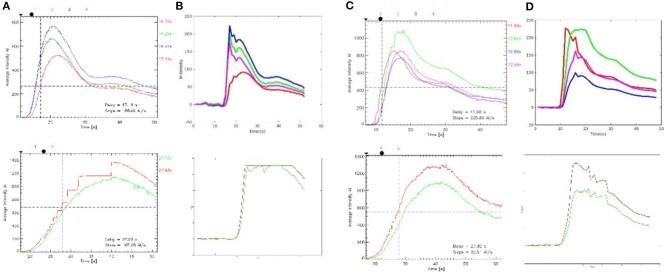
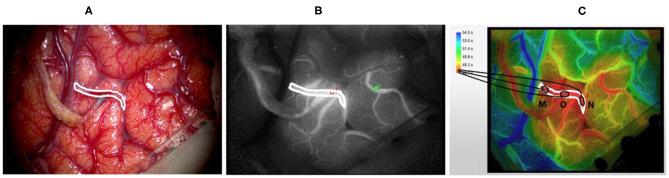
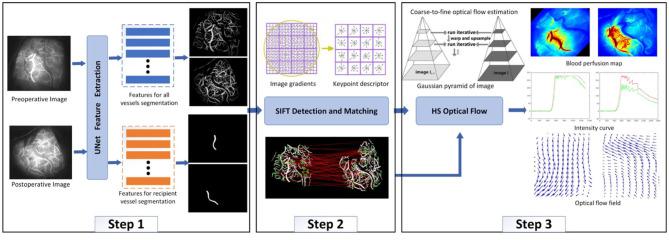
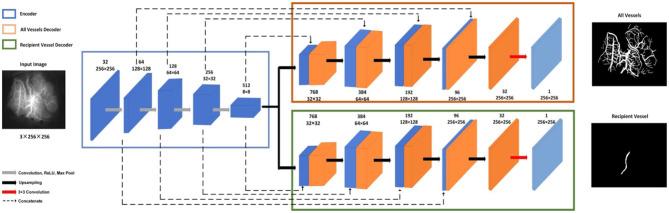
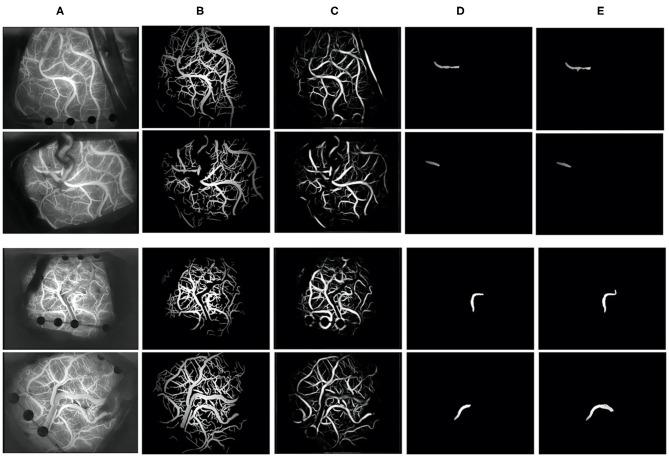
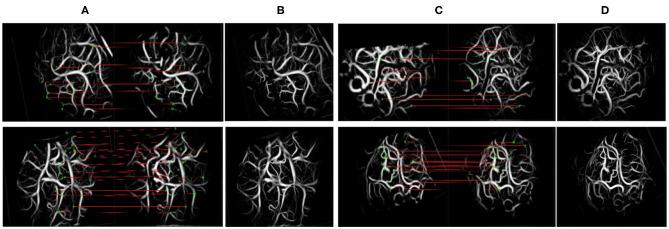
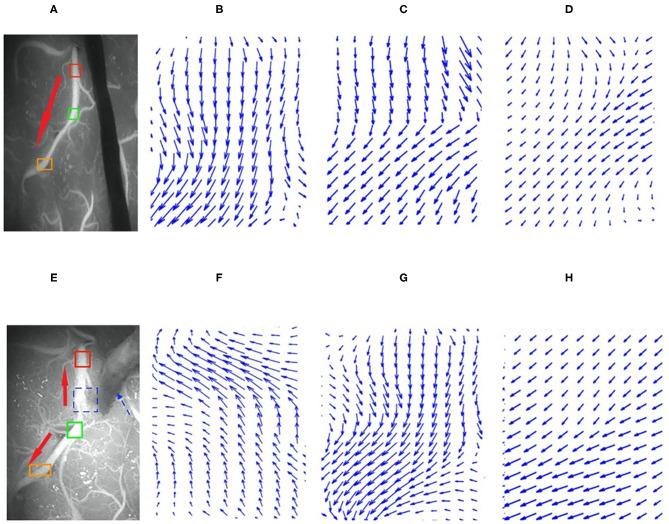
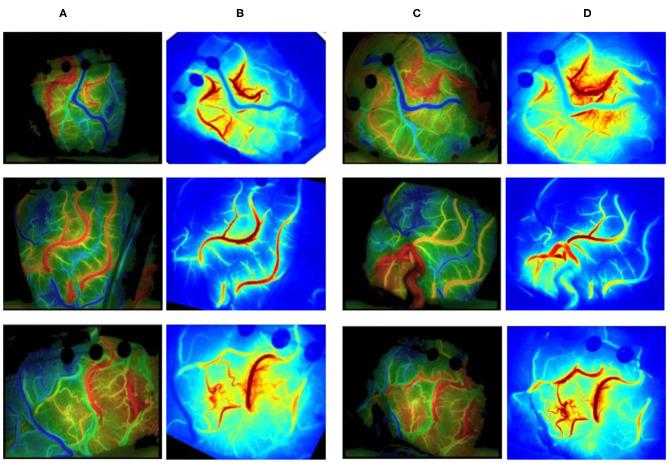
Microvascular imaging based on indocyanine green is an important tool for surgeons who carry out extracranial-intracranial arterial bypass surgery. In terms of blood perfusion, indocyanine green images contain abundant information, which cannot be effectively interpreted by humans or currently available commercial software. In this paper, an automatic processing framework for perfusion assessments based on indocyanine green videos is proposed and consists of three stages, namely, vessel segmentation based on the UNet deep neural network, preoperative and postoperative image registrations based on scale-invariant transform features, and blood flow evaluation based on the Horn-Schunck optical flow method. This automatic processing flow can reveal the blood flow direction and intensity curve of any vessel, as well as the blood perfusion changes before and after an operation. Commercial software embedded in a microscope is used as a reference to evaluate the effectiveness of the algorithm in this study. A total of 120 patients from multiple centers were sampled for the study. For blood vessel segmentation, a Dice coefficient of 0.80 and a Jaccard coefficient of 0.73 were obtained. For image registration, the success rate was 81%. In preoperative and postoperative video processing, the coincidence rates between the automatic processing method and commercial software were 89 and 87%, respectively. The proposed framework not only achieves blood perfusion analysis similar to that of commercial software but also automatically detects and matches blood vessels before and after an operation, thus quantifying the flow direction and enabling surgeons to intuitively evaluate the perfusion changes caused by bypass surgery.
基于吲哚菁绿的微血管成像对于进行颅外 - 颅内动脉搭桥手术的外科医生来说是一项重要工具。在血液灌注方面,吲哚菁绿图像包含丰富信息,这些信息无法被人类或当前可用的商业软件有效解读。本文提出了一种基于吲哚菁绿视频的灌注评估自动处理框架,该框架由三个阶段组成,即基于UNet深度神经网络的血管分割、基于尺度不变特征变换的术前和术后图像配准以及基于Horn - Schunck光流法的血流评估。这种自动处理流程可以揭示任何血管的血流方向和强度曲线,以及手术前后的血液灌注变化。本研究中使用嵌入显微镜的商业软件作为参考来评估算法的有效性。总共从多个中心抽取了120名患者进行研究。对于血管分割,获得了0.80的Dice系数和0.73的Jaccard系数。对于图像配准,成功率为81%。在术前和术后视频处理中,自动处理方法与商业软件之间的符合率分别为89%和87%。所提出的框架不仅实现了与商业软件类似的血液灌注分析,还能自动检测和匹配手术前后的血管,从而量化血流方向,使外科医生能够直观地评估搭桥手术引起的灌注变化。


 Zotero 插件