
用于神经外科手术导航的多模态光学-放射学图像系统的开发与验证:概念验证
Development and Validation of a Multimodal Optico-Radiological Image System for Neurosurgical Guidance: A Proof of Concept.
作者信息
Bhandari Dilip, Bakhit Mudathir, Hayashi Yuichiro, Hiruta Ryo, Saito Kiyoshi, Mori Kensaku, Fujii Masazumi
机构信息
Department of Neurosurgery, Graduate School of Medicine, Fukushima Medical University, Fukushima, JPN.
Department of Neurosurgery, Fukushima Medical University, Fukushima, JPN.
出版信息
Cureus. 2025 Mar 27;17(3):e81310. doi: 10.7759/cureus.81310. eCollection 2025 Mar.
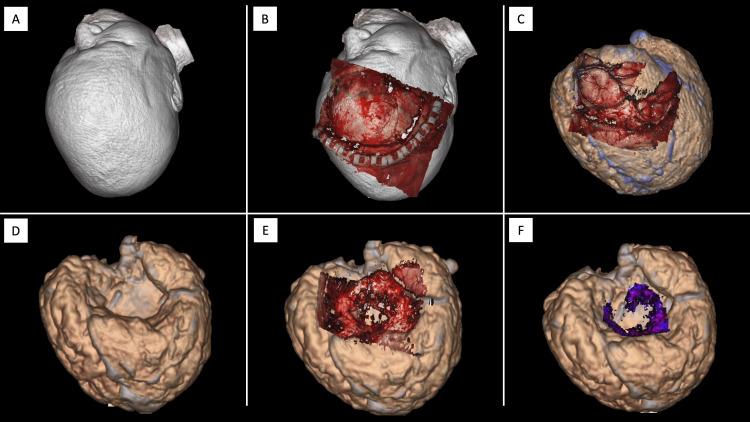
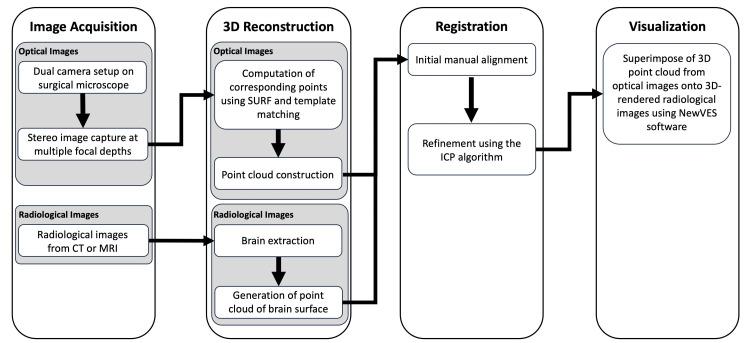
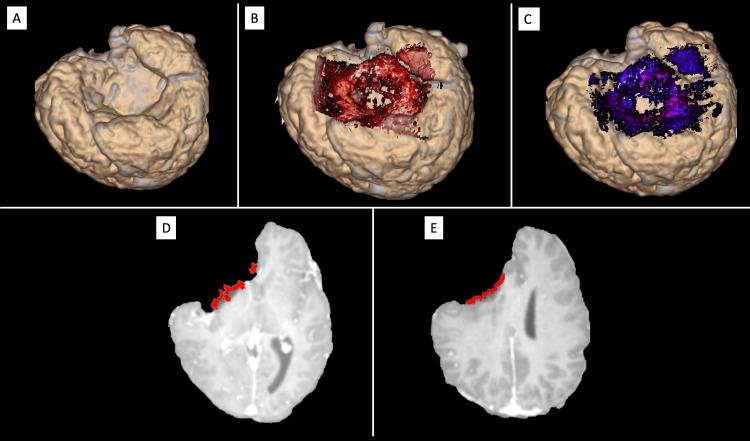
Introduction Advancements in neurosurgery have integrated imaging modalities like fluorescence imaging and neuronavigation to enhance tumor resection and functional preservation. However, aligning intra-operative optical data, such as 5-aminolaevulinic acid (5-ALA) fluorescence and direct cortical stimulation (DCS) tags, with radiological images remains challenging due to brain shift. To address this, we developed the Multimodal Optico-Radiological Image (MORI) platform, a proof-of-concept system integrating intra-operative optical imaging with MRI/CT for improved surgical visualization. Methods We evaluated MORI in 19 brain tumor surgeries near eloquent or deep-seated areas. The system comprised (1) optical image capture, (2) 3D surface reconstruction from stereo optical images, (3) registration of optical and radiological images using the iterative closest point (ICP) algorithm, and (4) visualization. Accuracy was validated by measuring registration errors between anatomical landmarks. Results MORI reconstructed 3D brain surfaces, integrating fluorescence and functional mapping with MRI. The system achieved an average registration error of 2.2 mm across 10 cases. Case studies demonstrated precise overlay of DCS tags onto MRI for eloquent area localization and 5-ALA fluorescence for tumor margin delineation. Additionally, MORI converted conventional 2D surgical videos into a 4D surgical record for timeline-based integration. Conclusion MORI enhances neurosurgical precision by dynamically integrating optical and radiological imaging. Future advancements, such as automation and surgical microscope integration, could refine it into a robust navigation tool, improving intra-operative decision-making, surgical education, and patient outcomes while advancing neurosurgical research.
引言 神经外科手术的进展已将荧光成像和神经导航等成像方式整合进来,以提高肿瘤切除率并保留功能。然而,由于脑移位,将术中光学数据,如5-氨基乙酰丙酸(5-ALA)荧光和直接皮质刺激(DCS)标记与放射图像对齐仍然具有挑战性。为了解决这个问题,我们开发了多模态光学-放射图像(MORI)平台,这是一个概念验证系统,将术中光学成像与MRI/CT整合,以改善手术可视化。方法 我们在19例靠近功能区或深部区域的脑肿瘤手术中评估了MORI。该系统包括:(1)光学图像采集;(2)从立体光学图像进行三维表面重建;(3)使用迭代最近点(ICP)算法对光学图像和放射图像进行配准;(4)可视化。通过测量解剖标志点之间的配准误差来验证准确性。结果 MORI重建了三维脑表面,将荧光和功能图谱与MRI整合。该系统在10例病例中平均配准误差为2.2毫米。病例研究表明,DCS标记能精确覆盖在MRI上用于功能区定位,5-ALA荧光用于勾勒肿瘤边缘。此外,MORI将传统的二维手术视频转换为基于时间线整合的四维手术记录。结论 MORI通过动态整合光学和放射成像提高了神经外科手术的精度。未来的进展,如自动化和与手术显微镜整合,可将其完善为一个强大的导航工具,改善术中决策、手术教学和患者预后,同时推动神经外科研究。


 Zotero 插件