
可卡因诱导神经元亚型通过 Egr3 转录调节的线粒体动力学。
Cocaine-induced neuron subtype mitochondrial dynamics through Egr3 transcriptional regulation.
机构信息
Department of Anatomy and Neurobiology, University of Maryland School of Medicine, HSF II Rm S265, 20 Penn Street, Baltimore, MD, 21201, USA.
Fishberg Department of Neuroscience and Friedman Brain Institute, Graduate School of Biomedical Sciences At the Icahn School of Medicine At Mount Sinai, New York, NY, USA.
出版信息
Mol Brain. 2021 Jun 29;14(1):101. doi: 10.1186/s13041-021-00800-y.
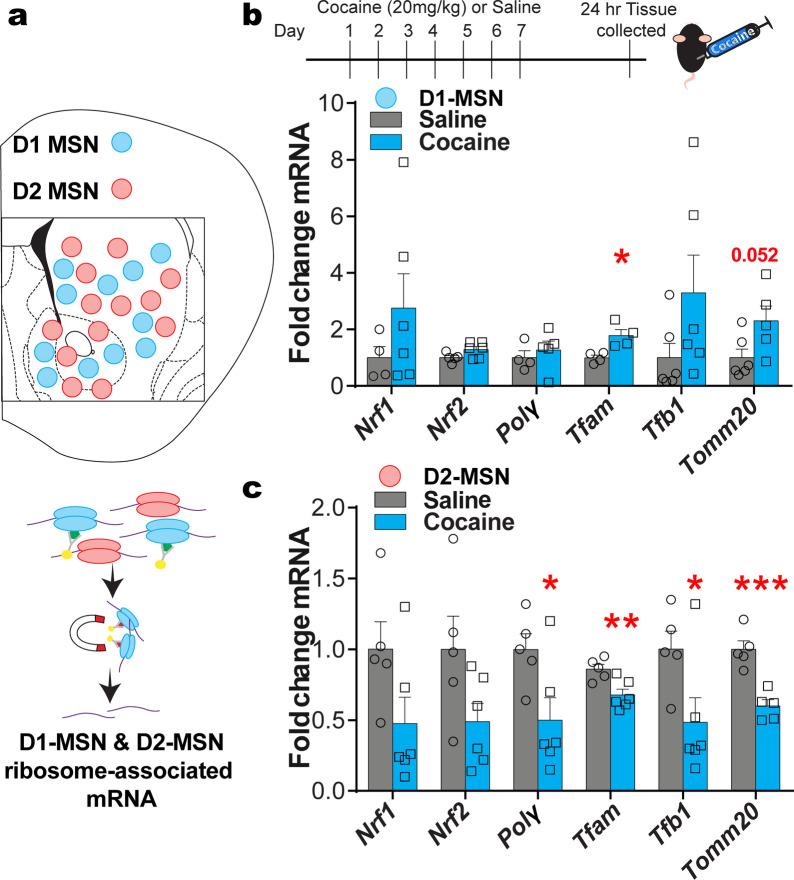
Mitochondrial function is required for brain energy homeostasis and neuroadaptation. Recent studies demonstrate that cocaine affects mitochondrial dynamics and morphological characteristics within the nucleus accumbens (NAc). Further, mitochondria are differentially regulated by cocaine in dopamine receptor-1 containing medium spiny neurons (D1-MSNs) vs dopamine receptor-2 (D2)-MSNs. However, there is little understanding into cocaine-induced transcriptional mechanisms and their role in regulating mitochondrial processes. Here, we demonstrate that cocaine enhances binding of the transcription factor, early growth response factor 3 (Egr3), to nuclear genes involved in mitochondrial function and dynamics. Moreover, cocaine exposure regulates mRNA of these mitochondria-associated nuclear genes in both contingent or noncontingent cocaine administration and in both rodent models and human postmortem tissue. Interestingly, several mitochondrial nuclear genes showed distinct profiles of expression in D1-MSNs vs D2-MSNs, with cocaine exposure generally increasing mitochondrial-associated nuclear gene expression in D1-MSNs vs suppression in D2-MSNs. Further, blunting Egr3 expression in D1-MSNs blocks cocaine-enhancement of the mitochondrial-associated transcriptional coactivator, peroxisome proliferator-activated receptor gamma coactivator (PGC1α), and the mitochondrial fission molecule, dynamin related protein 1 (Drp1). Finally, reduction of D1-MSN Egr3 expression attenuates cocaine-induced enhancement of small-sized mitochondria, causally demonstrating that Egr3 regulates mitochondrial morphological adaptations. Collectively, these studies demonstrate cocaine exposure impacts mitochondrial dynamics and morphology by Egr3 transcriptional regulation of mitochondria-related nuclear gene transcripts; indicating roles for these molecular mechanisms in neuronal function and plasticity occurring with cocaine exposure.
线粒体功能对于大脑能量稳态和神经适应至关重要。最近的研究表明,可卡因会影响伏隔核(NAc)内的线粒体动力学和形态特征。此外,线粒体在多巴胺受体-1 含有中型多棘神经元(D1-MSNs)和多巴胺受体-2(D2)-MSNs 中的调节方式不同。然而,对于可卡因诱导的转录机制及其在调节线粒体过程中的作用,我们的了解甚少。在这里,我们证明可卡因增强了转录因子早期生长反应因子 3(Egr3)与参与线粒体功能和动力学的核基因的结合。此外,可卡因暴露调节了这些与线粒体相关的核基因在 contingent 或 noncontingent 可卡因给药以及在啮齿动物模型和人类死后组织中的 mRNA。有趣的是,几种与线粒体相关的核基因在 D1-MSNs 与 D2-MSNs 之间表现出不同的表达模式,可卡因暴露通常会增加 D1-MSNs 中与线粒体相关的核基因表达,而在 D2-MSNs 中则抑制表达。此外,在 D1-MSNs 中阻断 Egr3 表达会阻止可卡因增强与线粒体相关的转录共激活因子过氧化物酶体增殖物激活受体γ共激活因子 1α(PGC1α)和线粒体分裂分子 dynamin 相关蛋白 1(Drp1)。最后,减少 D1-MSN 中的 Egr3 表达会减弱可卡因诱导的小线粒体的增强,这表明 Egr3 通过对与线粒体相关的核基因转录物进行转录调节来调节线粒体的形态适应。总的来说,这些研究表明,可卡因暴露通过 Egr3 对与线粒体相关的核基因转录物的转录调节来影响线粒体动力学和形态,表明这些分子机制在可卡因暴露引起的神经元功能和可塑性中发挥作用。


 Zotero 插件