
Zuranolone 与安慰剂治疗产后抑郁症的随机临床试验。
Effect of Zuranolone vs Placebo in Postpartum Depression: A Randomized Clinical Trial.
机构信息
Department of Psychiatry, Zucker Hillside Hospital, Glen Oaks, New York.
Feinstein Institutes for Medical Research, Northwell Health, Manhasset, New York.
出版信息
JAMA Psychiatry. 2021 Sep 1;78(9):951-959. doi: 10.1001/jamapsychiatry.2021.1559.
IMPORTANCE
Postpartum depression (PPD) is one of the most common medical complications during and after pregnancy, negatively affecting both mother and child.
OBJECTIVE
To demonstrate the efficacy and safety of zuranolone, a neuroactive steroid γ-aminobutyric acid receptor-positive allosteric modulator, in PPD.
DESIGN, SETTING, AND PARTICIPANTS: This phase 3, double-blind, randomized, outpatient, placebo-controlled clinical trial was conducted between January 2017 and December 2018 in 27 enrolling US sites. Participant were women aged 18 to 45 years, 6 months or fewer post partum, with PPD (major depressive episode beginning third trimester or ≤4 weeks postdelivery), and baseline 17-item Hamilton Rating Scale for Depression (HAMD-17) score of 26 or higher. Analysis was intention to treat and began December 2018 and ended March 2019.
INTERVENTIONS
Randomization 1:1 to placebo:zuranolone, 30 mg, administered orally each evening for 2 weeks.
MAIN OUTCOMES AND MEASURES
Primary end point was change from baseline in HAMD-17 score for zuranolone vs placebo at day 15. Secondary end points included changes from baseline in HAMD-17 total score at other time points, HAMD-17 response (≥50% score reduction) and remission (score ≤7) rates, Montgomery-Åsberg Depression Rating Scale score, and Hamilton Rating Scale for Anxiety score. Safety was assessed by adverse events and clinical assessments.
RESULTS
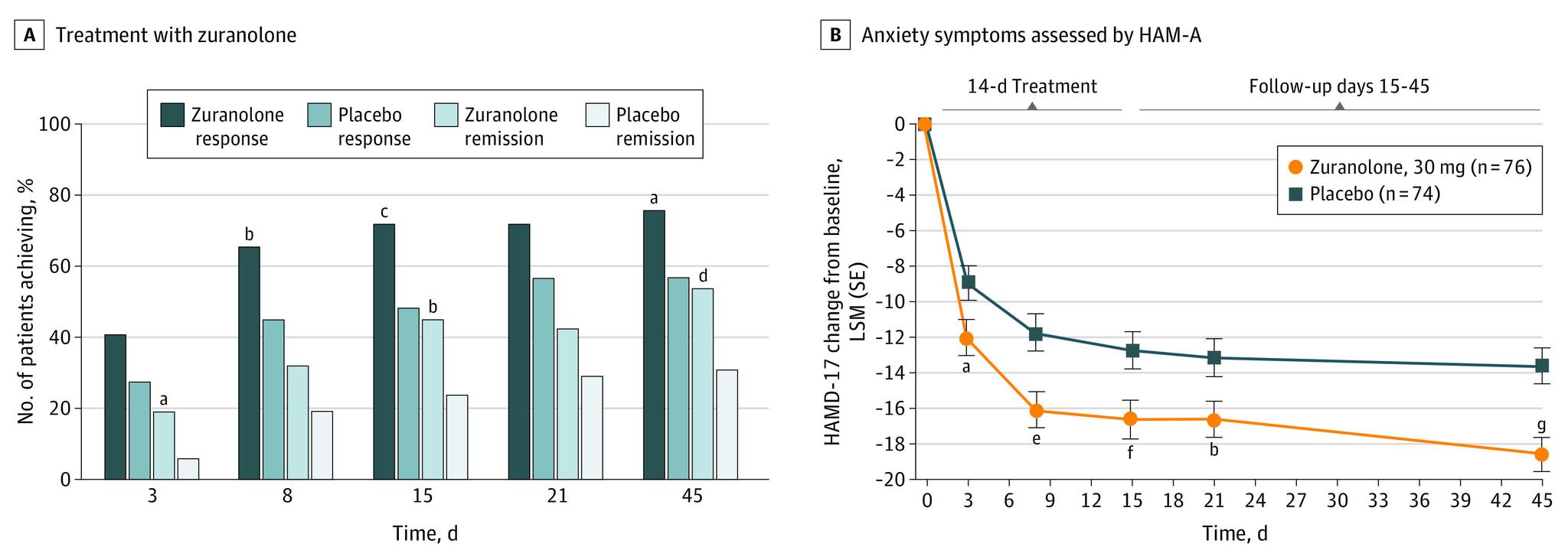
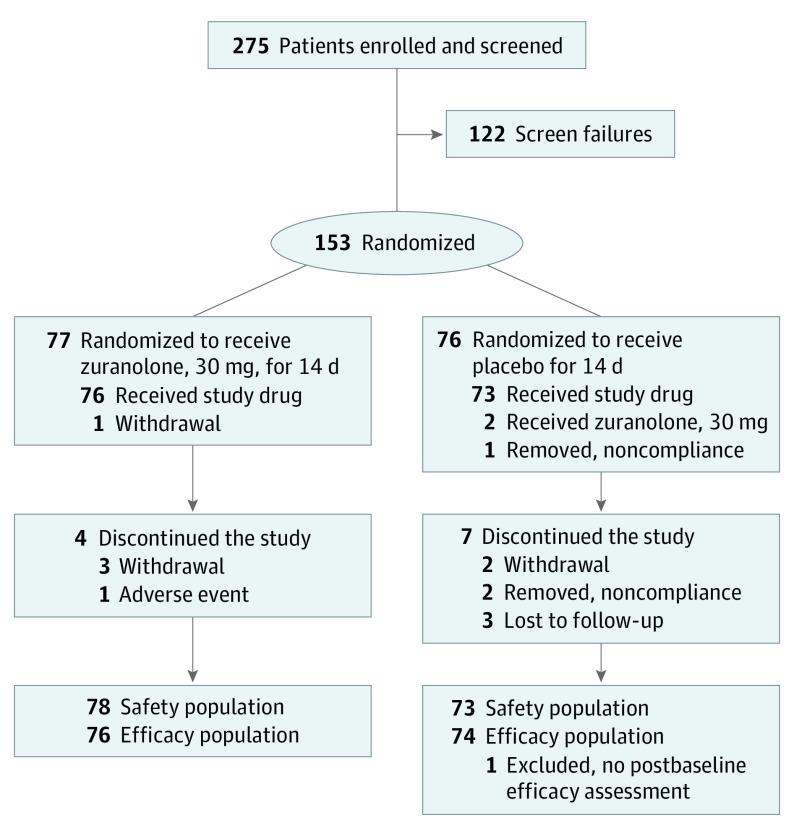
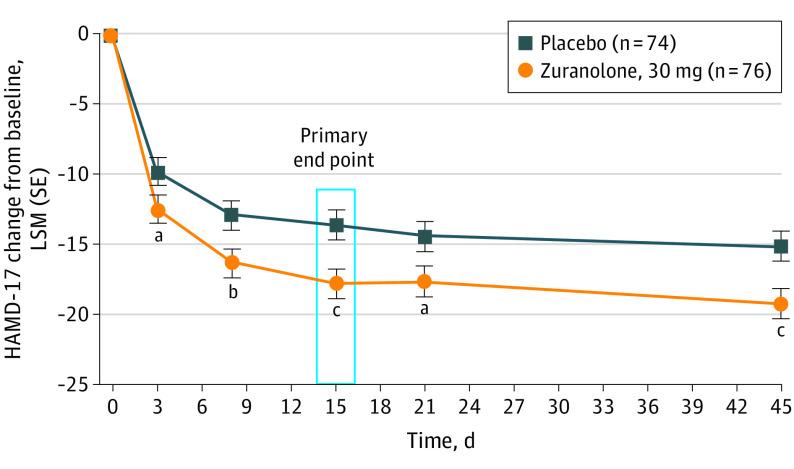
Of 153 randomized patients, the efficacy set comprised 150 patients (mean [SD] age, 28.3 [5.4] years), and 148 (98.7%) completed treatment. A total of 76 patients were randomized to placebo, and 77 were randomized to zuranolone, 30 mg. Zuranolone demonstrated significant day 15 HAMD-17 score improvements from baseline vs placebo (-17.8 vs -13.6; difference, -4.2; 95% CI, -6.9 to -1.5; P = .003). Sustained differences in HAMD-17 scores favoring zuranolone were observed from day 3 (difference, -2.7; 95% CI, -5.1 to -0.3; P = .03) through day 45 (difference, -4.1; 95% CI, -6.7 to -1.4; P = .003). Sustained differences at day 15 favoring zuranolone were observed in HAMD-17 response (odds ratio, 2.63; 95% CI, 1.34-5.16; P = .005), HAMD-17 score remission (odds ratio, 2.53; 95% CI, 1.24-5.17; P = .01), change from baseline for Montgomery-Åsberg Depression Rating Scale score (difference, -4.6; 95% CI, -8.3 to -0.8; P = .02), and Hamilton Rating Scale for Anxiety score (difference, -3.9; 95% CI, -6.7 to -1.1; P = .006). One patient per group experienced a serious adverse event (confusional state in the zuranolone group and pancreatitis in the placebo group). One patient in the zuranolone group discontinued because of an adverse event vs none for placebo.
CONCLUSIONS AND RELEVANCE
In this randomized clinical trial, zuranolone improved the core symptoms of depression as measured by HAMD-17 scores in women with PPD and was generally well tolerated, supporting further development of zuranolone in the treatment of PPD.
TRIAL REGISTRATION
ClinicalTrials.gov Identifier: NCT02978326.
重要提示
产后抑郁症(PPD)是怀孕期间和产后最常见的医学并发症之一,对母亲和孩子都有负面影响。
目的
展示神经活性甾体γ-氨基丁酸受体正变构调节剂佐拉诺酮治疗产后抑郁症(PPD)的疗效和安全性。
设计、地点和参与者:这是一项 3 期、双盲、随机、门诊、安慰剂对照临床试验,于 2017 年 1 月至 2018 年 12 月在 27 个美国参与机构进行。参与者为年龄在 18 至 45 岁、产后 6 个月或更短时间、有产后抑郁症(PPD)(重度抑郁发作始于孕晚期或产后≤4 周)且基线 17 项汉密尔顿抑郁量表(HAMD-17)评分≥26 的女性。分析是意向治疗,于 2018 年 12 月开始,2019 年 3 月结束。
干预措施
随机分组 1:1 为安慰剂:佐拉诺酮 30mg,每晚口服一次,连续 2 周。
主要结局和测量指标
主要终点是佐拉诺酮与安慰剂在第 15 天的 HAMD-17 评分从基线的变化。次要终点包括在其他时间点的 HAMD-17 总分从基线的变化、HAMD-17 反应(≥50%评分减少)和缓解(评分≤7)率、蒙哥马利-阿斯伯格抑郁评定量表评分和汉密尔顿焦虑量表评分。安全性通过不良事件和临床评估来评估。
结果
在 153 名随机患者中,有效集包括 150 名患者(平均[SD]年龄 28.3[5.4]岁),148 名(98.7%)完成了治疗。76 名患者被随机分配到安慰剂组,77 名患者被随机分配到佐拉诺酮 30mg 组。佐拉诺酮与安慰剂相比,在第 15 天的 HAMD-17 评分有显著改善(-17.8 与-13.6;差值,-4.2;95%置信区间,-6.9 至-1.5;P=0.003)。从第 3 天(差值,-2.7;95%置信区间,-5.1 至-0.3;P=0.03)到第 45 天(差值,-4.1;95%置信区间,-6.7 至-1.4;P=0.003),持续观察到 HAMD-17 评分有利于佐拉诺酮的差异。在第 15 天,佐拉诺酮在 HAMD-17 反应(优势比,2.63;95%置信区间,1.34-5.16;P=0.005)、HAMD-17 评分缓解(优势比,2.53;95%置信区间,1.24-5.17;P=0.01)、蒙哥马利-阿斯伯格抑郁评定量表评分从基线的变化(差值,-4.6;95%置信区间,-8.3 至-0.8;P=0.02)和汉密尔顿焦虑量表评分(差值,-3.9;95%置信区间,-6.7 至-1.1;P=0.006)方面均有利于佐拉诺酮。每个组各有 1 名患者发生严重不良事件(佐拉诺酮组出现意识模糊状态,安慰剂组出现胰腺炎)。与安慰剂组无患者因不良事件退出相比,佐拉诺酮组有 1 名患者退出。
结论和相关性
在这项随机临床试验中,佐拉诺酮改善了 HAMD-17 评分测量的 PPD 女性的抑郁核心症状,且总体耐受性良好,支持进一步开发佐拉诺酮治疗 PPD。
试验注册
ClinicalTrials.gov 标识符:NCT02978326。
 Zotero 插件