
蜂箱产品作为抗菌剂:综述
Beehive Products as Antibacterial Agents: A Review.
作者信息
Nader Rita Abou, Mackieh Rawan, Wehbe Rim, El Obeid Dany, Sabatier Jean Marc, Fajloun Ziad
机构信息
Faculty of Sciences 3, Department of Biology, Lebanese University, Campus Michel Slayman Ras Maska, Tripoli 1352, Lebanon.
Biology Department, Faculty of Arts and Sciences, American University of Beirut, Beirut 1107 2020, Lebanon.
出版信息
Antibiotics (Basel). 2021 Jun 15;10(6):717. doi: 10.3390/antibiotics10060717.
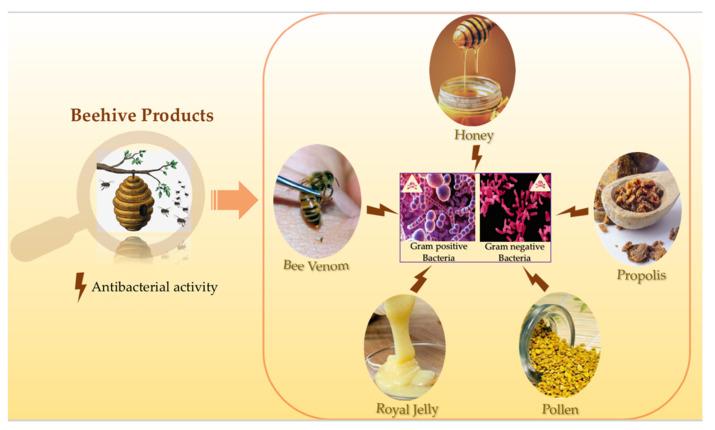
Honeybees are one of the most marvelous and economically beneficial insects. As pollinators, they play a vital role in every aspect of the ecosystem. Beehive products have been used for thousands of years in many cultures for the treatment of various diseases. Their healing properties have been documented in many religious texts like the Noble Quran and the Holy Bible. Honey, bee venom, propolis, pollen and royal jelly all demonstrated a richness in their bioactive compounds which make them effective against a variety of bacterial strains. Furthermore, many studies showed that honey and bee venom work as powerful antibacterial agents against a wide range of bacteria including life-threatening bacteria. Several reports documented the biological activities of honeybee products but none of them emphasized on the antibacterial activity of all beehive products. Therefore, this review aims to highlight the antibacterial activity of honey, bee venom, propolis, pollen and royal jelly, that are produced by honeybees.
蜜蜂是最神奇且具有重要经济价值的昆虫之一。作为传粉者,它们在生态系统的各个方面都发挥着至关重要的作用。蜂巢产品在许多文化中已被使用数千年,用于治疗各种疾病。它们的治疗特性在许多宗教文本如《古兰经》和《圣经》中都有记载。蜂蜜、蜂毒、蜂胶、花粉和蜂王浆都含有丰富的生物活性化合物,这使得它们对多种细菌菌株都有疗效。此外,许多研究表明,蜂蜜和蜂毒对包括危及生命的细菌在内的多种细菌都具有强大的抗菌作用。有几份报告记录了蜜蜂产品的生物活性,但没有一份强调所有蜂巢产品的抗菌活性。因此,本综述旨在突出蜜蜂所产的蜂蜜、蜂毒、蜂胶、花粉和蜂王浆的抗菌活性。
 Zotero 插件