
蜂产品:成分、药理特性及治疗应用。
Hive Products: Composition, Pharmacological Properties, and Therapeutic Applications.
作者信息
Bava Roberto, Castagna Fabio, Lupia Carmine, Poerio Giusi, Liguori Giovanna, Lombardi Renato, Naturale Maria Diana, Bulotta Rosa Maria, Biondi Vito, Passantino Annamaria, Britti Domenico, Statti Giancarlo, Palma Ernesto
机构信息
Department of Health Sciences, University of Catanzaro Magna Græcia, 88100 Catanzaro, Italy.
Mediterranean Ethnobotanical Conservatory, Sersale (CZ), 88054 Catanzaro, Italy.
出版信息
Pharmaceuticals (Basel). 2024 May 16;17(5):646. doi: 10.3390/ph17050646.
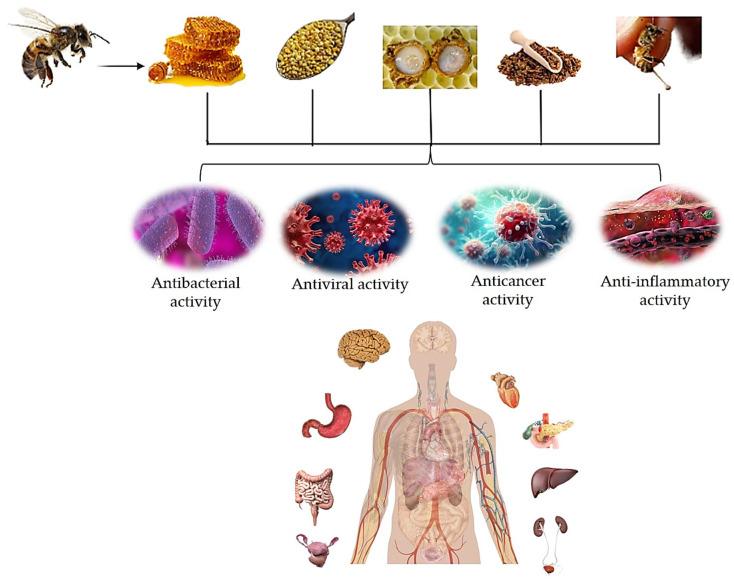
Beekeeping provides products with nutraceutical and pharmaceutical characteristics. These products are characterized by abundance of bioactive compounds. For different reasons, honey, royal jelly, propolis, venom, and pollen are beneficial to humans and animals and could be used as therapeutics. The pharmacological action of these products is related to many of their constituents. The main bioactive components of honey include oligosaccharides, methylglyoxal, royal jelly proteins (MRJPs), and phenolics compounds. Royal jelly contains jelleins, royalisin peptides, MRJPs, and derivatives of hydroxy-decenoic acid, particularly 10-hydroxy-2-decenoic acid (10-HDA), which possess antibacterial, anti-inflammatory, immunomodulatory, neuromodulatory, metabolic syndrome-preventing, and anti-aging properties. Propolis has a plethora of activities that are referable to compounds such as caffeic acid phenethyl ester. Peptides found in bee venom include phospholipase A2, apamin, and melittin. In addition to being vitamin-rich, bee pollen also includes unsaturated fatty acids, sterols, and phenolics compounds that express antiatherosclerotic, antidiabetic, and anti-inflammatory properties. Therefore, the constituents of hive products are particular and different. All of these constituents have been investigated for their properties in numerous research studies. This review aims to provide a thorough screening of the bioactive chemicals found in honeybee products and their beneficial biological effects. The manuscript may provide impetus to the branch of unconventional medicine that goes by the name of apitherapy.
养蜂业提供具有营养保健和药用特性的产品。这些产品的特点是含有丰富的生物活性化合物。出于不同原因,蜂蜜、蜂王浆、蜂胶、蜂毒和花粉对人类和动物有益,可作为治疗剂使用。这些产品的药理作用与其许多成分有关。蜂蜜的主要生物活性成分包括低聚糖、甲基乙二醛、蜂王浆蛋白(MRJPs)和酚类化合物。蜂王浆含有果冻蛋白、蜂王肽、MRJPs以及羟基癸烯酸的衍生物,特别是10-羟基-2-癸烯酸(10-HDA),它们具有抗菌、抗炎、免疫调节、神经调节、预防代谢综合征和抗衰老特性。蜂胶有大量与咖啡酸苯乙酯等化合物相关的活性。蜂毒中的肽包括磷脂酶A2、蜂毒明肽和蜂毒肽。除了富含维生素外,蜂花粉还包括具有抗动脉粥样硬化、抗糖尿病和抗炎特性的不饱和脂肪酸、甾醇和酚类化合物。因此,蜂产品的成分独特且各不相同。所有这些成分在众多研究中都对其特性进行了研究。本综述旨在全面筛选蜜蜂产品中发现的生物活性化学物质及其有益的生物学效应。该手稿可能会推动以蜂疗之名的非常规医学分支的发展。
 Zotero 插件