
迈向大流行场景下的智能诊断:新冠疫情
Toward Smart Diagnostics in a Pandemic Scenario: COVID-19.
作者信息
Hosseinifard Mohammad, Naghdi Tina, Morales-Narváez Eden, Golmohammadi Hamed
机构信息
Nanosensor Bioplatforms Laboratory, Chemistry and Chemical Engineering Research Center of Iran, Tehran, Iran.
Biophotonic Nanosensors Laboratory, Centro de Investigaciones en Óptica, Guanajuato, Mexico.
出版信息
Front Bioeng Biotechnol. 2021 Jun 17;9:637203. doi: 10.3389/fbioe.2021.637203. eCollection 2021.
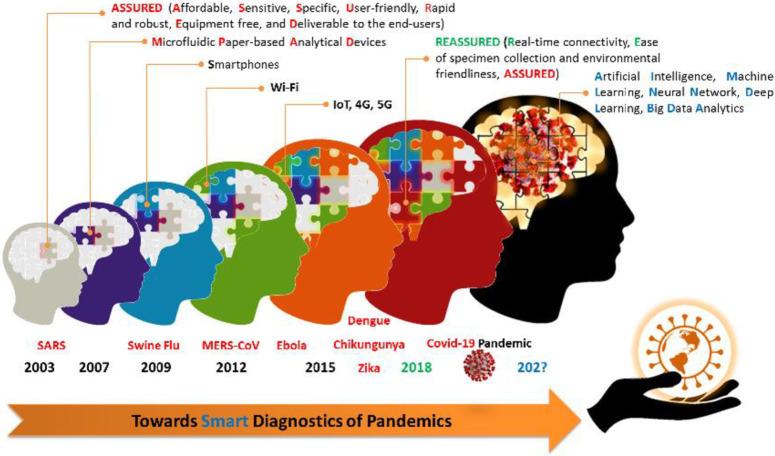
The incredible spread rate of coronavirus disease 2019 (COVID-19) outbreak has shocked the world. More than ever before, this dramatic scenario proved the significance of diagnostics as a cornerstone to make life-saving decisions. In this context, novel diagnostics that generates smart data leading to superior strategies for treatment, control, surveillance, prediction, prevention, and management of pandemic diseases is vital. Herein, we discuss the characteristics that should be met by COVID-19 diagnostics to become smart diagnostics enabled by industry 4.0 especially Internet of Things (IoT). The challenges ahead and our recommendations for moving faster from pure diagnostics toward smart diagnostics of COVID-19 and other possible epidemic/pandemic diseases are also outlined. An IoT-Fog-Cloud model based on smartphones as IoT gateways for smart diagnostics with unified strategies for data collection/transmission/interpretation is also proposed to integrate new digital technologies into a single platform for smarter decisions. Last but not least, we believe that "smart diagnostics" is a perspective that should be realized sooner before we encounter a pandemic far worse than the present one.
2019冠状病毒病(COVID-19)疫情惊人的传播速度震惊了世界。比以往任何时候都更甚的是,这一戏剧性的情况证明了诊断作为做出挽救生命决策的基石的重要性。在这种背景下,能够生成智能数据从而为大流行疾病的治疗、控制、监测、预测、预防和管理带来卓越策略的新型诊断至关重要。在此,我们讨论COVID-19诊断要成为由工业4.0尤其是物联网(IoT)驱动的智能诊断应具备的特征。还概述了未来的挑战以及我们对于更快地从单纯诊断迈向COVID-19及其他可能的流行/大流行疾病的智能诊断的建议。还提出了一种基于智能手机作为物联网网关的物联网-雾-云模型,用于智能诊断,并具有统一的数据收集/传输/解释策略,以便将新的数字技术集成到一个单一平台上,做出更明智的决策。最后但同样重要的是,我们认为“智能诊断”是一种观点,在我们遇到比当前情况严重得多的大流行之前,应尽早实现。

 Zotero 插件