
一种[植物名称]的乙醇水叶提取物通过细胞因子和谷氨酸能途径具有抗伤害感受活性。 (原文中Possesses前缺少具体植物名称)
A Hydroethanolic Leaf Extract of Possesses Antinociceptive Activity through Cytokine and Glutamatergic Pathways .
作者信息
Obese Ernest, Ameyaw Elvis O, Biney Robert P, Henneh Isaac T, Jackson Nora, Anokwah Daniel, Brah Augustine, Oppong Esther E, Adakudugu Emmanuel A
机构信息
School of Pharmacy and Pharmaceutical Sciences, College of Health and Allied Sciences, University of Cape Coast, Cape Coast, Ghana.
Department of Pharmacognosy, Faculty of Pharmacy and Pharmaceutical Sciences, Kwame Nkrumah University of Science and Technology, Kumasi, Ghana.
出版信息
Evid Based Complement Alternat Med. 2021 Jun 18;2021:5586789. doi: 10.1155/2021/5586789. eCollection 2021.
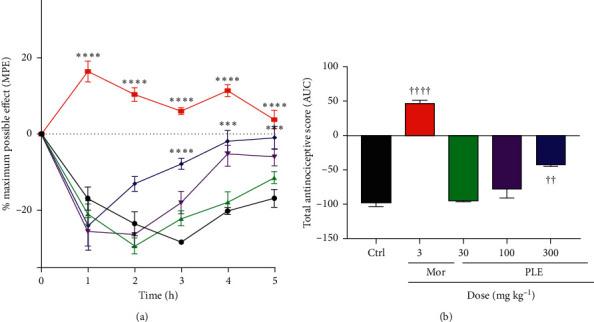
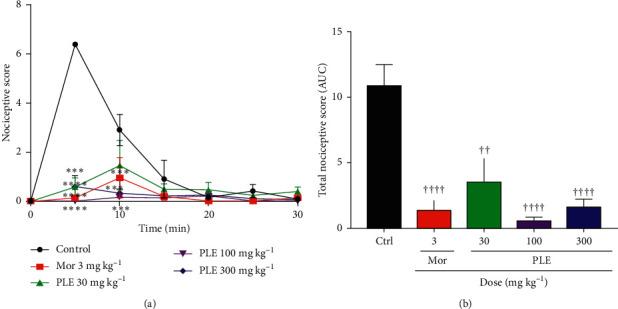
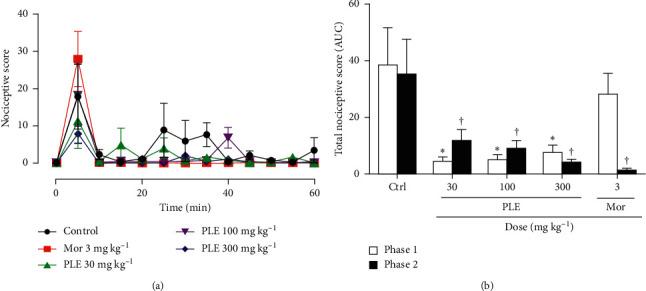
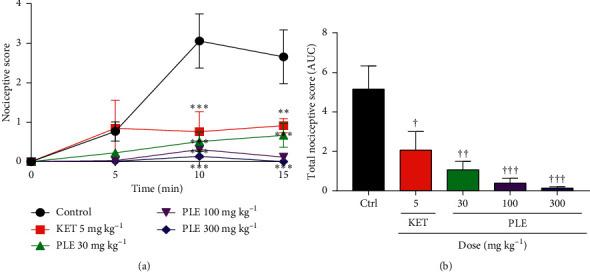
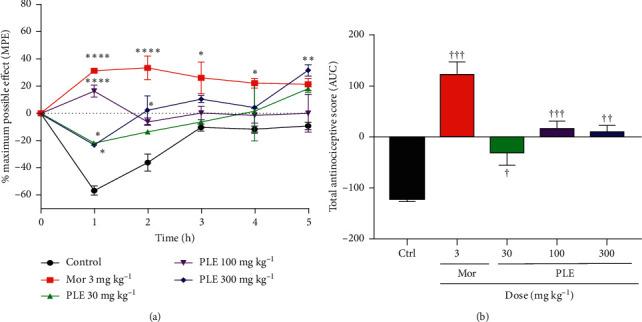
is used traditionally to treat pain. The antinociceptive properties of the hydroethanolic leaf extract of (PLE) were evaluated in rats and mice. Mice were pretreated orally with PLE (30, 100, and 300 mg kg) and evaluated for antinociceptive effects in the acetic acid-, glutamate-, and formalin-induced nociception models. Additionally, mechanical hyperalgesia models were used to evaluate PLE's influence on TNF-- and IL-1-induced hyperalgesia in rats. In the acetic acid-induced nociception model, 100 mg kg PLE exhibited the highest antinociceptive activity of 95.13 ± 9.52% at < 0.0001, followed by the 300 mg kg (85.44 ± 5.75%; < 0.0001) and then the 30 mg kg (67.95 ± 18.55%; < 0.01), compared to morphine 3 mg kg i.p. (86.97 ± 9.52; < 0.0001). PLE (30, 100, and 300 mg kg) also showed significant ( < 0.05) antinociceptive effect in phase two of the formalin-induced nociception with % inhibitions of 66.88 ± 12.17, 75.12 ± 9.01, and 89.12 ± 4.32%, respectively, compared to 3 mg/kg morphine (97.09 ± 2.84%). Similarly, PLE (30, 100, and 300 mg kg) significantly reduced pain in the glutamate-induced nociception model with % inhibitions of 79.28 ± 8.17, 90.54 ± 5.64, and 96.49 ± 1.43%, respectively, whereas ketamine (5 mg/kg i.p.) reduced nociception to be 59.94 ± 18.14%. All doses of PLE significantly reduced nociceptive scores in TNF-- and IL-1-induced mechanical hyperalgesia ( < 0.01). Similarly, PLE significantly inhibited bradykinin-induced nociception. The hydroethanolic extract of has antinociceptive effects; this is the first scientific report providing evidence to validate its traditional use for the management of pain.
传统上用于治疗疼痛。对[植物名称]叶的水乙醇提取物(PLE)在大鼠和小鼠中的抗伤害感受特性进行了评估。小鼠经口给予PLE(30、100和300mg/kg),并在乙酸、谷氨酸和福尔马林诱导的伤害感受模型中评估其抗伤害感受作用。此外,使用机械性痛觉过敏模型评估PLE对大鼠肿瘤坏死因子-α和白细胞介素-1诱导的痛觉过敏的影响。在乙酸诱导的伤害感受模型中,100mg/kg的PLE在P<0.0001时表现出最高的抗伤害感受活性,为95.13±9.52%,其次是300mg/kg(85.44±5.75%;P<0.0001),然后是30mg/kg(67.95±18.55%;P<0.01),而腹腔注射3mg/kg吗啡的抗伤害感受活性为86.97±9.52(P<0.0001)。在福尔马林诱导的伤害感受的第二阶段,PLE(30、100和300mg/kg)也显示出显著的(P<0.05)抗伤害感受作用,抑制率分别为66.88±12.17、75.12±9.01和89.12±4.32%,而3mg/kg吗啡的抑制率为97.09±2.84%。同样,在谷氨酸诱导的伤害感受模型中,PLE(30、100和300mg/kg)显著减轻疼痛,抑制率分别为79.28±8.17、90.54±5.64和96.49±1.43%,而氯胺酮(腹腔注射5mg/kg)使伤害感受降低至59.94±18.14%。所有剂量的PLE均显著降低肿瘤坏死因子-α和白细胞介素-1诱导的机械性痛觉过敏中的伤害感受评分(P<0.01)。同样,PLE显著抑制缓激肽诱导的伤害感受。[植物名称]的水乙醇提取物具有抗伤害感受作用;这是第一份为验证其在疼痛管理中的传统用途提供证据的科学报告。

 Zotero 插件