
COVID-19 大流行开始一年后接受透析的美国患者中估计的 SARS-CoV-2 血清流行率。
Estimated SARS-CoV-2 Seroprevalence in US Patients Receiving Dialysis 1 Year After the Beginning of the COVID-19 Pandemic.
机构信息
Division of Nephrology, Department of Medicine, Stanford University, Palo Alto, California.
Ascend Clinical Laboratory, Redwood City, California.
出版信息
JAMA Netw Open. 2021 Jul 1;4(7):e2116572. doi: 10.1001/jamanetworkopen.2021.16572.
IMPORTANCE
Seroprevalence studies complement data on detected cases and attributed deaths in assessing the cumulative spread of the SARS-CoV-2 virus.
OBJECTIVE
To estimate seroprevalence of SARS-CoV-2 antibodies in patients receiving dialysis and adults in the US in January 2021 before the widespread introduction of COVID-19 vaccines.
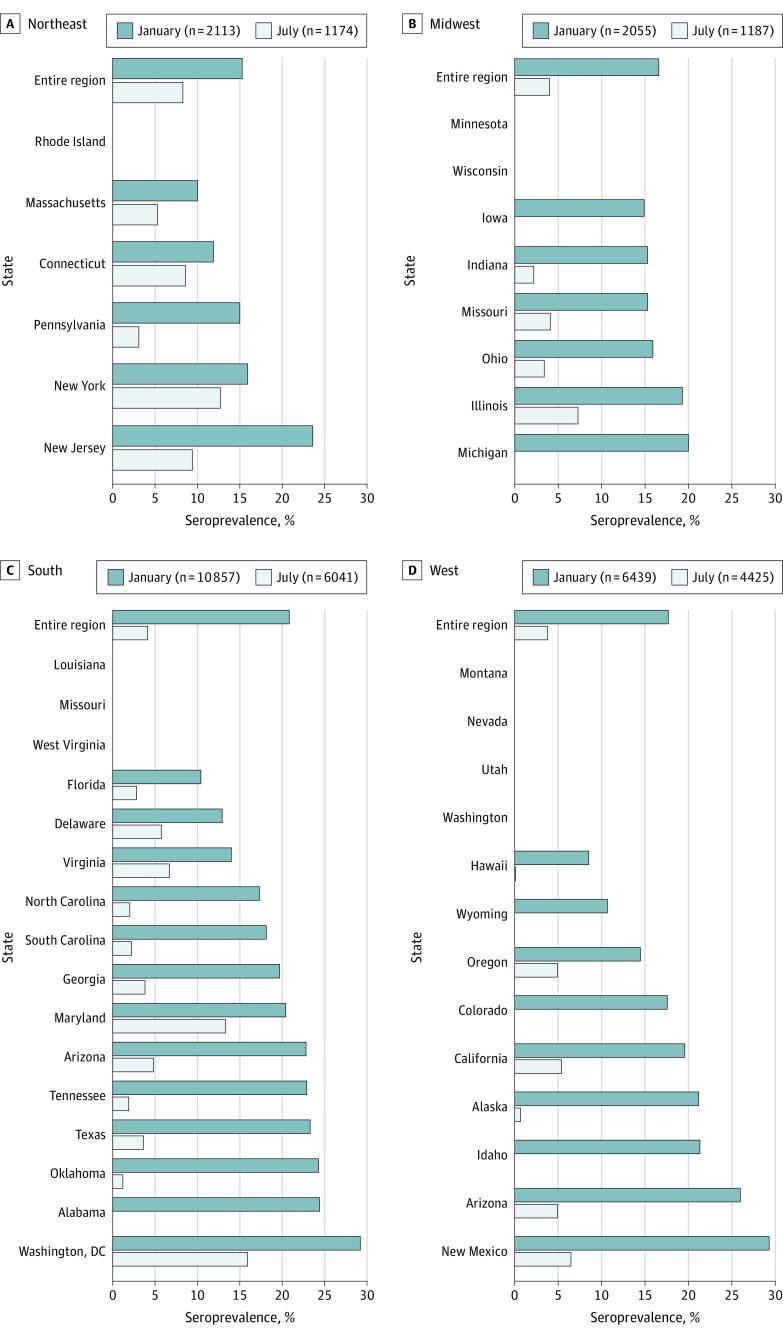
DESIGN, SETTING, AND PARTICIPANTS: This cross-sectional study used data from the third largest US dialysis organization (US Renal Care), which has facilities located nationwide, to estimate SARS-CoV-2 seroprevalence among US patients receiving dialysis. Remainder plasma (ie, plasma that would have otherwise been discarded) of all patients receiving dialysis at US Renal Care facilities from January 1 to 31, 2021, was tested for SARS-CoV-2 antibodies. Patients were excluded if they had a documented dose of SARS-CoV-2 vaccination or if a residence zip code was missing from electronic medical records. Crude seroprevalence estimates from this sample (January 2021) were standardized to the US adult population using the 2018 American Community Survey 1-year estimates and stratified by age group, sex, self-reported race/ethnicity, neighborhood race/ethnicity composition, neighborhood income level, and urban or rural status. These data and case detection rates were then compared with data from a July 2020 subsample of patients who received dialysis at the same facilities.
EXPOSURES
Age, sex, race/ethnicity, and region of residence as well as neighborhood race/ethnicity composition, poverty, population density, and urban or rural status.
MAIN OUTCOMES AND MEASURES
The spike protein receptor-binding domain total antibody assay (Siemens Healthineers; manufacturer-reported sensitivity of 100% and specificity of 99.8%) was used to estimate crude SARS-CoV-2 seroprevalence in the unweighted sample, and then the estimated seroprevalence rates for the US dialysis and adult populations were calculated, adjusting for age, sex, and region.
RESULTS
A total of 21 464 patients (mean [SD] age, 63.1 [14.2] years; 12 265 men [57%]) were included in the unweighted sample from January 2021. The patients were disproportionately older (aged 65-79 years, 7847 [37%]; aged ≥80 years, 2668 [12%]) and members of racial/ethnic minority groups (Hispanic patients, 2945 [18%]; non-Hispanic Black patients, 4875 [29%]). Seroprevalence of SARS-CoV-2 antibodies was 18.9% (95% CI, 18.3%-19.5%) in the sample, with a seroprevalence of 18.7% (95% CI, 18.1%-19.2%) standardized to the US dialysis population, and 21.3% (95% CI, 20.3%-22.3%) standardized to the US adult population. In the unweighted sample, younger persons (aged 18-44 years, 25.9%; 95% CI, 24.1%-27.8%), those who self-identified as Hispanic or living in Hispanic neighborhoods (25.1%; 95% CI, 23.6%-26.4%), and those living in the lowest-income neighborhoods (24.8%; 95% CI, 23.2%-26.5%) were among the subgroups with the highest seroprevalence. Little variability was observed in seroprevalence by geographic region, population density, and urban or rural status in the January 2021 sample (largest regional difference, 1.2 [95% CI, 1.1-1.3] higher odds of seroprevalence in residents of the Northeast vs West).
CONCLUSIONS AND RELEVANCE
In this cross-sectional study of patients receiving dialysis in the US, fewer than 1 in 4 patients had evidence of SARS-CoV-2 antibodies 1 year after the first case of SARS-CoV-2 infection was detected in the US. Results standardized to the US population indicate similar prevalence of antibodies among US adults. Vaccine introduction to younger individuals, those living in neighborhoods with a large population of racial/ethnic minority residents, and those living in low-income neighborhoods may be critical to disrupting the spread of infection.
重要性
血清流行率研究补充了已检测病例和归因死亡数据,以评估 SARS-CoV-2 病毒的累积传播情况。
目的
在 COVID-19 疫苗广泛接种之前,估计 2021 年 1 月美国接受透析治疗的患者和成年人中 SARS-CoV-2 抗体的血清流行率。
设计、地点和参与者:这项横断面研究使用了美国第三大透析机构(美国肾脏护理)的数据,该机构在美国各地设有设施,以估计美国接受透析治疗的患者中 SARS-CoV-2 的血清流行率。2021 年 1 月 1 日至 31 日,美国肾脏护理机构所有接受透析治疗的患者的剩余血浆(即原本将被丢弃的血浆)均接受了 SARS-CoV-2 抗体检测。如果患者有记录的 SARS-CoV-2 疫苗接种剂量,或者电子病历中缺少居住邮政编码,则将其排除在外。从这个样本(2021 年 1 月)中得出的粗血清流行率估计值根据 2018 年美国社区调查的 1 年估计值标准化为美国成年人群体,并按年龄组、性别、自我报告的种族/民族、邻里种族/民族构成、邻里收入水平以及城市或农村状况进行分层。然后将这些数据和病例检出率与同年同月在同一设施接受透析治疗的患者的 2020 年 7 月的亚组数据进行比较。
暴露因素
年龄、性别、种族/民族以及居住地区,以及邻里种族/民族构成、贫困程度、人口密度和城乡状况。
主要结果和措施
使用西门子 Healthineers 的刺突蛋白受体结合域总抗体检测试剂盒(制造商报告的敏感性为 100%,特异性为 99.8%)来估计未加权样本中的 SARS-CoV-2 粗血清流行率,然后计算美国透析和成年人群体的估计血清流行率,根据年龄、性别和地区进行调整。
结果
共有 21464 名患者(平均[SD]年龄,63.1[14.2]岁;12265 名男性[57%])纳入 2021 年 1 月的未加权样本。这些患者年龄较大(65-79 岁,7847[37%];≥80 岁,2668[12%]),且多为少数族裔(西班牙裔患者,2945[18%];非西班牙裔黑种人患者,4875[29%])。该样本中 SARS-CoV-2 抗体的血清流行率为 18.9%(95%CI,18.3%-19.5%),根据美国透析人群标准化后的血清流行率为 18.7%(95%CI,18.1%-19.2%),根据美国成年人群体标准化后的血清流行率为 21.3%(95%CI,20.3%-22.3%)。在未加权样本中,年龄较小的人群(18-44 岁,25.9%;95%CI,24.1%-27.8%)、自我认定为西班牙裔或居住在西班牙裔社区的人群(25.1%;95%CI,23.6%-26.4%)以及居住在收入最低社区的人群(24.8%;95%CI,23.2%-26.5%)的血清流行率最高。在 2021 年 1 月的样本中,血清流行率在地理区域、人口密度和城乡状况方面变化不大(最大的区域差异是东北部居民感染 SARS-CoV-2 的几率比西部高 1.2[95%CI,1.1-1.3])。
结论和相关性
在这项对美国接受透析治疗的患者进行的横断面研究中,在美国首次发现 SARS-CoV-2 感染病例一年后,不到 1/4 的患者有 SARS-CoV-2 抗体的证据。根据美国人口标准化的结果表明,美国成年人的抗体流行率相似。在年轻人群、居住在少数族裔居民较多的社区的人群以及居住在低收入社区的人群中,接种疫苗可能对阻断感染的传播至关重要。
 Zotero 插件