
与 2020 年欧洲主要地区相比,中东欧国家 COVID-19 大流行期间超额死亡率的不同趋势:匈牙利分析。
Different Trends in Excess Mortality in a Central European Country Compared to Main European Regions in the Year of the COVID-19 Pandemic (2020): a Hungarian Analysis.
机构信息
National Korányi Institute of Pulmonology, Budapest, Hungary.
2nd Department of Medicine and Nephrological Center, Faculty of Medicine, University of Pécs, Pécs, Hungary.
出版信息
Pathol Oncol Res. 2021 Apr 13;27:1609774. doi: 10.3389/pore.2021.1609774. eCollection 2021.
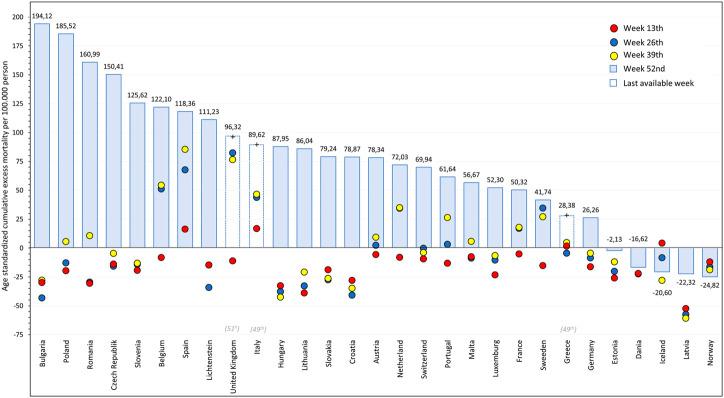
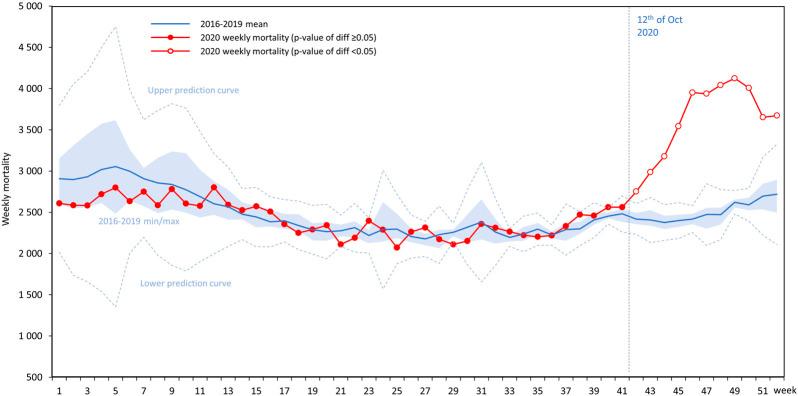
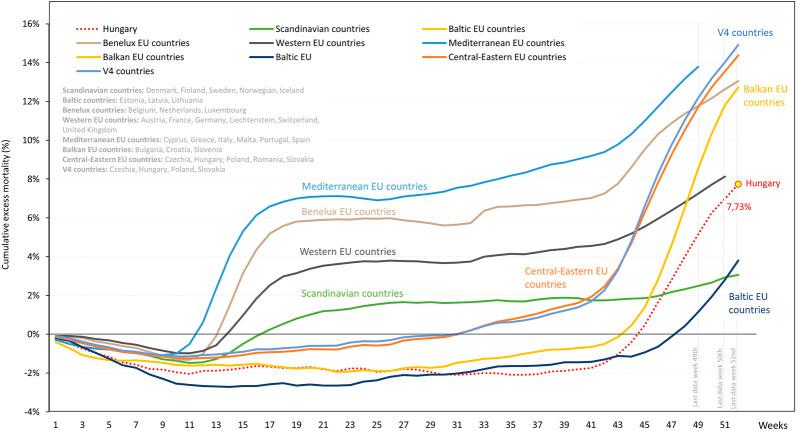
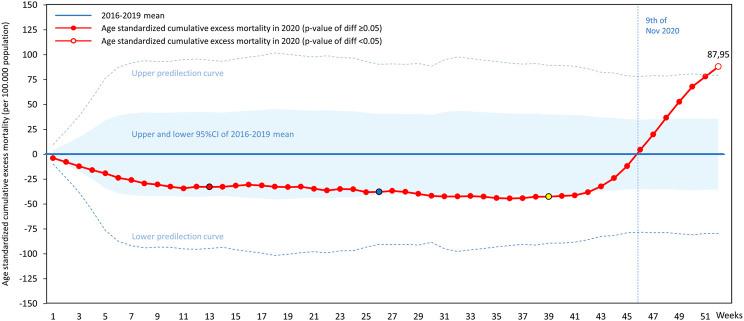
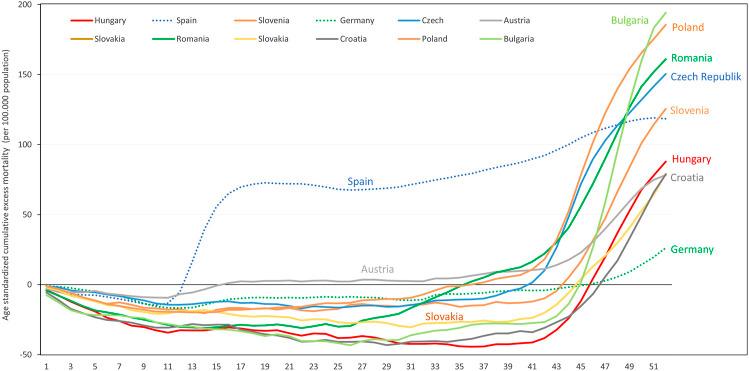
This study examined cumulative excess mortality in European countries in the year of the Covid-19 pandemic and characterized the dynamics of the pandemic in different countries, focusing on Hungary and the Central and Eastern European region. Age-standardized cumulative excess mortality was calculated based on weekly mortality data from the EUROSTAT database, and was compared between 2020 and the 2016-2019 reference period in European countries. Cumulate weekly excess mortality in Hungary was in the negative range until week 44. By week 52, it reached 9,998 excess deaths, corresponding to 7.73% cumulative excess mortality vs. 2016-2019 (-value = 0.030 vs. 2016-2019). In Q1, only Spain and Italy reported excess mortality compared to the reference period. Significant increases in excess mortality were detected between weeks 13 and 26 in Spain, United Kingdom, Belgium, Netherland and Sweden. Romania and Portugal showed the largest increases in age-standardized cumulative excess mortality in the Q3. The majority of Central and Eastern European countries experienced an outstandingly high impact of the pandemic in Q4 in terms of excess deaths. Hungary ranked 11th in cumulative excess mortality based on the latest available data of from the EUROSTAT database. Hungary experienced a mortality deficit in the first half of 2020 compared to previous years, which was followed by an increase in mortality during the second wave of the COVID-19 pandemic, reaching 7.7% cumulative excess mortality by the end of 2020. The excess was lower than in neighboring countries with similar dynamics of the pandemic.
本研究考察了 2020 年欧洲国家在新冠大流行年份的累积超额死亡率,并对不同国家的大流行动态进行了特征描述,重点关注匈牙利和中东欧地区。基于 EUROSTAT 数据库的每周死亡率数据,计算了年龄标准化的累积超额死亡率,并在欧洲国家中比较了 2020 年与 2016-2019 年的参考期之间的差异。匈牙利的累积每周超额死亡率在第 44 周之前一直处于负值范围。到第 52 周,它达到了 9998 例超额死亡,相当于与 2016-2019 年相比的累积超额死亡率为 7.73%(-值=0.030 与 2016-2019 年相比)。在第 1 季度,只有西班牙和意大利与参考期相比报告了超额死亡率。在西班牙、英国、比利时、荷兰和瑞典,在第 13 周至第 26 周之间检测到超额死亡率的显著增加。罗马尼亚和葡萄牙在第 3 季度的年龄标准化累积超额死亡率增幅最大。在第 4 季度,大多数中东欧国家的超额死亡人数受到了疫情的极大影响。根据 EUROSTAT 数据库中最新可用数据,匈牙利在累积超额死亡率方面排名第 11。与前几年相比,匈牙利在 2020 年上半年经历了死亡率不足,随后在第二波 COVID-19 大流行期间死亡率上升,到 2020 年底达到了 7.7%的累积超额死亡率。这一超额死亡率低于疫情动态相似的邻国。

 Zotero 插件