
将生菜或西洋菜纳入中高脂肪餐对健康年轻男性餐后脂质、血糖反应和血浆炎症细胞因子的急性影响:一项随机交叉试验。
The acute effect of incorporating lettuce or watercress into a moderately high-fat meal on postprandial lipid, glycemic response, and plasma inflammatory cytokines in healthy young men: a randomized crossover trial.
机构信息
Department of Clinical Nutrition & Dietetics, National Nutrition and Food Technology Research Institute, Faculty of Nutrition Sciences and Food Technology, Shahid Beheshti University of Medical Sciences, 46, Hafezi St., Farahzadi Blvd., Shahrak Qods, P.O.Box: 19395-4741, Tehran, Iran.
出版信息
Lipids Health Dis. 2021 Jul 15;20(1):66. doi: 10.1186/s12944-021-01487-9.
BACKGROUND
Postprandial responses to food mostly depend on the composition of the meal and the consumption of vegetables may modulate this postprandial state. In this study, the effects of lettuce or watercress consumption with a moderately high-fat meal (40% kcal from fat) on postprandial lipemia, glycemia, and inflammatory cytokines were determined in healthy men.
METHODS
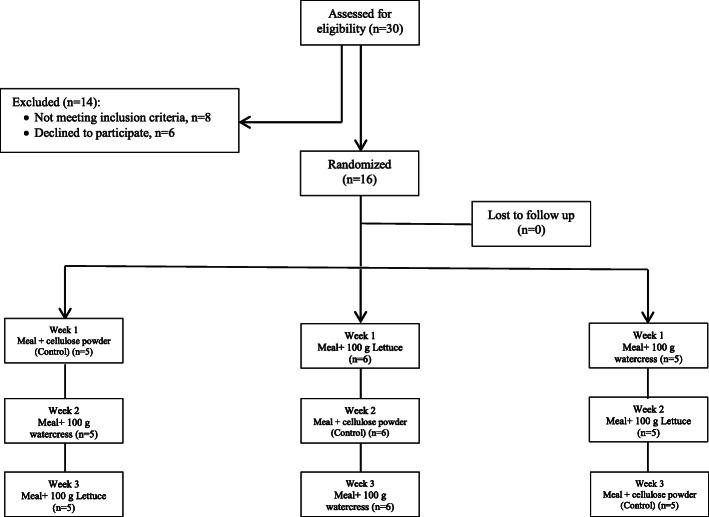
This randomized, 3-arm, crossover study was conducted in sixteen healthy young men with a mean ± SEM age and body mass index (in kg/m2) of 22.8 ± 0.5 years old and 23.7 ± 1.16, respectively. Lettuce and watercress were added to the test meal in portions of 100 g and cellulose was added to the control meal. Thereafter, blood samples were collected by passing 0, 1, 2, 3, and 4 h for analysis. The postprandial response was measured in plasma glucose, triglycerides (TG), total cholesterol, high-density-lipoproteins cholesterol (HDL-C), and low-density-lipoproteins cholesterol (LDL-C), as the area under the postprandial curve (AUC). Moreover, plasma tumor necrosis factor-α (TNF-α) and interleukin-6 (IL-6) were determined once before and once 4 h after the meal's consumption.
RESULTS
The 0-4-h AUCs for glucose (385.7, 361.9, and 382.3 mg/dL for the control, lettuce, and watercress meals, respectively) were calculated to be lower when meal was consumed with lettuce compared to the control (P < 0.05) and watercress (P < 0.01) meals. The maximum values of insulin were obtained as 43.8 ± 18.8, 33.5 ± 19.5, and 42.8 ± 17.7 μIU/mL for the control, lettuce, and watercress meals, respectively. As well, the lettuce-containing meal more reduced the AUC for insulin compared with the control (P < 0.05), but not watercress. Notably, plasma TG, total cholesterol, HDL-C, and LDL-C had no significant differences among the meals. Moreover, the levels of plasma IL-6 and TNF-α did not differ among the meals.
CONCLUSION
In this study on healthy men, the addition of lettuce to a moderately high-fat meal delayed the postprandial glycemic response. However, the effect of the consumption of these vegetables on postprandial responses in subjects with cardiometabolic risk factors remains to be elucidated yet. This clinical trial was registered at the Iran Clinical Trials Registration Office (IRCT) on March 3, 2018, with an ID of IRCT20160702028742N4 ( https://www.irct.ir/user/trial/23233/view ).
背景
食物的餐后反应主要取决于膳食的组成,而食用蔬菜可能会调节这种餐后状态。在这项研究中,我们确定了食用生菜或西洋菜与中等高脂肪餐(40%的热量来自脂肪)对健康男性餐后血脂、血糖和炎症细胞因子的影响。
方法
这是一项随机、三臂、交叉研究,在 16 名平均年龄和体重指数(以千克/平方米为单位)分别为 22.8±0.5 岁和 23.7±1.16 的健康年轻男性中进行。在测试餐中加入 100 克生菜和西洋菜,在对照餐中加入纤维素。此后,在 0、1、2、3 和 4 小时通过采血样进行分析。通过计算餐后曲线下面积(AUC)来测量餐后血糖、甘油三酯(TG)、总胆固醇、高密度脂蛋白胆固醇(HDL-C)和低密度脂蛋白胆固醇(LDL-C)的餐后反应。此外,在进食前和进食后 4 小时测定一次血浆肿瘤坏死因子-α(TNF-α)和白细胞介素-6(IL-6)。
结果
与对照餐和西洋菜餐相比,食用生菜餐后 0-4 小时的血糖 AUC(分别为 385.7、361.9 和 382.3mg/dL)较低(P<0.05 和 P<0.01)。对照餐、生菜餐和西洋菜餐的胰岛素最大浓度分别为 43.8±18.8、33.5±19.5 和 42.8±17.7μIU/mL。同样,与对照餐相比,含生菜的餐能降低胰岛素 AUC(P<0.05),但与西洋菜餐相比则没有差异。值得注意的是,餐后 TG、总胆固醇、HDL-C 和 LDL-C 水平在各餐之间没有显著差异。此外,各餐之间血浆 IL-6 和 TNF-α水平没有差异。
结论
在这项对健康男性的研究中,将生菜添加到中等高脂肪餐中可延缓餐后血糖反应。然而,这些蔬菜对心血管代谢危险因素患者的餐后反应的影响仍有待阐明。这项临床试验于 2018 年 3 月 3 日在伊朗临床试验注册办公室(IRCT)注册,注册号为 IRCT20160702028742N4(https://www.irct.ir/user/trial/23233/view)。

 Zotero 插件