
衣物护理产品中使用的香精微胶囊的特定国家环境风险。
Country-Specific Environmental Risks of Fragrance Encapsulates Used in Laundry Care Products.
机构信息
Technology and Society Laboratory, Swiss Federal Laboratories for Materials Science and Technology, St. Gallen, Switzerland.
Firmenich, Princeton, New Jersey, USA.
出版信息
Environ Toxicol Chem. 2022 Apr;41(4):905-916. doi: 10.1002/etc.5168. Epub 2021 Sep 2.
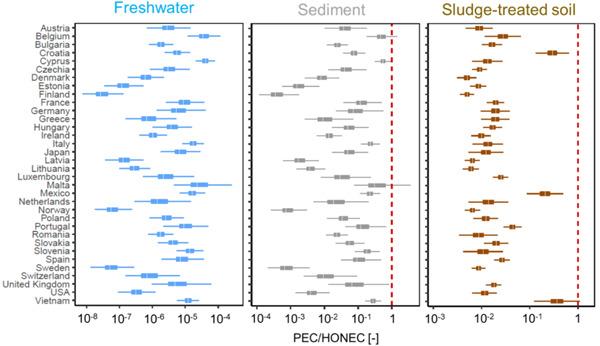
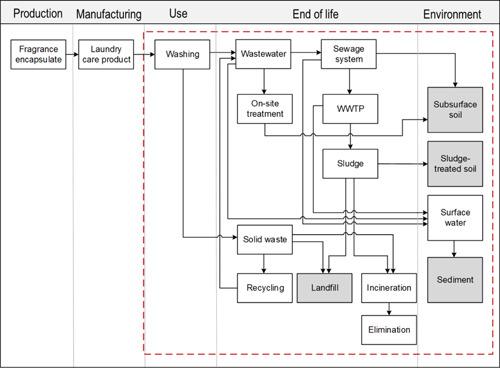
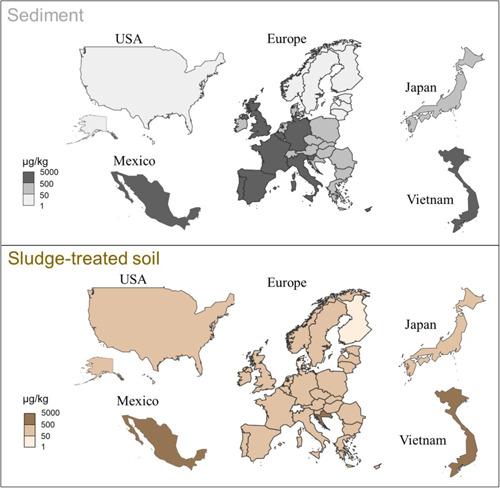
Fragrance encapsulates (FEs) are designed to deliver fragrance components, notably in laundry care products. They are made of thermoset polymeric shells surrounding the fragrance content. These materials enter the environment mainly during laundry washing, but little is known about their distribution in and impact on the environment. The aim of the present study was to estimate the environmental concentrations of FE shells in freshwater, sediment, and soil compartments for 34 selected countries and to compare them with ecotoxicological effects. Probabilistic material flow analysis was used to estimate worst-case predicted environmental concentrations (PECs). The lowest freshwater PEC was predicted for Finland (0.00011 µg/L) and the highest for Belgium (0.13 µg/L). Accumulation of FE shells between 2010 and 2019 was considered for sediments and sludge-treated soils. The PECs in sediments ranged from 3.0 µg/kg (Finland) to 3400 µg/kg (Belgium). For sludge-treated soil, the concentration was estimated to be between 0 (Malta and Switzerland) and 3600 µg/kg (Vietnam). Ecotoxicological tests showed no effects for FE shells at any tested concentration (up to 2700 µg/L freshwater, 5400 µg/kg sediment, and 9100 µg/kg soil), thus not allowing derivation of a predicted-no-effect concentration (PNEC). Therefore, to characterize the environmental risks, the PEC values were compared with highest-observed-no-effect concentrations (HONECs) derived from ecotoxicological tests. The PEC/HONEC ratios were 9.3 × 10 , 0.13, and 0.04 for surface waters, sediments, and sludge-treated soils, respectively, which are much below 1, suggesting no environmental risk. Because the PEC values constitute an upper boundary (no fate considered) and the HONEC values represent a lower boundary (actual PNEC values based on NOECs will be higher), the current risk estimation can be considered a precautionary worst-case assessment. Environ Toxicol Chem 2022;41:905-916. © 2021 The Authors. Environmental Toxicology and Chemistry published by Wiley Periodicals LLC on behalf of SETAC.
香精微胶囊是设计用来输送香精成分的,特别是在衣物护理产品中。它们由热固性聚合物外壳包围着香精内容物。这些材料主要在洗衣洗涤过程中进入环境,但人们对它们在环境中的分布和对环境的影响知之甚少。本研究的目的是估计 34 个选定国家的淡水、沉积物和土壤环境中香精微胶囊外壳的环境浓度,并将其与生态毒理学效应进行比较。概率物质流分析用于估计最坏情况下预测的环境浓度(PEC)。预测的芬兰淡水 PEC 最低(0.00011μg/L),比利时最高(0.13μg/L)。2010 年至 2019 年期间,考虑了沉积物和经污泥处理的土壤中香精微胶囊外壳的积累。沉积物中 PEC 范围从 3.0μg/kg(芬兰)到 3400μg/kg(比利时)。对于经污泥处理的土壤,浓度估计在 0(马耳他和瑞士)到 3600μg/kg(越南)之间。生态毒理学测试表明,在任何测试浓度下(高达 2700μg/L 淡水、5400μg/kg 沉积物和 9100μg/kg 土壤),香精微胶囊外壳均无影响,因此无法推导出预测无效应浓度(PNEC)。因此,为了表征环境风险,将 PEC 值与生态毒理学测试得出的最高观察无效应浓度(HONEC)进行了比较。PEC/HONEC 比值分别为 9.3×10、0.13 和 0.04,用于地表水、沉积物和经污泥处理的土壤,远低于 1,表明没有环境风险。由于 PEC 值构成了一个上限(未考虑命运),而 HONEC 值代表了一个下限(实际 PNEC 值将基于 NOEC 更高),因此当前的风险评估可以被认为是一种预防性的最坏情况评估。环境毒理学与化学 2022;41:905-916。 Wiley Periodicals LLC 代表 SETAC 出版©2021 作者。


 Zotero 插件