
模拟阳光对污染表面的 SARS-CoV-2 灭活作用。
Inactivation of SARS-CoV-2 by Simulated Sunlight on Contaminated Surfaces.
机构信息
DGA CBRN Defence Center, Vert-le-Petit, France.
出版信息
Microbiol Spectr. 2021 Sep 3;9(1):e0033321. doi: 10.1128/Spectrum.00333-21. Epub 2021 Jul 21.
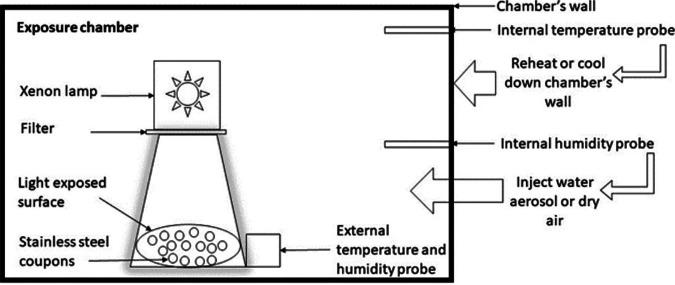
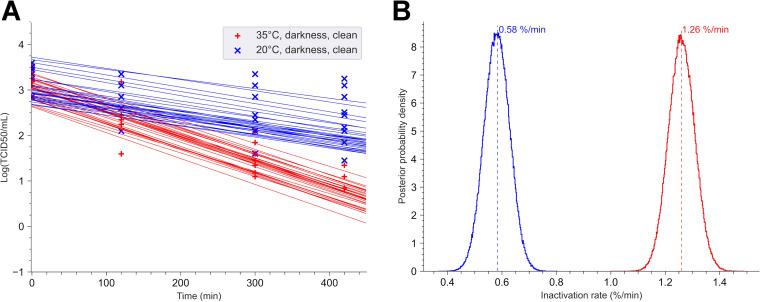
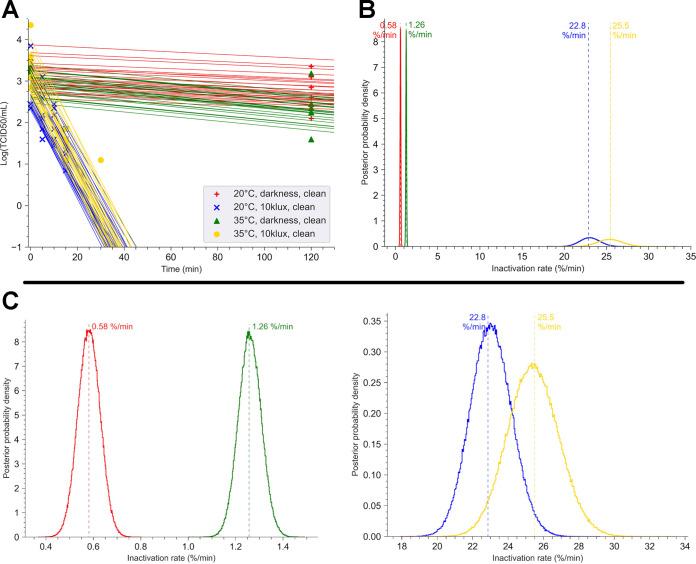
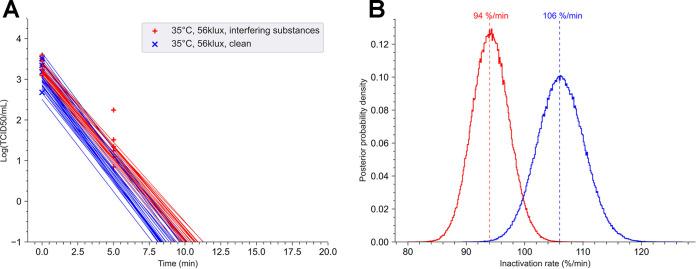
We studied the stability of severe acute respiratory syndrome coronavirus 2 (SARS-CoV-2) under different simulated outdoor conditions by changing the temperature (20°C and 35°C), the illuminance (darkness, 10 klx, and 56 klx), and/or the cleanness of the surfaces at 50% relative humidity (RH). In darkness, the loss of viability of the virus on stainless steel is temperature dependent, but this is hidden by the effect of the sunlight from the first minutes of exposure. The virus shows a sensitivity to sunlight proportional to the illuminance intensity of the sunlight. The presence of interfering substances has a moderate effect on virus viability even with an elevated illuminance. Thus, SARS-CoV-2 is rapidly inactivated by simulated sunlight in the presence or absence of high levels of interfering substances at 20°C or 35°C and 50% relative humidity. Clinical matrix contains high levels of interfering substances. This study is the first to reveal that the presence of high levels of interfering substances had little impact on the persistence of SARS-CoV-2 on stainless steel following exposure to simulated sunlight. Thus, SARS-CoV-2 should be rapidly inactivated in outdoor environments in the presence or absence of interfering substances. Our results indicate that transmission of SARS-CoV-2 is unlikely to occur through outdoor surfaces, dependent on illuminance intensity. Moreover, most studies are interested in lineage S of SARS-CoV-2. In our experiments, we studied the stability of L-type strains, which comprise the majority of strains isolated from worldwide patients. Nevertheless, the effect of sunlight seems to be similar regardless of the strain studied, suggesting that the greater spread of certain variants is not correlated with better survival in outdoor conditions.
我们通过改变温度(20°C 和 35°C)、光照度(黑暗、10 klx 和 56 klx)和/或 50%相对湿度(RH)下表面的清洁度,研究了严重急性呼吸综合征冠状病毒 2(SARS-CoV-2)在不同模拟户外条件下的稳定性。在黑暗中,病毒在不锈钢上的生存能力随温度而变化,但这种变化被暴露后最初几分钟的阳光效应所掩盖。病毒对阳光的敏感性与阳光的光照度强度成正比。即使在高照度下,存在干扰物质对病毒生存能力也有适度的影响。因此,SARS-CoV-2 在 20°C 或 35°C 和 50%相对湿度下,在存在或不存在高水平干扰物质的情况下,通过模拟阳光迅速失活。临床基质含有高水平的干扰物质。这项研究首次揭示,在暴露于模拟阳光后,即使存在高水平的干扰物质,临床基质对 SARS-CoV-2 在不锈钢上的持久性影响也很小。因此,SARS-CoV-2 在存在或不存在干扰物质的情况下,应该在户外环境中迅速失活。我们的研究结果表明,SARS-CoV-2 通过户外表面传播的可能性不大,这取决于光照度强度。此外,大多数研究都对 SARS-CoV-2 的谱系 S 感兴趣。在我们的实验中,我们研究了 L 型株的稳定性,L 型株是从全球患者中分离出的大多数株。然而,无论研究的菌株如何,阳光的影响似乎是相似的,这表明某些变体的更大传播与户外条件下更好的生存能力无关。


 Zotero 插件