
在口咽和深部鼻拭子检测中增加唾液检测可提高基层医疗和儿童中SARS-CoV-2的PCR检测率。
Adding saliva testing to oropharyngeal and deep nasal swab testing increases PCR detection of SARS-CoV-2 in primary care and children.
作者信息
Oliver Jane, Tosif Shidan, Lee Lai-Yang, Costa Anna-Maria, Bartel Chelsea, Last Katherine, Clifford Vanessa, Daley Andrew, Allard Nicole, Orr Catherine, Nind Ashley, Alexander Karyn, Meagher Niamh, Sait Michelle, Ballard Susan A, Williams Eloise, Bond Katherine, Williamson Deborah A, Crawford Nigel W, Gibney Katherine B
机构信息
The Peter Doherty Institute for Infection and Immunity, University of Melbourne, Melbourne, VIC.
The Royal Children's Hospital, Melbourne, VIC.
出版信息
Med J Aust. 2021 Sep 20;215(6):273-278. doi: 10.5694/mja2.51188. Epub 2021 Jul 20.
OBJECTIVE
To compare the concordance and acceptability of saliva testing with standard-of-care oropharyngeal and bilateral deep nasal swab testing for severe acute respiratory syndrome coronavirus-2 (SARS-CoV-2) in children and in general practice.
DESIGN
Prospective multicentre diagnostic validation study.
SETTING
Royal Children's Hospital, and two general practices (cohealth, West Melbourne; Cirqit Health, Altona North) in Melbourne, July-October 2020.
PARTICIPANTS
1050 people who provided paired saliva and oropharyngeal-nasal swabs for SARS-CoV-2 testing.
MAIN OUTCOME MEASURES
Numbers of cases in which SARS-CoV-2 was detected in either specimen type by real-time polymerase chain reaction; concordance of results for paired specimens; positive percent agreement (PPA) for virus detection, by specimen type.
RESULTS
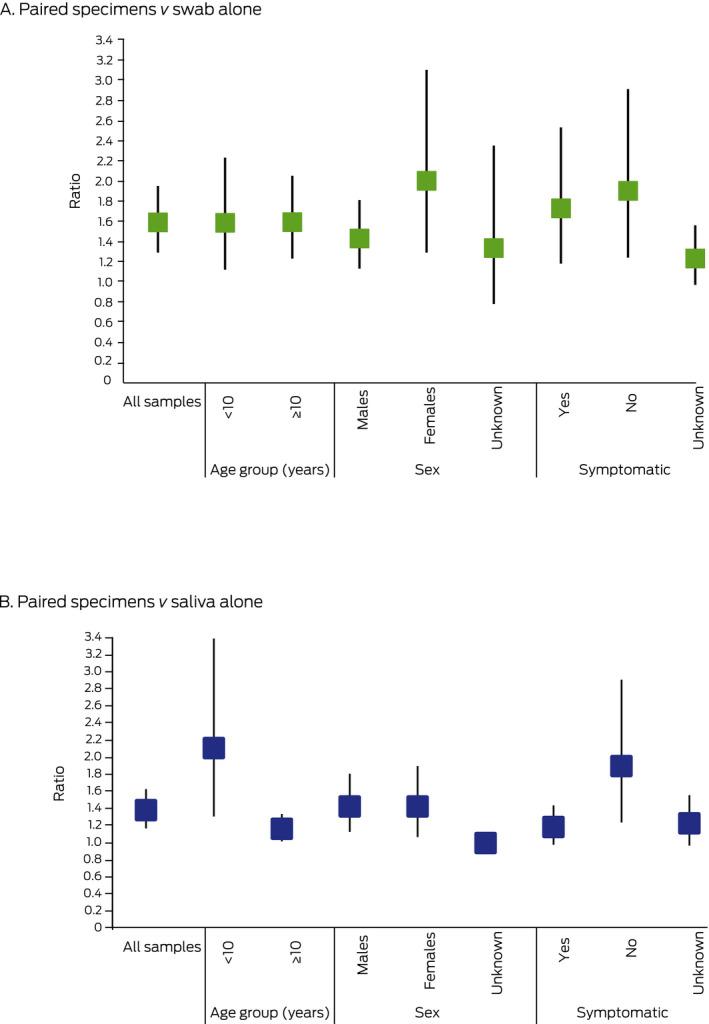
SARS-CoV-2 was detected in 54 of 1050 people with assessable specimens (5%), including 19 cases (35%) in which both specimens were positive. The overall PPA was 72% (95% CI, 58-84%) for saliva and 63% (95% CI, 49-76%) for oropharyngeal-nasal swabs. For the 35 positive specimens from people aged 10 years or more, PPA was 86% (95% CI, 70-95%) for saliva and 63% (95% CI, 45-79%) for oropharyngeal-nasal swabs. Adding saliva testing to standard-of-care oropharyngeal-nasal swab testing increased overall case detection by 59% (95% CI, 29-95%). Providing saliva was preferred to an oropharyngeal-nasal swab by most participants (75%), including 141 of 153 children under 10 years of age (92%).
CONCLUSION
In children over 10 years of age and adults, saliva testing alone may be suitable for SARS-CoV-2 detection, while for children under 10, saliva testing may be suitable as an adjunct to oropharyngeal-nasal swab testing for increasing case detection.
目的
比较唾液检测与标准护理口咽及双侧深部鼻拭子检测在儿童和全科医疗中对严重急性呼吸综合征冠状病毒2(SARS-CoV-2)检测的一致性和可接受性。
设计
前瞻性多中心诊断验证研究。
地点
2020年7月至10月,墨尔本皇家儿童医院以及两家全科医疗机构(西墨尔本的cohealth;阿尔托纳北的Cirqit Health)。
参与者
1050名提供了用于SARS-CoV-2检测的配对唾液和口咽-鼻拭子的人员。
主要观察指标
通过实时聚合酶链反应在任一标本类型中检测到SARS-CoV-2的病例数;配对标本结果的一致性;按标本类型划分的病毒检测阳性百分比一致性(PPA)。
结果
在1050名有可评估标本的人员中,有54人(5%)检测到SARS-CoV-2,其中19例(35%)两种标本均为阳性。唾液检测的总体PPA为72%(95%CI,58 - 84%),口咽-鼻拭子检测的总体PPA为63%(95%CI,49 - 76%)。对于35份来自10岁及以上人群的阳性标本,唾液检测的PPA为86%(95%CI,70 - 95%),口咽-鼻拭子检测的PPA为63%(95%CI,45 - 79%)。在标准护理口咽-鼻拭子检测中增加唾液检测使总体病例检出率提高了59%(95%CI, 29 - 95%)。大多数参与者(75%)更倾向于提供唾液而非口咽-鼻拭子,其中153名10岁以下儿童中有141名(92%)也是如此。
结论
在10岁以上儿童和成人中,单独进行唾液检测可能适合SARS-CoV-2检测,而对于10岁以下儿童,唾液检测作为口咽-鼻拭子检测的辅助手段可能适合用于提高病例检出率。
 Zotero 插件