
智能睡眠实验:大规模媒体公民科学运动后夜间智能手机行为变化的评估。
The SmartSleep Experiment: Evaluation of changes in night-time smartphone behavior following a mass media citizen science campaign.
机构信息
Section of Epidemiology, Department of Public Health, University of Copenhagen, Copenhagen, Denmark.
出版信息
PLoS One. 2021 Jul 21;16(7):e0253783. doi: 10.1371/journal.pone.0253783. eCollection 2021.
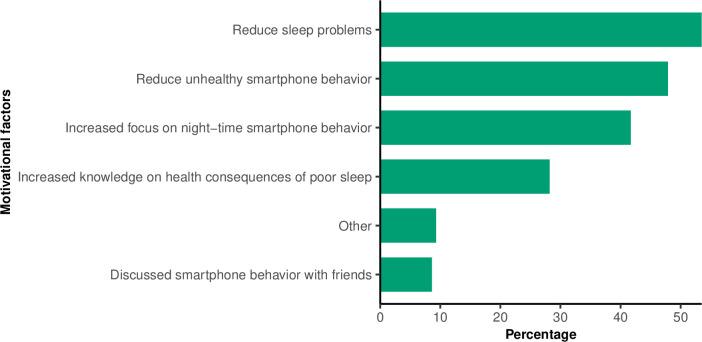
The increasing 24-hour smartphone use is of public health concern. This study aims to evaluate whether a massive public focus on sleep and smartphone use generated through a large-scale citizen science project, the SmartSleep Experiment, influence participants' night-time smartphone behavior. A total of 8,894 Danish adults aged 16 and above participated in the SmartSleep Experiment, a web-based survey on smartphones and sleep behavior. The survey was carried out for one week in 2018, combined with an extensive national mass media campaign focusing on smartphone behaviors and sleep. A follow-up survey aimed at evaluating whether survey-participants had changed their night-time smartphone behavior was carried out two weeks after the campaign. A total of 15% of the participants who used their smartphone during sleep hours at baseline had changed their night-time smartphone behavior, and 83% of those indicated that they used their smartphone less at follow-up. The participants who had changed their smartphone behavior had primarily taken active precautions to avoid night-time smartphone use, e.g., activating silent mode (36%) or reduced their smartphone use before (50%) and during sleep hours (52%). The reduction in sleep problems (54%), recognition of poor smartphone behavior (48%), and the increased focus on night-time smartphone use (42%) were motivational factors for these behavior changes. Using citizen science and mass media appeared to be associated with changes in night-time smartphone behavior. Public health projects may benefit from combining citizen science with other interventional approaches.
智能手机 24 小时使用量的不断增加引起了公众的健康关注。本研究旨在评估通过大规模公民科学项目“SmartSleep 实验”对睡眠和智能手机使用进行大规模公众关注是否会影响参与者夜间智能手机行为。共有 8894 名丹麦 16 岁及以上的成年人参加了 SmartSleep 实验,这是一项关于智能手机和睡眠行为的在线调查。该调查于 2018 年进行了一周,同时还开展了一项广泛的全国大众媒体运动,重点关注智能手机行为和睡眠。两周后进行了一项后续调查,旨在评估调查参与者是否改变了夜间智能手机行为。在基线时在睡眠时间内使用智能手机的参与者中,有 15%改变了夜间智能手机行为,其中 83%表示在随访时使用智能手机的次数减少了。改变智能手机行为的参与者主要采取了积极的预防措施来避免夜间使用智能手机,例如启用静音模式(36%)或减少睡前(50%)和睡眠时间内(52%)使用智能手机。减少睡眠问题(54%)、认识到不良智能手机行为(48%)以及更加关注夜间智能手机使用(42%)是这些行为改变的动机因素。使用公民科学和大众媒体似乎与夜间智能手机行为的改变有关。公共卫生项目可能受益于将公民科学与其他干预方法结合使用。


 Zotero 插件