
[FOXC1基因敲低逆转非小细胞肺癌对吉非替尼的耐药性]
[FOXC1 Knockdown Reverses Gefitinib Resistance in Non-small Cell Lung Cancer].
作者信息
Peng Cong, Li Pan, Yang Mingqiang, Chen Danyang, Huang Yuanfeng
机构信息
Department of Pathology, Affiliated Cancer Hospital of Guangzhou Medical University, Guangzhou 510095, China.
Caner Research Institute, Affiliated Cancer Hospital of Guangzhou Medical University, Guangzhou 510095, China.
出版信息
Zhongguo Fei Ai Za Zhi. 2021 Aug 20;24(8):538-547. doi: 10.3779/j.issn.1009-3419.2021.103.11. Epub 2021 Aug 2.
BACKGROUND
Lung cancer is the malignant tumor with the highest incidence and mortality in China, among which non-small cell lung cancer (NSCLC) accounts for about 80%. Epidermal growth factor receptor-tyrosine kinase inhibitor (EGFR-TKI) targeted therapy has been playing an important role in treatment of NSCLC. However, unavoidable therapeutic resistance significantly limits the clinical efficacy of EGFR-TKI. As a key member of the forkhead box protein family, FOXC1 is aberrantly expressed in NSCLC and involved in NSCLC progression. The aim of this work is to investigate the effect and potential mechanism of FOXC1 on gefitinib resistance in NSCLC.
METHODS
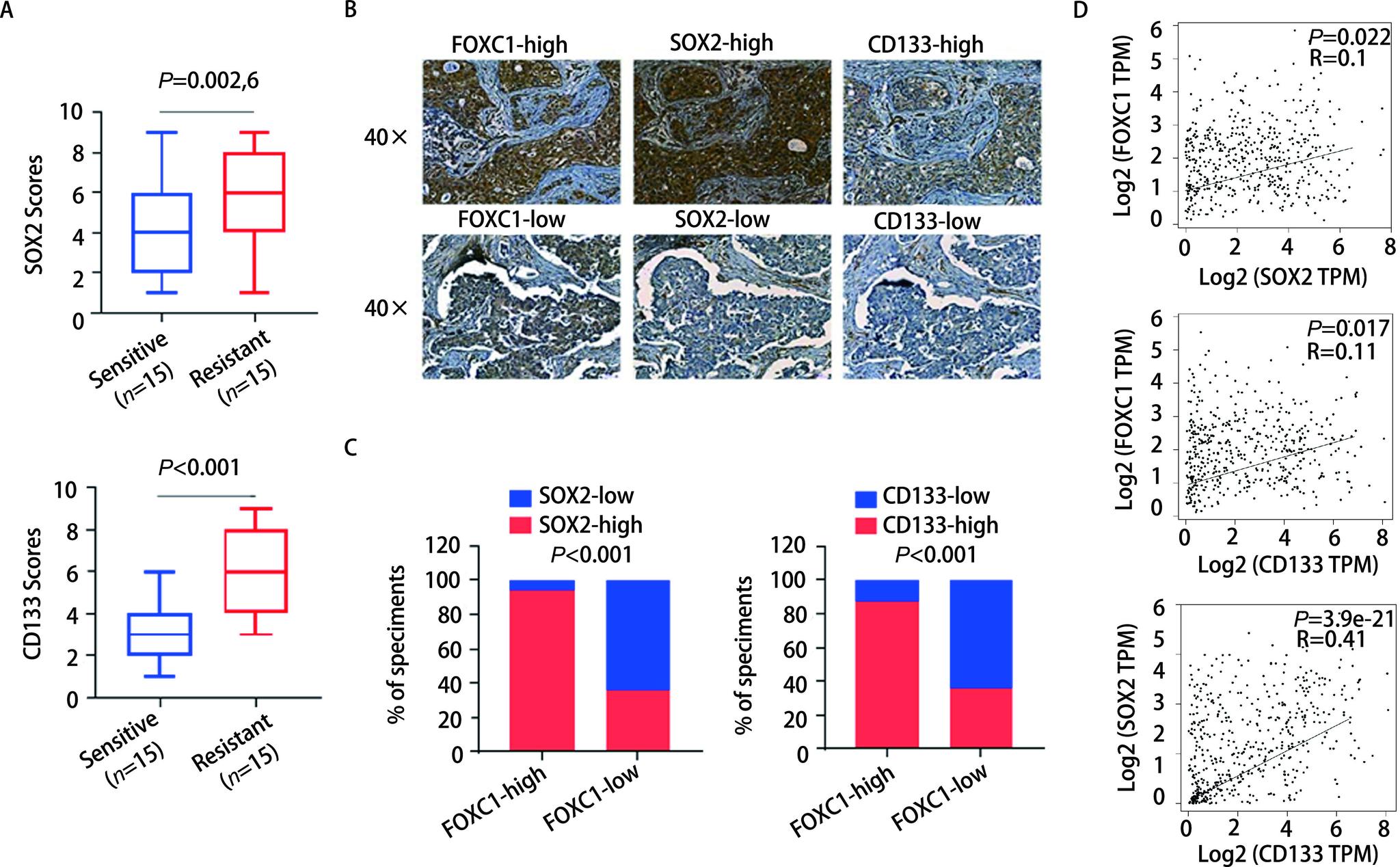
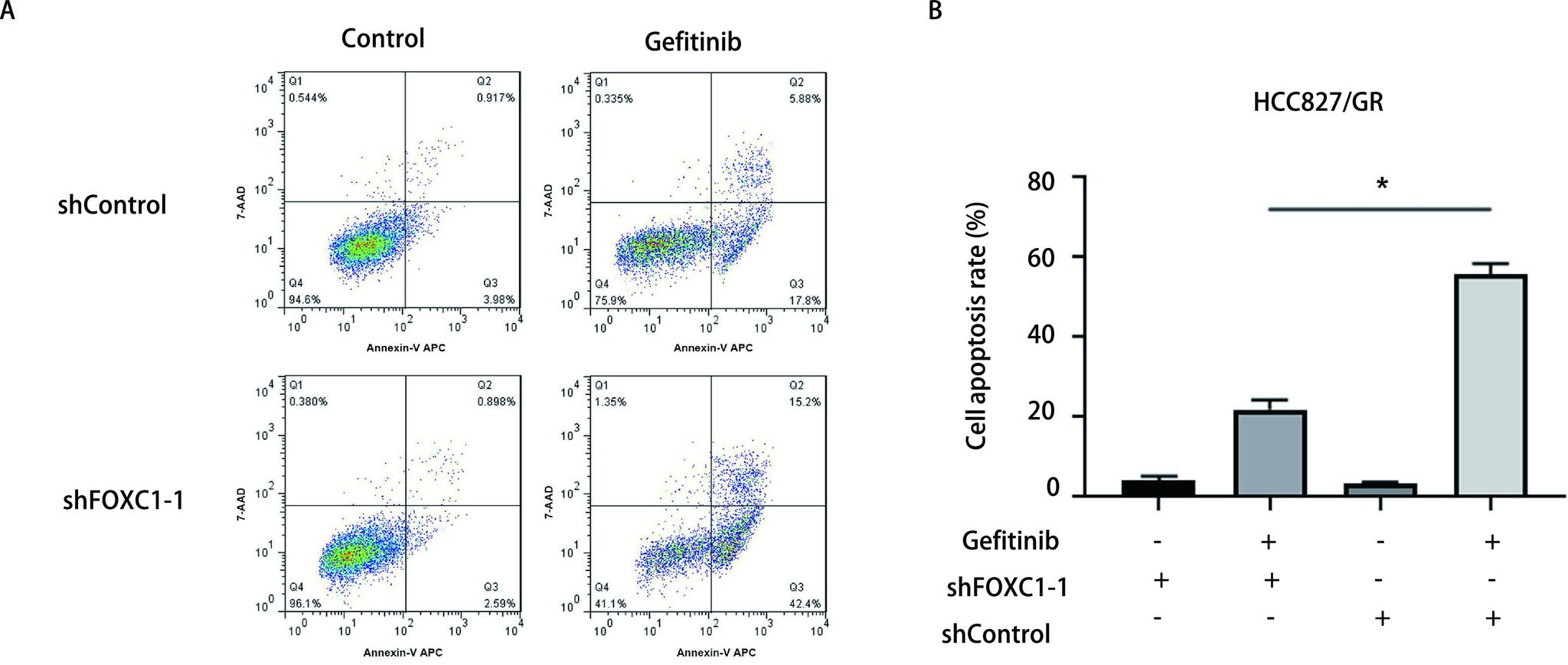
Western blot was performed to assess the expression of FOXC1 protein in HCC827/GR cells. Immunohistochemistry (IHC) assays were performed in human NSCLC tissues with gefitinib resistance. HCC827/GR cells were transfected with shRNA specifically targeting FOXC1 mRNA and stable cell lines were established. The effects of FOXC1 on cell viability and apoptosis were analyzed using a new methyl thiazolyl tetrazolium assay (MTS assay) and flow cytometry. Self-renewal ability was determined by mammosphere-formation analysis. Quantitative real-time PCR (qRT-PCR) and Western blot were employed to detect the expression of SOX2, Nanog, OCT4 and CD133. Flow cytometry analysis were further used to detect the level of CD133. IHC assays were used to detect the levels of SOX2 and CD133 in NSCLC tissues with genfitiinb resistance. Correlations of the expressions of FOXC1, CD133 and SOX2 with each other in lung adenocarcinoma samples were analyzed based on The Cancer Genome Atlas (TCGA) database.
RESULTS
The expression of FOXC1 is significantly increased in HCC827/GR cells compared with HCC827 cells (P<0.05). IHC results showed FOXC1 was highly expressed in NSCLC tissues with gefitinib resisitance. Knockdown of FOXC1 significantly increased the sensitivity of HCC827/GR cells to gefitinib. The cell viability was decreased and the apoptosis was promoted (P<0.05). Moreover, FOXC1 knockdown apparently inhibited the expression of SOX2 and CD133, and decreased the mammosphere-formation capacity in HCC827/GR cells. In NSCLC tissues with gefitinib resistance, the expressions of SOX2 and CD133 were significantly higher compared with gefitinib-sensitive tissues (P<0.01). Meanwhile, the expressions of FOXC1, CD133 and SOX2 with each other were positively correlated (P<0.05).
CONCLUSIONS
FOXC1 could increase gefitinib resitance in NSCLC, by which mechanism is related to the regulation of cancer stem cell properties.
背景
肺癌是我国发病率和死亡率最高的恶性肿瘤,其中非小细胞肺癌(NSCLC)约占80%。表皮生长因子受体-酪氨酸激酶抑制剂(EGFR-TKI)靶向治疗在NSCLC治疗中一直发挥着重要作用。然而,不可避免的治疗耐药性显著限制了EGFR-TKI的临床疗效。作为叉头框蛋白家族的关键成员,FOXC1在NSCLC中异常表达并参与NSCLC进展。本研究旨在探讨FOXC1对NSCLC吉非替尼耐药的影响及潜在机制。
方法
采用蛋白质免疫印迹法检测HCC827/GR细胞中FOXC1蛋白的表达。对吉非替尼耐药的人NSCLC组织进行免疫组织化学(IHC)检测。用特异性靶向FOXC1 mRNA的短发夹RNA(shRNA)转染HCC827/GR细胞,建立稳定细胞系。采用新型甲基噻唑基四氮唑蓝法(MTS法)和流式细胞术分析FOXC1对细胞活力和凋亡的影响。通过乳腺球形成分析确定自我更新能力。采用定量实时聚合酶链反应(qRT-PCR)和蛋白质免疫印迹法检测SOX2、Nanog、OCT4和CD133的表达。进一步用流式细胞术分析检测CD133水平。用IHC检测吉非替尼耐药NSCLC组织中SOX2和CD133水平。基于癌症基因组图谱(TCGA)数据库分析肺腺癌样本中FOXC1、CD133和SOX2表达之间的相关性。
结果
与HCC827细胞相比,HCC827/GR细胞中FOXC1的表达显著增加(P<0.05)。IHC结果显示,FOXC1在吉非替尼耐药的NSCLC组织中高表达。敲低FOXC1可显著增加HCC827/GR细胞对吉非替尼的敏感性。细胞活力降低,凋亡增加(P<0.05)。此外,敲低FOXC1明显抑制了HCC827/GR细胞中SOX2和CD133的表达,并降低了其乳腺球形成能力。在吉非替尼耐药的NSCLC组织中,SOX2和CD133的表达明显高于吉非替尼敏感组织(P<0.01)。同时,FOXC1、CD133和SOX2的表达之间呈正相关(P<0.05)。
结论
FOXC1可增加NSCLC对吉非替尼的耐药性,其机制与癌症干细胞特性的调控有关。




 Zotero 插件