
应用程序提供的、针对特定个体的自我管理支持对腰痛相关残疾的成年人的有效性:一项 selfBACK 随机临床试验。
Effectiveness of App-Delivered, Tailored Self-management Support for Adults With Lower Back Pain-Related Disability: A selfBACK Randomized Clinical Trial.
机构信息
Department of Sports Science and Clinical Biomechanics, University of Southern Denmark, Odense, Denmark.
Department of Computer Science, Norwegian University of Science and Technology, Trondheim, Norway.
出版信息
JAMA Intern Med. 2021 Oct 1;181(10):1288-1296. doi: 10.1001/jamainternmed.2021.4097.
IMPORTANCE
Lower back pain (LBP) is a prevalent and challenging condition in primary care. The effectiveness of an individually tailored self-management support tool delivered via a smartphone app has not been rigorously tested.
OBJECTIVE
To investigate the effectiveness of selfBACK, an evidence-based, individually tailored self-management support system delivered through an app as an adjunct to usual care for adults with LBP-related disability.
DESIGN, SETTING, AND PARTICIPANTS: This randomized clinical trial with an intention-to-treat data analysis enrolled eligible individuals who sought care for LBP in a primary care or an outpatient spine clinic in Denmark and Norway from March 8 to December 14, 2019. Participants were 18 years or older, had nonspecific LBP, scored 6 points or higher on the Roland-Morris Disability Questionnaire (RMDQ), and had a smartphone and access to email.
INTERVENTIONS
The selfBACK app provided weekly recommendations for physical activity, strength and flexibility exercises, and daily educational messages. Self-management recommendations were tailored to participant characteristics and symptoms. Usual care included advice or treatment offered to participants by their clinician.
MAIN OUTCOMES AND MEASURES
Primary outcome was the mean difference in RMDQ scores between the intervention group and control group at 3 months. Secondary outcomes included average and worst LBP intensity levels in the preceding week as measured on the numerical rating scale, ability to cope as assessed with the Pain Self-Efficacy Questionnaire, fear-avoidance belief as assessed by the Fear-Avoidance Beliefs Questionnaire, cognitive and emotional representations of illness as assessed by the Brief Illness Perception Questionnaire, health-related quality of life as assessed by the EuroQol-5 Dimension questionnaire, physical activity level as assessed by the Saltin-Grimby Physical Activity Level Scale, and overall improvement as assessed by the Global Perceived Effect scale. Outcomes were measured at baseline, 6 weeks, 3 months, 6 months, and 9 months.
RESULTS
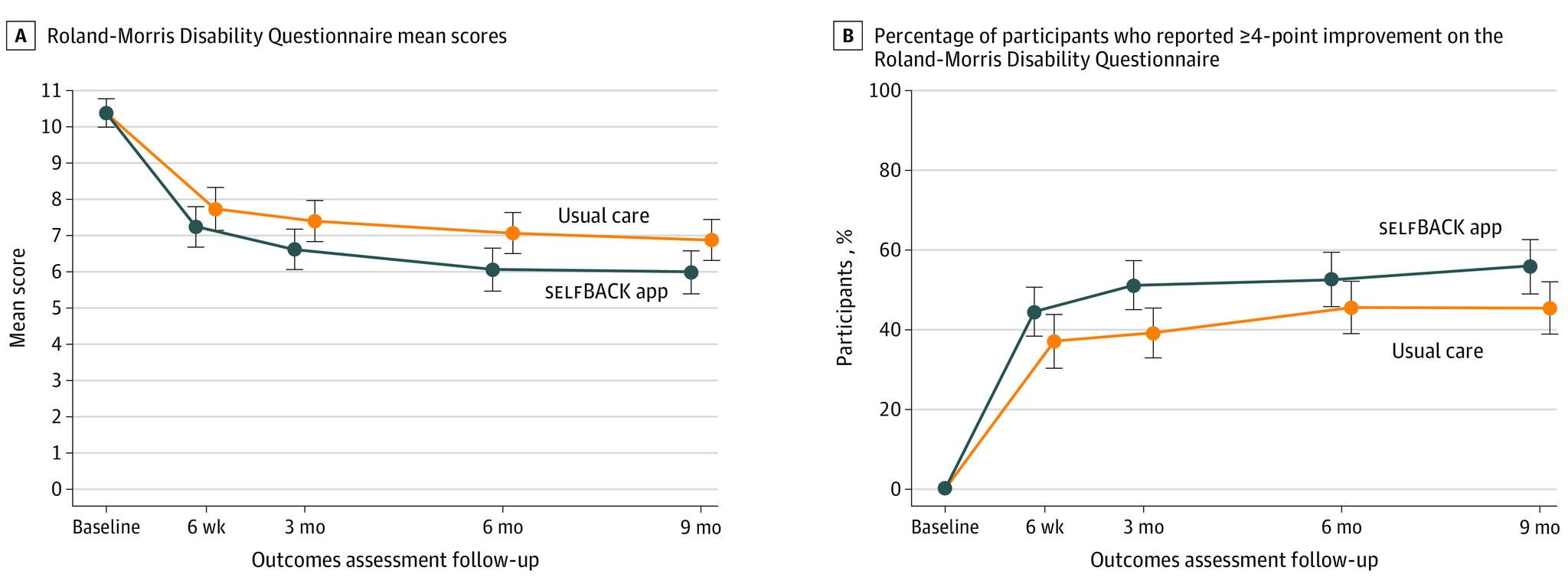
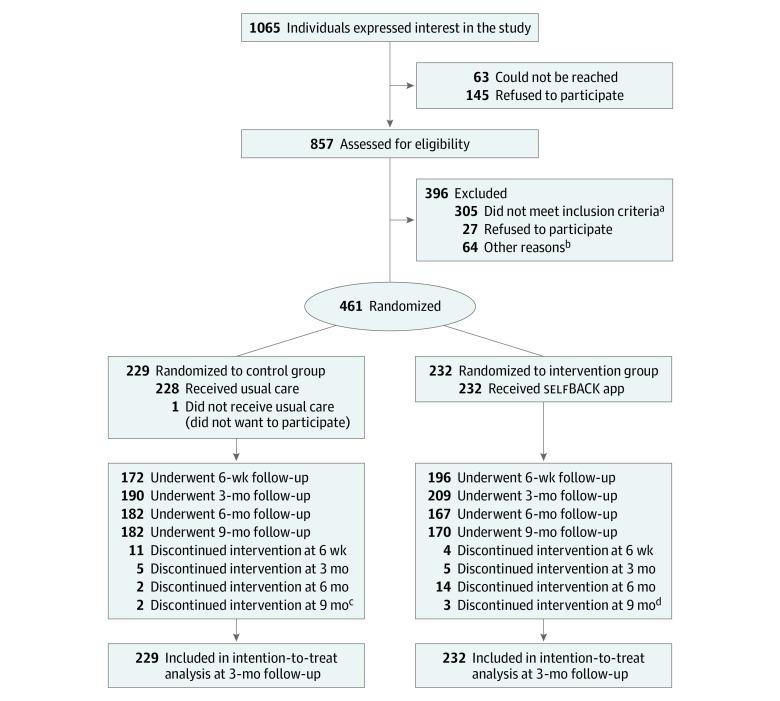
A total of 461 participants were included in the analysis; the population had a mean [SD] age of 47.5 [14.7] years and included 255 women (55%). Of these participants, 232 were randomized to the intervention group and 229 to the control group. By the 3-month follow-up, 399 participants (87%) had completed the trial. The adjusted mean difference in RMDQ score between the 2 groups at 3 months was 0.79 (95% CI, 0.06-1.51; P = .03), favoring the selfBACK intervention. The percentage of participants who reported a score improvement of at least 4 points on the RMDQ was 52% in the intervention group vs 39% in the control group (adjusted odds ratio, 1.76; 95% CI, 1.15-2.70; P = .01).
CONCLUSIONS AND RELEVANCE
Among adults who sought care for LBP in a primary care or an outpatient spine clinic, those who used the selfBACK system as an adjunct to usual care had reduced pain-related disability at 3 months. The improvement in pain-related disability was small and of uncertain clinical significance. Process evaluation may provide insights into refining the selfBACK app to increase its effectiveness.
TRIAL REGISTRATION
ClinicalTrials.gov Identifier: NCT03798288.
重要性
下腰痛(LBP)是初级保健中普遍存在且具有挑战性的病症。尚未经过严格测试将个性化量身定制的自我管理支持工具通过智能手机应用程序提供的有效性。
目的
研究 selfBACK 的有效性,selfBACK 是一种基于证据的个性化量身定制的自我管理支持系统,通过应用程序作为患有与 LBP 相关的残疾的成年人的常规护理的辅助手段。
设计、地点和参与者:这是一项随机临床试验,意向治疗数据分析纳入了 2019 年 3 月 8 日至 12 月 14 日在丹麦和挪威的初级保健或门诊脊柱诊所寻求 LBP 治疗的合格个体。参与者年龄在 18 岁或以上,患有非特异性 LBP,Roland-Morris 残疾问卷(RMDQ)得分为 6 分或更高,并且拥有智能手机并可以访问电子邮件。
干预措施
selfBACK 应用程序每周提供有关体育活动、力量和灵活性练习以及日常教育信息的建议。自我管理建议根据参与者的特征和症状量身定制。常规护理包括临床医生为参与者提供的建议或治疗。
主要结果和措施
主要结果是干预组和对照组在 3 个月时 RMDQ 评分的平均差异。次要结果包括前一周用数字评分量表测量的平均和最差 LBP 强度水平、用疼痛自我效能问卷评估的应对能力、用恐惧-回避信念问卷评估的恐惧-回避信念、用简要疾病感知问卷评估的认知和情绪疾病表现、用 EuroQol-5 维度问卷评估的健康相关生活质量、用 Saltin-Grimby 体力活动水平量表评估的体力活动水平以及用全球感知效果量表评估的整体改善。结果在基线、6 周、3 个月、6 个月和 9 个月时进行测量。
结果
共有 461 名参与者纳入分析;该人群的平均[标准差]年龄为 47.5[14.7]岁,包括 255 名女性(55%)。这些参与者中,232 人被随机分配到干预组,229 人被分配到对照组。在 3 个月的随访中,399 名参与者(87%)完成了试验。两组在 3 个月时 RMDQ 评分的调整平均差异为 0.79(95%置信区间,0.06-1.51;P=0.03),有利于 selfBACK 干预。在 RMDQ 上报告至少 4 分改善的参与者比例,干预组为 52%,对照组为 39%(调整优势比,1.76;95%置信区间,1.15-2.70;P=0.01)。
结论和相关性
在初级保健或门诊脊柱诊所寻求 LBP 治疗的成年人中,那些将 selfBACK 系统作为常规护理的辅助手段的人在 3 个月时疼痛相关残疾得到了改善。疼痛相关残疾的改善很小,临床意义不确定。过程评估可能提供有关改进 selfBACK 应用程序以提高其有效性的见解。
试验注册
ClinicalTrials.gov 标识符:NCT03798288。
 Zotero 插件