
疼痛时长和强度对应用程序自我管理治疗腰痛(selfBACK)有效性的作用:一项随机对照试验的二次分析。
The Role of Pain Duration and Pain Intensity on the Effectiveness of App-Delivered Self-Management for Low Back Pain (selfBACK): Secondary Analysis of a Randomized Controlled Trial.
机构信息
Department of Neuromedicine and Movement Science, Norwegian University of Science and Technology, Trondheim, Norway.
Department of Physical Medicine and Rehabilitation, Trondheim University Hospital, Trondheim, Norway.
出版信息
JMIR Mhealth Uhealth. 2023 Aug 31;11:e40422. doi: 10.2196/40422.
BACKGROUND
Clinical guidelines for nonspecific low back pain (LBP) recommend self-management tailored to individual needs and capabilities as a first-line treatment. Mobile health solutions are a promising method for delivering tailored self-management interventions to patients with nonspecific LBP. However, it is not clear if the effectiveness of such self-management interventions depends on patients' initial pain characteristics. High pain intensity and long-term symptoms of LBP have been associated with an unfavorable prognosis, and current best evidence indicates that long-term LBP (lasting more than 3 months) requires a more extensive treatment approach compared to more acute LBP. The artificial intelligence-based selfBACK app supports tailored and evidence-based self-management of nonspecific LBP. In a recent randomized controlled trial, we showed that individuals who received the selfBACK app in addition to usual care had lower LBP-related disability at the 3-month follow-up compared to those who received usual care only. This effect was sustained at 6 and 9 months.
OBJECTIVE
This study aims to explore if the baseline duration and intensity of LBP influence the effectiveness of the selfBACK intervention in a secondary analysis of the selfBACK randomized controlled trial.
METHODS
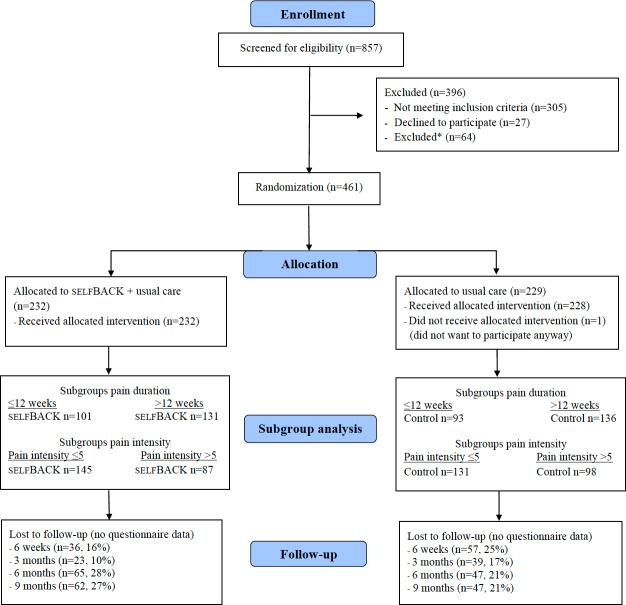
In the selfBACK trial, 461 adults (18 years or older) who sought care for nonspecific LBP in primary care or at an outpatient spine clinic were randomized to receive the selfBACK intervention adjunct to usual care (n=232) or usual care alone (n=229). In this secondary analysis, the participants were stratified according to the duration of the current LBP episode at baseline (≤12 weeks vs >12 weeks) or baseline LBP intensity (≤5 points vs >5 points) measured by a 0-10 numeric rating scale. The outcomes were LBP-related disability measured by the Roland-Morris Disability Questionnaire (0- to 24-point scale), average LBP intensity, pain self-efficacy, and global perceived effect. To assess whether the duration and intensity of LBP influenced the effect of selfBACK, we estimated the difference in treatment effect between the strata at the 3- and 9-month follow-ups with a 95% CI.
RESULTS
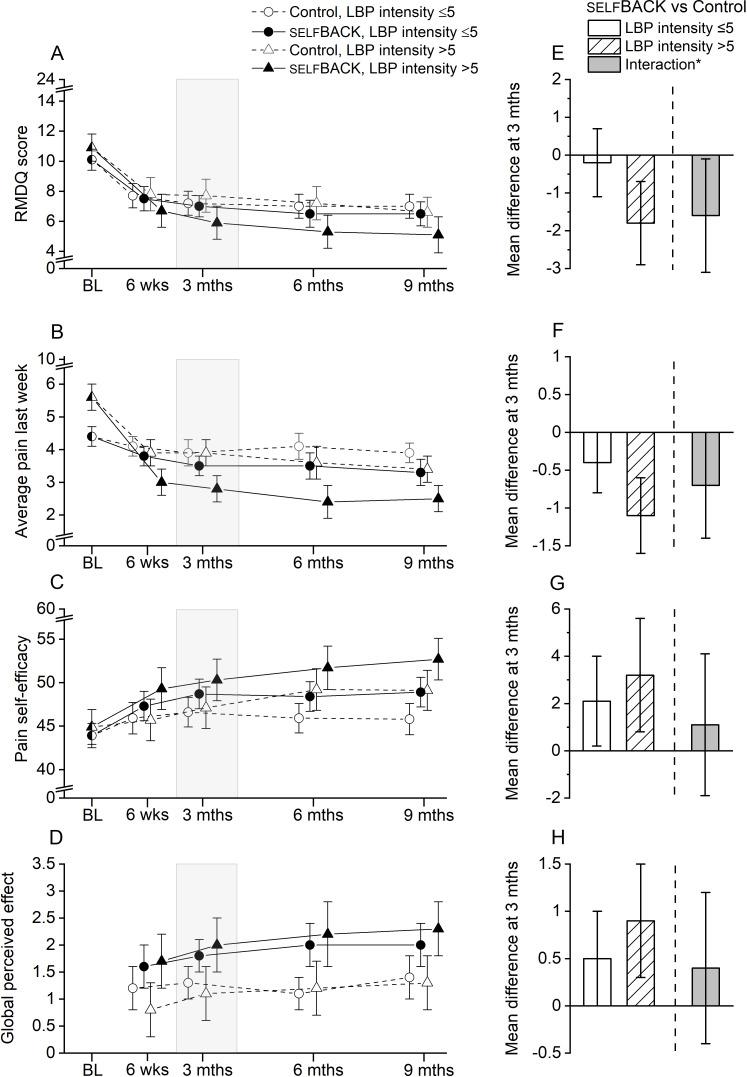
Overall, there was no difference in effect for patients with different durations or intensities of LBP at either the 3- or 9-month follow-ups. However, there was suggestive evidence that the effect of the selfBACK intervention on LBP-related disability at the 3-month follow-up was largely confined to people with the highest versus the lowest LBP intensity (mean difference between the intervention and control group -1.8, 95% CI -3.0 to -0.7 vs 0.2, 95% CI -1.1 to 0.7), but this was not sustained at the 9-month follow-up.
CONCLUSIONS
The results suggest that the intensity and duration of LBP have negligible influence on the effectiveness of the selfBACK intervention on LBP-related disability, average LBP intensity, pain self-efficacy, and global perceived effect.
背景
针对非特异性下腰痛(LBP)的临床指南建议根据个体需求和能力进行自我管理,作为一线治疗方法。移动健康解决方案是向非特异性 LBP 患者提供量身定制的自我管理干预措施的一种有前途的方法。然而,目前尚不清楚这种自我管理干预措施的效果是否取决于患者的初始疼痛特征。高疼痛强度和长期的 LBP 症状与预后不良有关,目前的最佳证据表明,与更急性的 LBP 相比,长期的 LBP(持续超过 3 个月)需要更广泛的治疗方法。基于人工智能的自我 BACK 应用程序支持非特异性 LBP 的量身定制和基于证据的自我管理。在最近的一项随机对照试验中,我们表明,与仅接受常规护理的患者相比,接受自我 BACK 应用程序加常规护理的患者在 3 个月随访时 LBP 相关残疾程度较低。这种效果在 6 个月和 9 个月时仍然存在。
目的
本研究旨在通过自我 BACK 随机对照试验的二次分析,探讨 LBP 的基线持续时间和强度是否会影响自我 BACK 干预的效果。
方法
在自我 BACK 试验中,461 名(18 岁或以上)因非特异性 LBP 到初级保健或门诊脊柱诊所就诊的成年人被随机分配接受自我 BACK 干预加常规护理(n=232)或仅常规护理(n=229)。在这项二次分析中,根据基线时当前 LBP 发作的持续时间(≤12 周与>12 周)或基线时 LBP 强度(≤5 分与>5 分),参与者按分层。结果是用 Roland-Morris 残疾问卷(0-24 分)测量的 LBP 相关残疾、平均 LBP 强度、疼痛自我效能感和总体感知效果。为了评估 LBP 的持续时间和强度是否影响自我 BACK 的效果,我们使用 95%CI 估计了 3 个月和 9 个月随访时分层之间的治疗效果差异。
结果
总体而言,在 3 个月和 9 个月的随访中,LBP 持续时间或强度不同的患者的治疗效果没有差异。然而,有迹象表明,自我 BACK 干预对 3 个月随访时 LBP 相关残疾的影响主要局限于 LBP 强度最高与最低的人群(干预组与对照组之间的平均差异-1.8,95%CI-3.0 至-0.7 与 0.2,95%CI-1.1 至 0.7),但这种效果在 9 个月的随访中没有持续。
结论
结果表明,LBP 的强度和持续时间对自我 BACK 干预治疗 LBP 相关残疾、平均 LBP 强度、疼痛自我效能感和总体感知效果的效果几乎没有影响。

 Zotero 插件