
道路交通事故相关胸部创伤的流行病学和临床特征:5095 例住院胸部损伤患者的分析。
Epidemiological and clinical characteristics of road traffic crashes related thoracic traumas: analysis of 5095 hospitalized chest injury patients.
机构信息
Department of Thoracic Surgery, Zhongshan Hospital Qingpu Branch, Fudan University, 1158 East Parkway, Shanghai, 201700, China.
Department of Thoracic Surgery, Zhongshan Hospital Xuhui Branch, Fudan University, 966 Huaihai Road, Shanghai, 200032, China.
出版信息
J Cardiothorac Surg. 2021 Aug 4;16(1):220. doi: 10.1186/s13019-021-01599-4.
BACKGROUND
Road traffic crashes related (RTCR) chest traumas remain important global public health challenge. The impact of boosting market of automobile vehicles in China during last decade on thoracic injury needs to be defined. This study aimed to review and analyze the demographic and clinical characteristics of RTCR thoracic injuries in China.
METHODS
Clinical records of patients with thoracic trauma admitted to thoracic surgery department between January 2003 and June 2020 were retrospectively retrieved and reviewed. Patients' profiles and clinical characteristics were comparatively analyzed between road traffic crashes caused injury and other injury mechanisms, and in RTCR chest trauma patients before January 2011 (2003 group), and after January 2011 (2011 group), when is considered as the beginning year of Chinese household vehicle era.
RESULTS
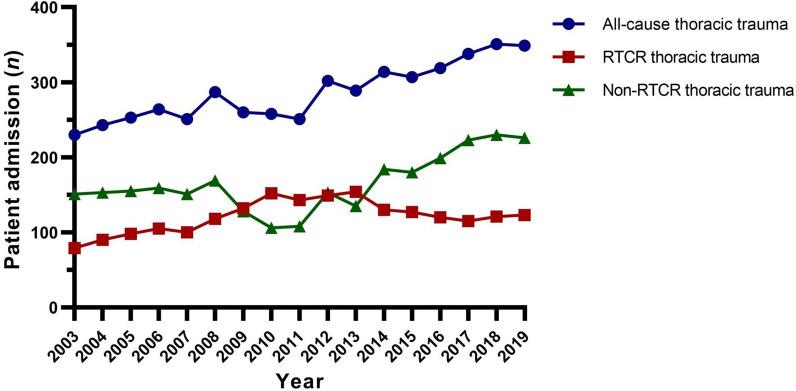
The study included 5095 thoracic trauma patients with mean age of 50.2 years, of whom 79.4% were male. Most of the patients (70.3%, n = 3583) had rib fractures. Associated injuries were present in 52.0% of the patients, of them 78.5% (n = 2080) were extremity fractures. Road traffic crashes accounted for 41.4% (n = 2108) of the injuries, most of them (98.0%) were related to motor vehicles. In comparison with other chest trauma mechanisms, RTCR chest injuries affected females and older males more frequently, with a higher incidence of rib fractures and sternum fractures, and higher injury severity scores (ISS) (all p < 0.05). Surgeries were required in 1495 (70.9%) patients of the RRTCR chest traumas, while the majority of non-RTCR thoracic injuries were managed conservatively or with tube thoracostomy (30.2%, n = 901). RTCR chest traumas caused longer hospital stay (13.0 ± 9.6 days vs. 11.8 ± 7.4 days, p = 0.001), higher ICU usage (30.7% vs. 19.6%, p = 0.001), higher rate of ventilator support (12.9% vs. 7.5%, p = 0.001), and higher mortalities (3.8% vs. 1.6%, p = 0.005) than that of non-RTRA chest injuries. For RTCR patients, when compared with 2003 group, 2011 group had similar patterns in terms of accident category, associated injury and treatment. However, 2011 group had more females (38.5% vs. 18.0%, p = 0.001) and older males (50.6 ± 9.7 vs. 47.9 ± 17.2, p = 0.001), with a higher ISS (18.3 ± 10.2 vs. 17.1 ± 8.9, p = 0.004), and fewer were managed with chest tubes (25.0% vs. 29.2%, p = 0.031). Clinical outcomes were not significantly different between the groups in terms of hospital length of stay, intensive care unit (ICU) usage, ICU length of stay, duration of ventilator hours and mortality. However, the 2011 group had more patients requiring ventilator support (14.4% vs. 10.6%, p = 0.011).
CONCLUSIONS
Road traffic crashes remain to be the major etiology of thoracic injuries in China, which usually affects middle-aged males, causing rib fractures with concomitant injuries frequently occurring to other organ systems. Treatments mainly include tube thoracotomy and surgical procedures. Although the clinical characteristics and outcomes of traffic accident related chest traumas are largely unchanged in spite of the rapid increasing numbers of motor vehicles, variations in the pattern of injuries by gender, age, injury severity and ventilator usage may still provide important information for targeted management.
背景
道路交通相关胸部创伤仍然是全球重要的公共卫生挑战。在中国,过去十年汽车市场的增长对胸部创伤的影响需要加以确定。本研究旨在回顾和分析中国道路交通相关胸部创伤的人口统计学和临床特征。
方法
回顾性检索 2003 年 1 月至 2020 年 6 月胸外科收治的胸部创伤患者的临床记录。比较分析道路交通碰撞伤与其他损伤机制、2011 年 1 月前(2003 组)和 2011 年 1 月后(2011 组)的患者特征和临床特征,2011 年被认为是中国家庭用车时代的开始年份。
结果
本研究纳入了 5095 例胸部创伤患者,平均年龄为 50.2 岁,其中 79.4%为男性。大多数患者(70.3%,n=3583)有肋骨骨折。52.0%的患者合并其他损伤,其中 78.5%(n=2080)为四肢骨折。道路交通碰撞伤占损伤的 41.4%(n=2108),其中 98.0%与机动车有关。与其他胸部创伤机制相比,道路交通相关胸部创伤更常影响女性和老年男性,其肋骨骨折和胸骨骨折发生率较高,损伤严重程度评分(ISS)较高(均 P<0.05)。2108 例道路交通相关胸部创伤患者中,1495 例(70.9%)需要手术治疗,而非道路交通相关胸部创伤患者多采用保守治疗或胸腔引流管治疗(30.2%,n=901)。道路交通相关胸部创伤患者的住院时间(13.0±9.6 天比 11.8±7.4 天,P=0.001)、ICU 使用率(30.7%比 19.6%,P=0.001)、呼吸机使用率(12.9%比 7.5%,P=0.001)和死亡率(3.8%比 1.6%,P=0.005)均高于非道路交通相关胸部创伤患者。对于道路交通相关胸部创伤患者,与 2003 组相比,2011 组在事故类别、合并伤和治疗方面具有相似的模式。然而,2011 组女性患者(38.5%比 18.0%,P=0.001)和老年男性患者(50.6±9.7 岁比 47.9±17.2 岁,P=0.001)更多,ISS 更高(18.3±10.2 比 17.1±8.9,P=0.004),胸腔引流管治疗更少(25.0%比 29.2%,P=0.031)。两组患者在住院时间、ICU 使用率、ICU 住院时间、呼吸机使用时间和死亡率方面的临床结局无显著差异。然而,2011 组需要呼吸机支持的患者更多(14.4%比 10.6%,P=0.011)。
结论
道路交通碰撞仍然是中国胸部创伤的主要病因,通常影响中年男性,常伴有其他器官系统的肋骨骨折和合并伤。治疗主要包括胸腔引流和手术治疗。尽管机动车数量迅速增加,但道路交通相关胸部创伤的临床特征和结局基本不变,但性别、年龄、损伤严重程度和呼吸机使用等方面的损伤模式变化可能仍为有针对性的管理提供重要信息。
 Zotero 插件