
衰老与 COVID-19 易感性、疾病严重程度和临床结局:纠缠风险因素的作用。
Aging & COVID-19 susceptibility, disease severity, and clinical outcomes: The role of entangled risk factors.
机构信息
School of Medicine, Tehran University of Medical Sciences, Tehran, Iran.
School of Medicine, Tehran University of Medical Sciences, Tehran, Iran; NeuroImaging Network (NIN), Universal Scientific Education and Research Network (USERN), Tehran, Iran.
出版信息
Exp Gerontol. 2021 Oct 15;154:111507. doi: 10.1016/j.exger.2021.111507. Epub 2021 Aug 3.
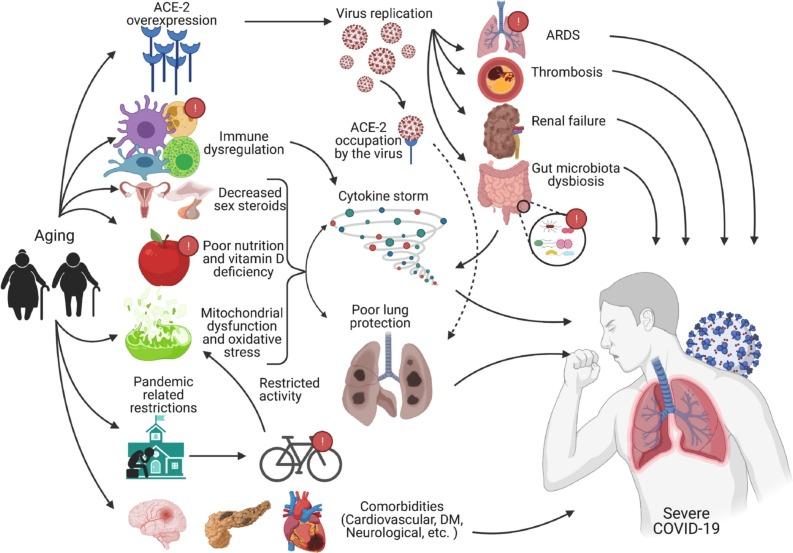
The emergence of Severe Acute Respiratory Syndrome Corona Virus 2 (SARS-CoV-2) in late 2019 has been associated with a high rate of mortality and morbidity. It has been determined that the old population are not only at an increased risk for affliction with COVID-19 infection, but also atypical presentations, severe forms of the disease, and mortality are more common in this population. A plethora of mechanisms and risk factors contribute to the higher risk of infection in the old population. For instance, aging is associated with an increment in the expression of Angiotensin-Converting Enzyme-2 (ACE-2), the receptor for SARS-CoV-2 spike protein, which precipitates replication of the virus in the old population. On the other hand, immune dysregulation and changes in gut microbiota as a result of aging can contribute to the cytokine storm, one of the main indicators of disease severity. Decrement in sex steroids, especially in women, as well as growth hormone, both of which have crucial roles in immune regulation, is a key contributor to disease severity in old age. Senescence-associated oxidative stress and mitochondrial dysfunction in both pneumocytes and immune cells contribute to the severity of infection in an exacerbative manner. In addition, lifestyle-associated factors such as nutrition and physical activity, which are compromised in old age, are known as important factors in COVID-19 infection. Aging-associated comorbidities, especially cardiovascular diseases and diabetes mellitus, also put older adults at an increased risk of complications, and disease severity.
严重急性呼吸综合征冠状病毒 2 (SARS-CoV-2) 于 2019 年末出现,其死亡率和发病率都很高。据确定,老年人不仅更容易感染 COVID-19,而且在该人群中,疾病的非典型表现、严重形式和死亡率更为常见。大量的机制和风险因素导致老年人感染的风险更高。例如,衰老与血管紧张素转换酶 2 (ACE-2) 的表达增加有关,ACE-2 是 SARS-CoV-2 刺突蛋白的受体,这会促使病毒在老年人群中复制。另一方面,衰老导致免疫失调和肠道微生物群的变化,这可能导致细胞因子风暴,这是疾病严重程度的主要指标之一。性激素的减少,尤其是女性,以及生长激素的减少,这两者在免疫调节中都起着至关重要的作用,是导致老年人疾病严重程度的关键因素。肺泡细胞和免疫细胞中与衰老相关的氧化应激和线粒体功能障碍以加重的方式导致感染的严重程度增加。此外,与生活方式相关的因素,如营养和身体活动,在老年人中受到损害,这些因素被认为是 COVID-19 感染的重要因素。与衰老相关的合并症,特别是心血管疾病和糖尿病,也使老年人面临更高的并发症和疾病严重程度风险。
 Zotero 插件