
癌症中的 CD8 T 细胞耗竭。
CD8 T Cell Exhaustion in Cancer.
机构信息
Cancer Immunology Discovery, Pfizer, San Diego, CA, United States.
出版信息
Front Immunol. 2021 Jul 20;12:715234. doi: 10.3389/fimmu.2021.715234. eCollection 2021.
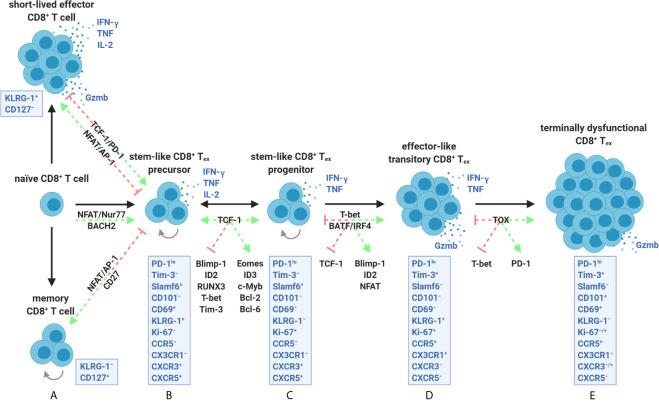
A paradigm shift in the understanding of the exhausted CD8 T cell (T) lineage is underway. Originally thought to be a uniform population that progressively loses effector function in response to persistent antigen, single-cell analysis has now revealed that CD8 T is composed of multiple interconnected subpopulations. The heterogeneity within the CD8 T lineage is comprised of immune checkpoint blockade (ICB) permissive and refractory subsets termed stem-like and terminally differentiated cells, respectively. These populations occupy distinct peripheral and intratumoral niches and are characterized by transcriptional processes that govern transitions between cell states. This review presents key findings in the field to construct an updated view of the spatial, transcriptional, and functional heterogeneity of anti-tumoral CD8 T. These emerging insights broadly call for (re-)focusing cancer immunotherapies to center on the driver mechanism(s) underlying the CD8 T developmental continuum aimed at stabilizing functional subsets.
衰竭的 CD8 T 细胞(T)谱系的理解正在发生范式转变。最初被认为是一个单一的群体,随着持续抗原的刺激,其效应功能逐渐丧失,但单细胞分析现在已经揭示,CD8 T 由多个相互关联的亚群组成。CD8 T 谱系内的异质性包括免疫检查点阻断(ICB)许可和耐药亚群,分别称为类干细胞样和终末分化细胞。这些群体占据不同的外周和肿瘤内生态位,并以转录过程为特征,这些转录过程控制着细胞状态之间的转变。这篇综述介绍了该领域的关键发现,以构建抗肿瘤 CD8 T 的空间、转录和功能异质性的最新观点。这些新出现的观点广泛呼吁(重新)将癌症免疫疗法的重点放在 CD8 T 发育连续体的驱动机制上,以稳定功能亚群。


 Zotero 插件