
稻壳二氧化硅液保护胰岛β细胞免受链脲佐菌素诱导的氧化损伤。
Rice Husk Silica Liquid Protects Pancreatic β Cells from Streptozotocin-Induced Oxidative Damage.
作者信息
Chen Hsin-Yuan, Chiang Yi-Fen, Wang Kai-Lee, Huang Tsui-Chin, Ali Mohamed, Shieh Tzong-Ming, Chang Hsin-Yi, Hong Yong-Han, Hsia Shih-Min
机构信息
School of Nutrition and Health Sciences, College of Nutrition, Taipei Medical University, Taipei 11031, Taiwan.
Department of Nutrition, I-Shou University, Kaohsiung 84001, Taiwan.
出版信息
Antioxidants (Basel). 2021 Jul 5;10(7):1080. doi: 10.3390/antiox10071080.
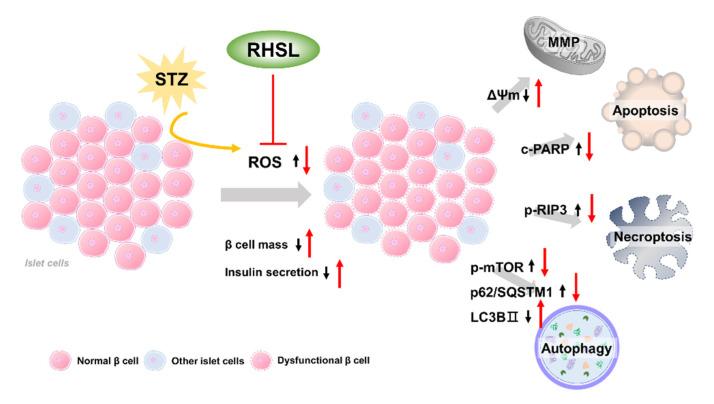
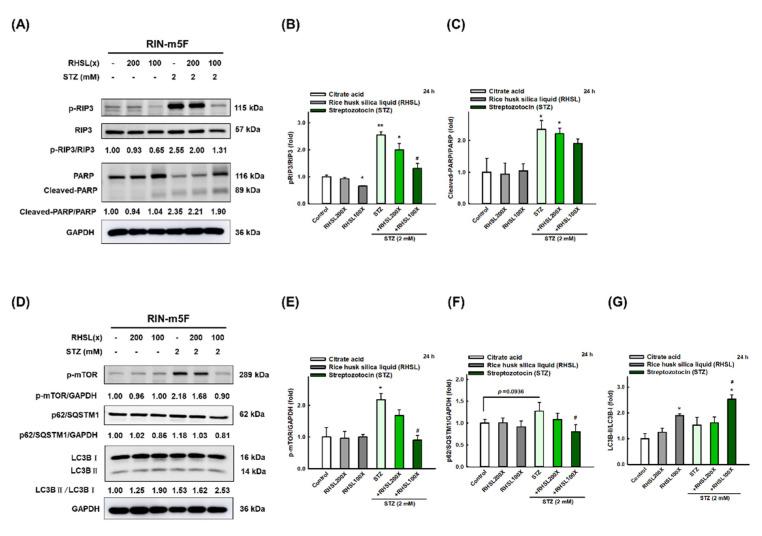
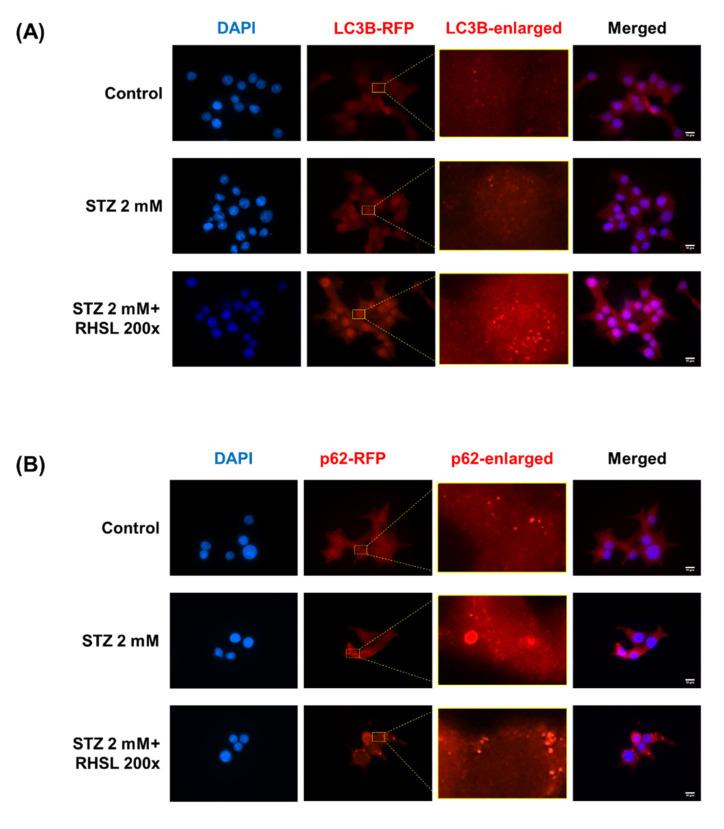
Type 2 diabetes mellitus is a complex multifactorial disease characterized by insulin resistance and dysfunction of pancreatic β-cells. Rice husk silica liquid (RHSL) is derived from rice husks and has not been explored in diabetes mellitus until now. Previous studies showed that rice husk is enriched with silica, and its silica nanoparticles are higher more biocompatible. To investigate the potential protective role of RHSL on pancreatic β cells, we utilized RIN-m5F pancreatic β cells and explored RHSL effect after streptozotocin (STZ)-stimulation. The recovery effects of RHSL were evaluated using flow cytometry, Western blotting, and immunofluorescence analysis. Results of our study showed that RHSL reversed the cell viability, insulin secretion, reactive oxygen species (ROS) production, and the change of mitochondria membrane potential (ΔΨm) in STZ-treated RIN-m5F cells. Moreover, the expression of phospho-receptor-interacting protein 3 (p-RIP3) and cleaved-poly (ADP-ribose) polymerase (PARP), phospho-mammalian target of rapamycin (p-mTOR), and sequestosome-1 (p62/SQSTM1) were significantly decreased, while the transition of light chain (LC)3-I to LC3-II was markedly increased after RHSL treatment in STZ-induced RIN-m5F cells. Interestingly, using autophagy inhibitors such as 3-methyladenine (3-MA) and chloroquine (CQ) both showed an increase in cleaved-PARP protein level, indicating apoptosis induction. Taken together, this study demonstrated that RHSL induced autophagy and alleviated STZ-induced ROS-mediated apoptosis in RIN-m5F cells.
2型糖尿病是一种复杂的多因素疾病,其特征为胰岛素抵抗和胰腺β细胞功能障碍。稻壳二氧化硅液体(RHSL)源自稻壳,迄今为止尚未在糖尿病研究中得到探索。先前的研究表明,稻壳富含二氧化硅,其二氧化硅纳米颗粒具有更高的生物相容性。为了研究RHSL对胰腺β细胞的潜在保护作用,我们使用了RIN-m5F胰腺β细胞,并探讨了链脲佐菌素(STZ)刺激后RHSL的作用。通过流式细胞术、蛋白质免疫印迹法和免疫荧光分析评估了RHSL的恢复效果。我们的研究结果表明,RHSL可逆转STZ处理的RIN-m5F细胞的细胞活力、胰岛素分泌、活性氧(ROS)产生以及线粒体膜电位(ΔΨm)的变化。此外,在STZ诱导的RIN-m5F细胞中,RHSL处理后磷酸化受体相互作用蛋白3(p-RIP3)和裂解的聚(ADP-核糖)聚合酶(PARP)、磷酸化哺乳动物雷帕霉素靶蛋白(p-mTOR)和sequestosome-1(p62/SQSTM1)的表达显著降低,而轻链(LC)3-I向LC3-II的转变明显增加。有趣的是,使用3-甲基腺嘌呤(3-MA)和氯喹(CQ)等自噬抑制剂均显示裂解的PARP蛋白水平升高,表明诱导了细胞凋亡。综上所述,本研究表明RHSL诱导自噬并减轻了STZ诱导的RIN-m5F细胞中ROS介导的细胞凋亡。



 Zotero 插件