
自然转化作为……中水平基因转移的一种机制
Natural Transformation as a Mechanism of Horizontal Gene Transfer in .
作者信息
Bonifácio Marina, Mateus Cristiana, Alves Ana R, Maldonado Emanuel, Duarte Ana P, Domingues Fernanda, Oleastro Mónica, Ferreira Susana
机构信息
CICS-UBI-Health Sciences Research Centre, University of Beira Interior, 6201-506 Covilhã, Portugal.
C4-UBI-Cloud Computing Competence Centre, University of Beira Interior, 6200-284 Covilhã, Portugal.
出版信息
Pathogens. 2021 Jul 19;10(7):909. doi: 10.3390/pathogens10070909.
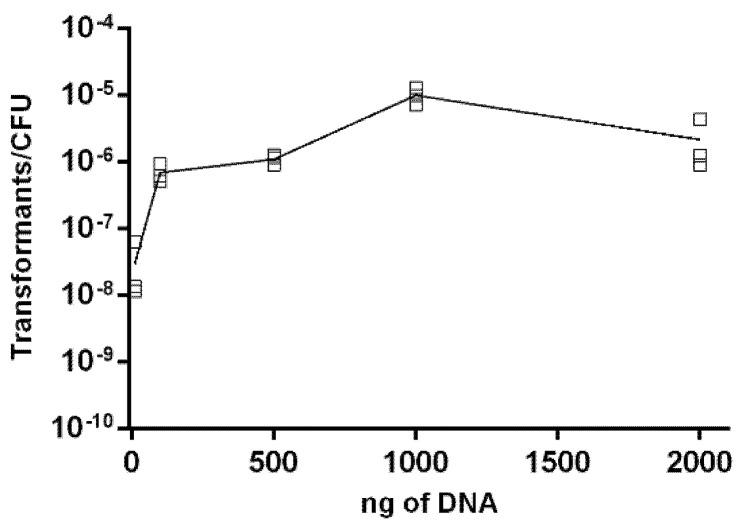
is an emergent enteropathogen, showing high genetic diversity, which likely contributes to its adaptive capacity to different environments. Whether natural transformation can be a mechanism that generates genetic diversity in is still unknown. In the present study, we aimed to establish if is naturally competent for transformation and to investigate the factors influencing this process. Two different transformation procedures were tested using exogenous and isogenic DNA containing antibiotic resistance markers, and different external conditions influencing the process were evaluated. The highest number of transformable strains were obtained with the agar transformation method when compared to the biphasic system (65% versus 47%). was able to uptake isogenic chromosomal DNA at different growth phases, and the competence state was maintained from the exponential to the stationary phases. Overall, the optimal conditions for transformation with the biphasic system were the use of 1 μg of isogenic DNA and incubation at 30 °C under a microaerobic atmosphere, resulting in a transformation frequency ~8 × 10 transformants/CFU. We also observed that favored the transformation with the genetic material of its own strain/species, with the DNA incorporation process occurring promptly after the addition of genomic material. In addition, we observed that strains could exchange genetic material in co-culture assays. The presence of homologs of well-known genes involved in the competence in the genome corroborates the natural competence of this species. In conclusion, our results show that is a naturally transformable species, suggesting that horizontal gene transfer mediated by natural transformation is one of the processes contributing to its genetic diversity. In addition, natural transformation can be used as a tool for genetic studies of this species.
是一种新兴的肠道病原体,具有高度的遗传多样性,这可能有助于其对不同环境的适应能力。自然转化是否可以作为在中产生遗传多样性的一种机制仍不清楚。在本研究中,我们旨在确定是否具有自然转化能力,并研究影响这一过程的因素。使用含有抗生素抗性标记的外源和同基因DNA测试了两种不同的转化程序,并评估了影响该过程的不同外部条件。与双相系统相比,琼脂转化法获得的可转化菌株数量最多(65%对47%)。能够在不同生长阶段摄取同基因染色体DNA,感受态状态从指数期维持到稳定期。总体而言,双相系统转化的最佳条件是使用1μg同基因DNA,并在微需氧气氛下于30°C孵育,转化频率约为8×10转化子/CFU。我们还观察到有利于用其自身菌株/物种的遗传物质进行转化,在添加基因组物质后DNA掺入过程迅速发生。此外,我们观察到在共培养试验中菌株可以交换遗传物质。基因组中参与感受态的已知基因同源物的存在证实了该物种的自然感受态。总之,我们的结果表明是一种自然可转化的物种,这表明由自然转化介导的水平基因转移是导致其遗传多样性的过程之一。此外,自然转化可作为该物种遗传研究的工具。



 Zotero 插件