
骨肉瘤的免疫景观:对预后和治疗反应的影响。
The Immune Landscape of Osteosarcoma: Implications for Prognosis and Treatment Response.
机构信息
Molecular Immunology Unit, Department of Research, Fondazione IRCCS Istituto Nazionale dei Tumori, 20133 Milan, Italy.
出版信息
Cells. 2021 Jul 2;10(7):1668. doi: 10.3390/cells10071668.
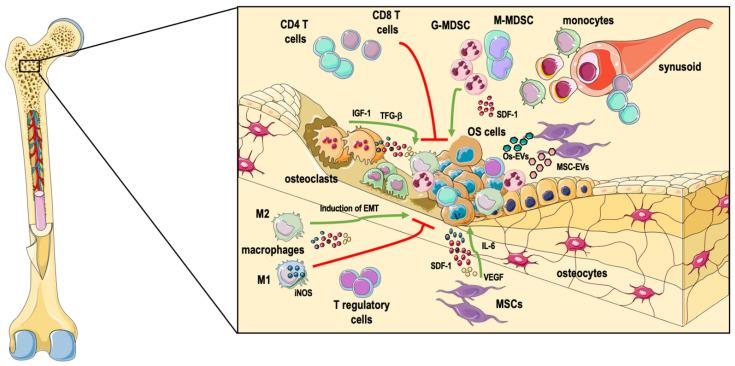
Osteosarcoma (OS) is a high-grade malignant stromal tumor composed of mesenchymal cells producing osteoid and immature bone, with a peak of incidence in the second decade of life. Hence, although relatively rare, the social impact of this neoplasm is particularly relevant. Differently from carcinomas, molecular genetics and the role of the tumor microenvironment in the development and progression of OS are mainly unknown. Indeed, while the tumor microenvironment has been widely studied in other solid tumor types and its contribution to tumor progression has been definitely established, tumor-stroma interaction in OS has been quite neglected for years. Only recently have new insights been gained, also thanks to the availability of new technologies and bioinformatics tools. A better understanding of the cross-talk between the bone microenvironment, including immune and stromal cells, and OS will be key not only for a deeper knowledge of osteosarcoma pathophysiology, but also for the development of novel therapeutic strategies. In this review, we summarize the current knowledge about the tumor microenvironment in OS, mainly focusing on immune cells, discussing their role and implication for disease prognosis and treatment response.
骨肉瘤(OS)是一种由间充质细胞产生骨样组织和未成熟骨的高级恶性基质肿瘤,发病高峰在生命的第二个十年。因此,尽管相对罕见,但这种肿瘤的社会影响尤其相关。与癌不同,骨肉瘤的分子遗传学和肿瘤微环境在其发生和发展中的作用主要是未知的。事实上,虽然肿瘤微环境已在其他实体瘤类型中得到广泛研究,其对肿瘤进展的贡献已得到明确确立,但骨肉瘤中的肿瘤-基质相互作用多年来一直被忽视。仅在最近,由于新技术和生物信息学工具的可用性,才获得了新的认识。更好地了解包括免疫细胞和基质细胞在内的骨微环境与骨肉瘤之间的串扰不仅对于更深入地了解骨肉瘤的病理生理学至关重要,而且对于开发新的治疗策略也至关重要。在这篇综述中,我们总结了骨肉瘤肿瘤微环境的当前知识,主要集中在免疫细胞上,讨论了它们在疾病预后和治疗反应中的作用和意义。
 Zotero 插件