
血管生成素 1、血管生成素 2 和血管内皮生长因子在血浆水平对肝癌的预后作用。
Prognostic role of plasma level of angiopoietin-1, angiopoietin-2, and vascular endothelial growth factor in hepatocellular carcinoma.
机构信息
Department of Internal Medicine, Seoul National University Bundang Hospital, Seoul National University College of Medicine, Seongnam 13620, South Korea.
出版信息
World J Gastroenterol. 2021 Jul 21;27(27):4453-4467. doi: 10.3748/wjg.v27.i27.4453.
BACKGROUND
Most hepatocellular carcinomas (HCCs) are hypervascular, with characteristic features of hepatic arterial supply to the tumor. The factors involved in tumor angiogenesis include angiopoietin-1 (Ang-1), angiopoietin-2 (Ang-2), and vascular endothelial growth factor (VEGF).
AIM
To investigate the profiles of plasma levels of angiogenesis markers in patients with HCC and evaluate their roles in predicting overall survival (OS) and progression-free survival (PFS).
METHODS
Plasma samples from 240 prospectively enrolled HCC patients in the very early to advanced stages were used to measure the levels of Ang-1, Ang-2, and VEGF. Their associations with clinical characteristics, OS, and PFS were analyzed.
RESULTS
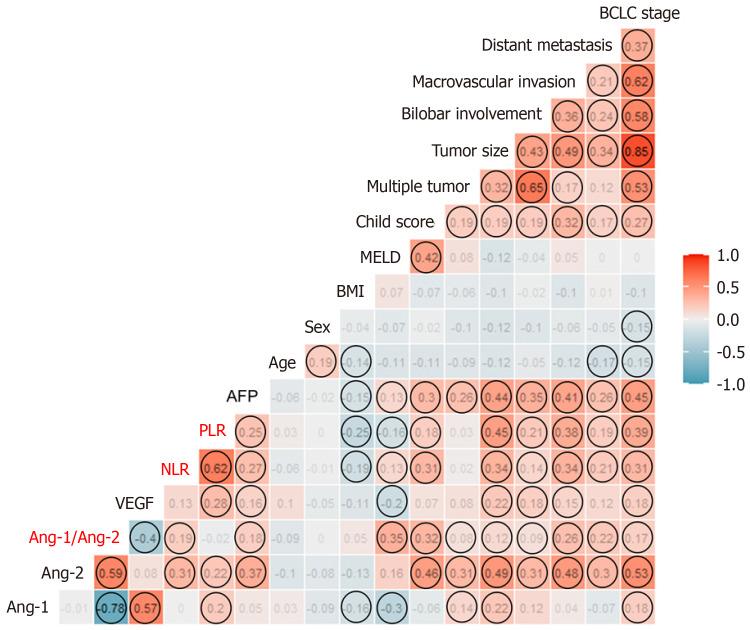
The median plasma levels of Ang-1, Ang-2, and VEGF were 3216 pg/mL, 1684 pg/mL, and 26.5 pg/mL, respectively. The plasma level of Ang-2 showed a significant increase from early stage [Barcelona clinic liver cancer (BCLC) A] to intermediate (BCLC B) and advanced stage HCC (BCLC C/D), whereas Ang-1, VEGF, and alpha-fetoprotein (AFP) levels in the plasma did not show any such changes. Multivariable analysis, propensity score-matched analysis, and time-dependent receiver operating curve analysis revealed that Ang-2 levels had the highest predictive power for OS and PFS. Neither Ang-1 nor VEGF was significantly associated with OS or PFS. The neutrophil-to-lymphocyte ratio was an independent factor for OS and PFS.
CONCLUSION
The plasma levels of Ang-2 correlated with liver function, tumor stage, and tumor invasiveness, showing better performance in predicting OS and PFS than AFP, Ang-1, or VEGF.
背景
大多数肝细胞癌(HCC)是富血管性的,具有肝动脉向肿瘤供血的特征。肿瘤血管生成的相关因素包括血管生成素-1(Ang-1)、血管生成素-2(Ang-2)和血管内皮生长因子(VEGF)。
目的
探讨 HCC 患者血浆血管生成标志物水平的特征,并评估其在预测总生存期(OS)和无进展生存期(PFS)中的作用。
方法
使用 240 例从早期到晚期 HCC 患者的前瞻性入组的血浆样本测量 Ang-1、Ang-2 和 VEGF 的水平。分析其与临床特征、OS 和 PFS 的关系。
结果
Ang-1、Ang-2 和 VEGF 的血浆中位水平分别为 3216pg/ml、1684pg/ml 和 26.5pg/ml。Ang-2 的血浆水平从早期(巴塞罗那临床肝癌(BCLC)A 期)到中期(BCLC B 期)和晚期 HCC(BCLC C/D 期)显著增加,而 Ang-1、VEGF 和甲胎蛋白(AFP)的血浆水平没有任何变化。多变量分析、倾向评分匹配分析和时间依赖性接收者操作曲线分析显示,Ang-2 水平对 OS 和 PFS 具有最高的预测能力。Ang-1 或 VEGF 与 OS 或 PFS 均无显著相关性。中性粒细胞与淋巴细胞比值是 OS 和 PFS 的独立因素。
结论
Ang-2 的血浆水平与肝功能、肿瘤分期和肿瘤侵袭性相关,在预测 OS 和 PFS 方面优于 AFP、Ang-1 或 VEGF。




 Zotero 插件