
新型冠状病毒肺炎的心电图表现:对心脏激动和复极的影响
Electrocardiographic manifestations of COVID-19: Effect on cardiac activation and repolarization.
作者信息
Thakore Avni, Nguyen James, Pollack Simcha, Muehlbauer Stefan, Chi Benjamin, Knight Derek, Mehrotra Bhoomi, Stern Joshua, Cao J Jane, Lucore Charles, Levine Joseph
机构信息
Department of Cardiology and Research, St. Francis Hospital, The Heart Center - 100 Port Washington Blvd, Roslyn, New York 11576, United States.
Department of Emergency Medicine, St. Francis Hospital, The Heart Center -100 Port Washington Blvd, Roslyn, New York 11576, United States.
出版信息
EClinicalMedicine. 2021 Sep;39:101057. doi: 10.1016/j.eclinm.2021.101057. Epub 2021 Aug 6.
BACKGROUND
Prolonged QT intervals are reported in patients with COVID-19. Additionally, virus particles in heart tissue and abnormal troponin levels have been reported. Consequently, we hypothesize that cardiac electrophysiologic abnormalities may be associated with COVID-19.
METHODS
This is a retrospective study between March 15, 2020 and May 30, 2020 of 828 patients with COVID-19 and baseline ECG. Corrected QT (QTc) and QRS intervals were measured from ECGs performed prior to intervention or administration of QT prolonging drugs. QTc and QRS intervals were evaluated as a function of disease severity (patients admitted versus discharged; inpatients admitted to medical unit vs ICU) and cardiac involvement (troponin elevation >0.03 ng/ml, elevated B-natriuretic peptide (BNP) or NT pro-BNP >500 pg/ml). Multivariable analysis was used to test for significance. Odds ratios for predictors of disease severity and mortality were generated.
FINDINGS
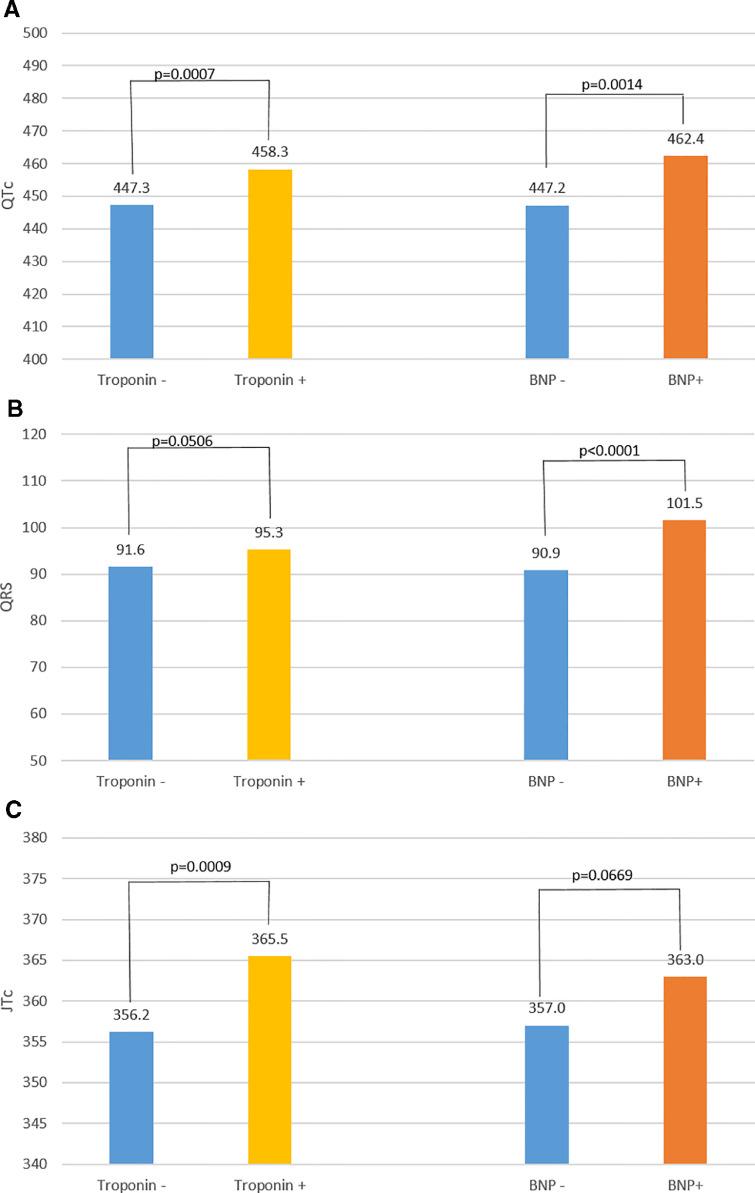
Baseline QTc of inpatients was prolonged compared to patients discharged (450.1±30.2 versus 423.4±21.7 msec, <0.0001) and relative to a control group of patients with influenza (=0.006). Inpatients with abnormal cardiac biomarkers had prolonged QTc and QRS compared to those with normal levels (troponin - QTc: 460.9±34.6 versus 445.3±26.6 msec, <0.0001, QRS: 98.7±24.6 vs 90.5±16.9 msec, <0.0001; BNP - QTc: 465.9±33.0 versus 446.0±26.2 msec, <0.0001, QRS: 103.6±25.3 versus 90.6±17.6 msec, <0.0001). Findings were confirmed with multivariable analysis (all <0.05). QTc prolongation independently predicted mortality (8.3% increase in mortality for every 10 msec increase in QTc; OR 1.083, CI [1.002, 1.171], =0.04).
INTERPRETATION
QRS and QTc intervals are early markers for COVID-19 disease progression and mortality. ECG, a readily accessible tool, identifies cardiac involvement and may be used to predict disease course.
FUNDING
St. Francis Foundation.
背景
据报道,新冠病毒病(COVID-19)患者存在QT间期延长的情况。此外,也有关于心脏组织中病毒颗粒及肌钙蛋白水平异常的报道。因此,我们推测心脏电生理异常可能与COVID-19有关。
方法
这是一项回顾性研究,研究对象为2020年3月15日至2020年5月30日期间的828例COVID-19患者及基线心电图。校正QT(QTc)和QRS间期通过干预前或使用延长QT药物前的心电图进行测量。QTc和QRS间期根据疾病严重程度(入院患者与出院患者;入住内科病房的患者与入住重症监护病房的患者)及心脏受累情况(肌钙蛋白升高>0.03 ng/ml、B型利钠肽(BNP)或N末端B型利钠肽原(NT pro-BNP)升高>500 pg/ml)进行评估。采用多变量分析检验其显著性。生成疾病严重程度和死亡率预测指标的比值比。
结果
与出院患者相比,住院患者的基线QTc延长(450.1±30.2对423.4±21.7毫秒,P<0.0001),且相对于流感患者对照组也延长(P=0.006)。与心脏生物标志物正常的患者相比,心脏生物标志物异常的住院患者QTc和QRS延长(肌钙蛋白 - QTc:460.9±34.6对445.3±26.6毫秒,P<0.0001,QRS:98.7±24.6对90.5±16.9毫秒,P<0.0001;BNP - QTc:465.9±33.0对446.0±26.2毫秒,P<0.0001,QRS:103.6±25.3对90.6±17.6毫秒,P<0.0001)。多变量分析证实了这些结果(均P<0.05)。QTc延长独立预测死亡率(QTc每增加10毫秒,死亡率增加8.3%;比值比1.083,95%置信区间[1.002, 1.171],P=0.04)。
解读
QRS和QTc间期是COVID-19疾病进展和死亡率的早期标志物。心电图是一种易于获取的工具,可识别心脏受累情况并可用于预测疾病进程。
资助
圣弗朗西斯基金会。




 Zotero 插件