
中国一家大型教学医院碳青霉烯类抗生素处方监管的效果:一项2016 - 2018年的中断时间序列分析
Effects of Regulation on Carbapenem Prescription in a Large Teaching Hospital in China: An Interrupted Time Series Analysis, 2016-2018.
作者信息
Xie Lewei, Du Yaling, Wang Xuemei, Zhang Xinping, Liu Chenxi, Liu Junjie, Peng Xi, Guo Xinhong
机构信息
School of Medicine and Health Management, Tongji Medical School, Huazhong University of Science and Technology, Wuhan, Hubei, People's Republic of China.
School of Statistics and Mathematics, Central University of Finance and Economics, Beijing, People's Republic of China.
出版信息
Infect Drug Resist. 2021 Aug 11;14:3099-3108. doi: 10.2147/IDR.S322938. eCollection 2021.
PURPOSE
Carbapenem resistance due to the overuse of carbapenems has become a public health problem worldwide, particularly in low- and middle-income countries (LMICs). However, there are few policies guiding carbapenem prescription, and their effectiveness is still unclear. A regulation targeting carbapenem prescription was implemented in March 2017 in China. This study aimed to assess the effects of the regulation for providing evidence on the prudent use of carbapenems.
PATIENTS AND METHODS
This was an interventional, retrospective study started in January 2017. The intervention covered establishing performance appraisal indicators, special authorisation, strict prescribing restrictions, and dedicated supervision, particularly in the intensive care unit (ICU). Data on adult inpatients who received at least one carbapenems were extracted from January 2016 to December 2018. Segmented regression analysis was performed to evaluate the effect of the regulation.
RESULTS
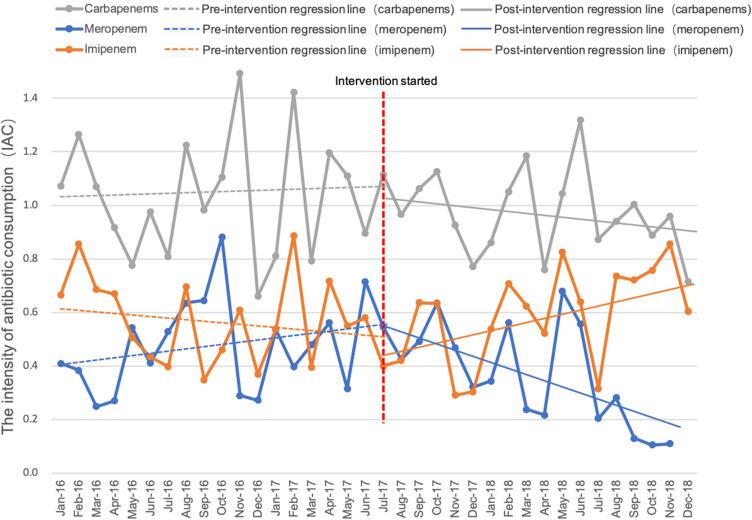
A total of 2005 inpatients received carbapenems. Segmented regression models showed an immediate decline in the intensity of antibiotic consumption (IAC) of carbapenems (coefficient = -9.65, p < 0.001), particularly imipenem (coefficient = -6.82, p = 0.002), and the antibiotic consumption of carbapenems (coefficient = -133.60, p = 0.003) in the ICU. And there is a decreasing trend in the IAC of meropenem (coefficient = -0.03, = 0.008) in all departments. Furthermore, the IAC of carbapenems and imipenem (coefficient = -0.36, = 0.035; coefficient = -0.49, = 0.025, respectively), and the average length of stay (ALoS) (coefficient = -0.73, < 0.001) showed downward trends in the ICU.
CONCLUSION
The intervention effectively reduced the IAC of carbapenems and imipenem, carbapenem consumption and the ALoS in the ICU, and the IAC of meropenem in all departments. The effects of the intervention were significant in the ICU, which indicated an urgent need for stronger regulations focusing on critical departments in the future.
目的
由于碳青霉烯类药物的过度使用导致的碳青霉烯类耐药已成为全球公共卫生问题,尤其是在低收入和中等收入国家(LMICs)。然而,指导碳青霉烯类药物处方的政策很少,其有效性仍不明确。中国于2017年3月实施了一项针对碳青霉烯类药物处方的规定。本研究旨在评估该规定的效果,为碳青霉烯类药物的合理使用提供证据。
患者与方法
这是一项始于2017年1月的干预性回顾性研究。干预措施包括建立绩效考核指标、特殊授权、严格的处方限制以及专门的监督,尤其是在重症监护病房(ICU)。从2016年1月至2018年12月提取接受过至少一剂碳青霉烯类药物的成年住院患者的数据。进行分段回归分析以评估该规定的效果。
结果
共有2005名住院患者接受了碳青霉烯类药物治疗。分段回归模型显示,碳青霉烯类药物的抗生素消费强度(IAC)立即下降(系数=-9.65,p<0.001),尤其是亚胺培南(系数=-6.82,p=0.002),以及ICU中碳青霉烯类药物的抗生素消费量(系数=-133.60,p=0.003)。所有科室美罗培南的IAC呈下降趋势(系数=-0.03,p=0.008)。此外,ICU中碳青霉烯类药物和亚胺培南的IAC(系数分别为=-0.36,p=0.035;系数=-0.49,p=0.025)以及平均住院时间(ALoS)(系数=-0.73,p<0.001)呈下降趋势。
结论
该干预措施有效降低了碳青霉烯类药物和亚胺培南的IAC、ICU中碳青霉烯类药物的消费量以及ALoS,以及所有科室美罗培南的IAC。该干预措施在ICU中的效果显著,这表明未来迫切需要针对关键科室制定更强有力的规定。


 Zotero 插件