
门诊和住院泌尿外科患者中与菌尿相关的碳青霉烯类耐药性。
Carbapenem resistance associated with coliuria among outpatient and hospitalised urology patients.
作者信息
Adegoke A A, Ikott W E, Okoh A I
机构信息
Department of Microbiology, University of Uyo, Uyo, Nigeria.
Adjunct Researcher, Faculty of Health Sciences, Durban University of Technology (DUT), Durban, South Africa.
出版信息
New Microbes New Infect. 2022 Aug 29;48:101019. doi: 10.1016/j.nmni.2022.101019. eCollection 2022 Jul.
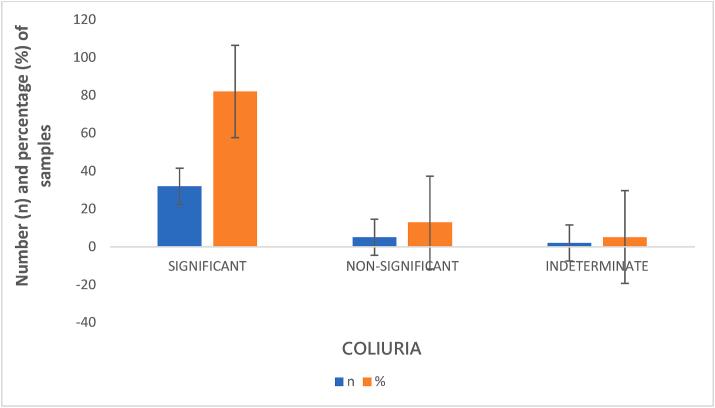
The World Health Organization in 2017 listed carbapenem resistant Enterobacteriaceae (CRE) with critical priority for research. A research to assess carbapenem resistant (CREc) in coliuria among the outpatients and inpatients of a tertiary health institution was carried out using conventional methods, polymerase chain reaction, Sanger sequencing, and bioinformatics. There were 39 positive coliuria cases from the urine samples collected from a total of 126 patients with various genitourinary diseases. The enumeration (log CFU/mL) revealed that 82.1% (n = 32) of the samples showed significant coliuria, 12.8% (n = 5) showed non-significant coliuria while 5.1% (n = 2) showed indeterminate coliuria even when repeated. Significantly higher numbers (p > 0.05) of the sampled inpatients yielded positive coliuria (57.9%) than the outpatients. Though there were significantly more (P > 0.05) urology female patients (n = 77) than male (n = 49), coliuria was more prevalent in sampled male patients (34.9%) than female (28.6%). Highest prevalence of coliuria was observed among the age range (18-30) years. Selected CREc that was sequenced and the sequences submitted to GenBank of National Center for Biotechnological Information (NCBI) were AYO-WINI111 and AYO-WINI112 with accession number MT735391 and MT735392, respectively. High resistance was observed against ertapenem (53%), imipenem (62%), meropenem (48%), and doripenem (47%), while 7%-22% of the isolates showed phenotypic intermediate carbapenem resistance. Critically dangerous CREc are harboured by large number urology patients in the study area, depicting the need for more attention in the management of the condition, as CREc are close to achieving totally antibiotic resistance.
世界卫生组织在2017年将耐碳青霉烯类肠杆菌科细菌(CRE)列为重点研究对象。采用传统方法、聚合酶链反应、桑格测序和生物信息学,对一家三级医疗机构门诊和住院患者的尿菌中耐碳青霉烯类(CREc)情况进行了研究。从总共126例患有各种泌尿生殖系统疾病的患者收集的尿液样本中有39例尿菌阳性。计数(log CFU/mL)显示,82.1%(n = 32)的样本显示有显著尿菌,12.8%(n = 5)显示无显著尿菌,而5.1%(n = 2)即使重复检测仍显示不确定的尿菌情况。住院患者尿菌阳性率(57.9%)显著高于门诊患者(p > 0.05)。虽然泌尿外科女性患者(n = 77)明显多于男性(n = 49)(P > 0.05),但抽样男性患者中尿菌患病率(34.9%)高于女性(28.6%)。在年龄范围(18 - 30)岁的人群中观察到尿菌患病率最高。经测序并提交至美国国立生物技术信息中心(NCBI)基因库的选定CREc分别为AYO - WINI111和AYO - WINI112,登录号分别为MT735391和MT735392。观察到对厄他培南(53%)、亚胺培南(62%)、美罗培南(48%)和多利培南(47%)的耐药性较高,而7% - 22%的分离株表现出碳青霉烯类耐药表型为中度。研究区域内大量泌尿外科患者携带极其危险的CREc,这表明在该疾病的管理中需要更多关注,因为CREc已接近完全耐药。


 Zotero 插件