
2007 年至 2017 年间,2170 万人的数据表明,中国人群中的 1 型糖尿病发病率可能被低估。
Incidence of Type 1 Diabetes May Be Underestimated in the Chinese Population: Evidence From 21.7 Million People Between 2007 and 2017.
机构信息
Department of Endocrinology, Beijing Tongren Hospital, Capital Medical University, Beijing, China.
Beijing Diabetes Institute, Beijing, China.
出版信息
Diabetes Care. 2021 Nov;44(11):2503-2509. doi: 10.2337/dc21-0342. Epub 2021 Aug 19.
OBJECTIVE
Previous reports of the annual incidence of type 1 diabetes (T1D) in China were conducted using retrospective hospital cases, which may not reflect the reality. This longitudinal study estimated T1D incidence in a Chinese population of 21.7 million from 2007 to 2017.
RESEARCH DESIGN AND METHODS
A population-based registry of T1D was performed by the Beijing Municipal Health Commission Information Center. Annual incidence and 95% CIs were calculated by age group and sex. The association of sex with T1D incidence and predicted new cases of T1D were assessed using Poisson regression models. Annual percentage change and average annual percentage of change were assessed using Joinpoint regression.
RESULTS
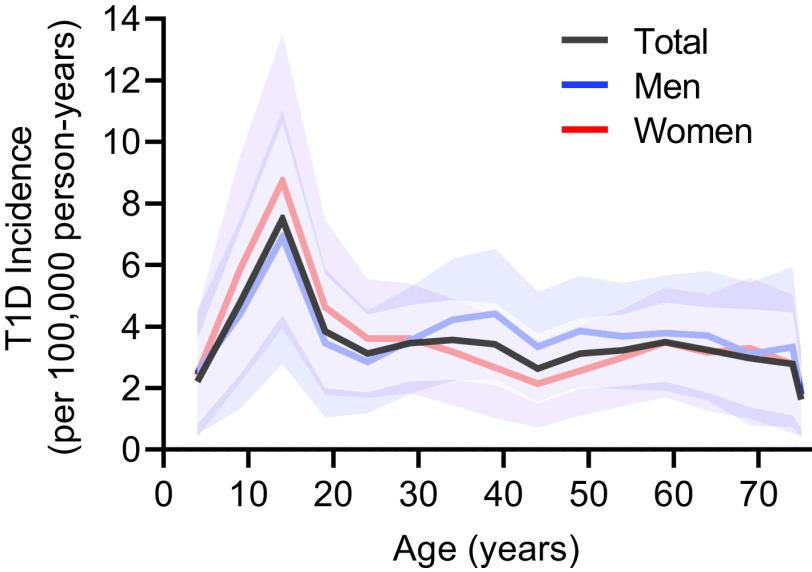
Overall, there were 6,875 individuals who developed T1D from 2007 to 2017 in this population. T1D incidence (/100,000 persons) (95% CI) significantly increased from 2.72 (2.51, 2.93) in 2007 to 3.60 (3.38, 3.78) in 2017 ( < 0.001). The T1D onset peak was in the 10-14-year-old age group. While no significant trend was found in the 0-14- and 15-29-year-old age groups, T1D incidence markedly increased from 1.87 to 3.52 in the ≥30-year-old age group ( < 0.05). The prevalence of diabetic ketoacidosis at diagnosis was highest in the 0-4-year-old age group. We predicted new cases of T1D will increase 1.57-fold over the next decade.
CONCLUSIONS
T1D incidence in this large Chinese population is higher than has been reported previously. From 2007 to 2017, although the incidence peak was in the 10-14-year age group, the T1D incidence increased sharply in adults but not in youth.
目的
之前中国的 1 型糖尿病(T1D)年度发病率报告是使用回顾性医院病例进行的,这可能无法反映实际情况。本纵向研究估计了 2007 年至 2017 年期间 2170 万中国人群中的 T1D 发病率。
研究设计和方法
北京市卫生健康委员会信息中心开展了一项基于人群的 T1D 登记。按年龄组和性别计算发病率及 95%CI。使用泊松回归模型评估性别与 T1D 发病率及预测的 T1D 新发病例之间的关系。使用 Joinpoint 回归评估年度百分比变化和平均年百分比变化。
结果
在该人群中,2007 年至 2017 年期间共有 6875 人发生 T1D。T1D 发病率(/100000 人)(95%CI)从 2007 年的 2.72(2.51,2.93)显著增加至 2017 年的 3.60(3.38,3.78)(<0.001)。T1D 发病高峰在 10-14 岁年龄组。0-14 岁和 15-29 岁年龄组未发现明显趋势,但≥30 岁年龄组 T1D 发病率从 1.87 增加到 3.52(<0.05)。诊断时糖尿病酮症酸中毒的患病率在 0-4 岁年龄组最高。我们预测未来十年 T1D 新发病例将增加 1.57 倍。
结论
在这个大型中国人群中,T1D 的发病率高于之前的报告。从 2007 年至 2017 年,尽管发病率高峰在 10-14 岁年龄组,但成年人的 T1D 发病率急剧上升,而青少年则没有。

 Zotero 插件