
一种基于遗传算法的用于能源需求预测的残差灰色预测模型。
A genetic-algorithm-based remnant grey prediction model for energy demand forecasting.
作者信息
Hu Yi-Chung
机构信息
College of Management & College of Tourism, Fujian Agriculture and Forestry University, Fuzhou City, China.
Department of Business Administration, Chung Yuan Christian University, Taoyuan City, Taiwan.
出版信息
PLoS One. 2017 Oct 5;12(10):e0185478. doi: 10.1371/journal.pone.0185478. eCollection 2017.
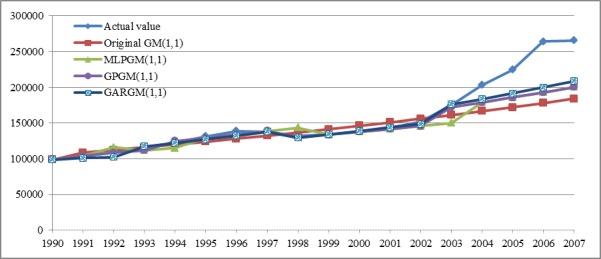
Energy demand is an important economic index, and demand forecasting has played a significant role in drawing up energy development plans for cities or countries. As the use of large datasets and statistical assumptions is often impractical to forecast energy demand, the GM(1,1) model is commonly used because of its simplicity and ability to characterize an unknown system by using a limited number of data points to construct a time series model. This paper proposes a genetic-algorithm-based remnant GM(1,1) (GARGM(1,1)) with sign estimation to further improve the forecasting accuracy of the original GM(1,1) model. The distinctive feature of GARGM(1,1) is that it simultaneously optimizes the parameter specifications of the original and its residual models by using the GA. The results of experiments pertaining to a real case of energy demand in China showed that the proposed GARGM(1,1) outperforms other remnant GM(1,1) variants.
能源需求是一项重要的经济指标,需求预测在制定城市或国家的能源发展规划中发挥了重要作用。由于使用大型数据集和统计假设来预测能源需求往往不切实际,GM(1,1)模型因其简单性以及能够通过使用有限数量的数据点构建时间序列模型来表征未知系统而被广泛使用。本文提出了一种基于遗传算法的残差GM(1,1)(GARGM(1,1))并进行符号估计,以进一步提高原始GM(1,1)模型的预测精度。GARGM(1,1)的独特之处在于它通过使用遗传算法同时优化原始模型及其残差模型的参数规格。针对中国能源需求实际案例的实验结果表明,所提出的GARGM(1,1)优于其他残差GM(1,1)变体。

 Zotero 插件