
宿主微生物群对骨髓炎发病机制的影响。
Impact of the Host-Microbiome on Osteomyelitis Pathogenesis.
作者信息
Chen Jun, Xiong Ailin, Ma Yuhao, Qin Chenghe, Ho Chun Loong
机构信息
Department of Biomedical Engineering, Southern University of Science and Technology (SUSTech), Shenzhen, China.
Department of Orthopaedic Trauma, Guangdong Second Provincial General Hospital, Guangzhou, China.
出版信息
Front Mol Biosci. 2021 Aug 9;8:702484. doi: 10.3389/fmolb.2021.702484. eCollection 2021.
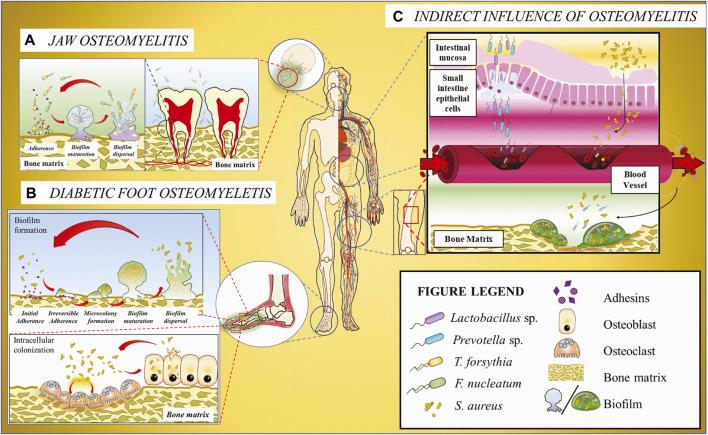
The microbiome is a collection of genomes from microbiota, including all microorganisms in a niche, through direct and indirect interactions with the host. Certain microorganisms can exist in areas conventionally considered to be sterile, such as the bone matrix. Osseous microbiota dysbiosis caused by host-microbiome perturbation or external infections may ultimately lead to osteomyelitis, a bone inflammatory disorder. Our review covers the current discoveries on the impact of host-microbiome on osteomyelitis and some common osseous diseases. Some studies suggest that the microbiotas from both osseous and non-osseous tissues (e.g., blood or gut) impact the pathogenicity of osteomyelitis and other osseous diseases (e.g., rheumatoid arthritis). We believe that this review will provide readers with a better understanding on the role of the microbiome to the host's bone health.
微生物组是微生物群基因组的集合,包括特定生态位中的所有微生物,它们通过与宿主的直接和间接相互作用而存在。某些微生物可以存在于传统上被认为是无菌的区域,如骨基质中。由宿主-微生物组扰动或外部感染引起的骨微生物群失调最终可能导致骨髓炎,一种骨炎症性疾病。我们的综述涵盖了目前关于宿主-微生物组对骨髓炎和一些常见骨疾病影响的发现。一些研究表明,来自骨组织和非骨组织(如血液或肠道)的微生物群会影响骨髓炎和其他骨疾病(如类风湿性关节炎)的致病性。我们相信,这篇综述将使读者更好地了解微生物组对宿主骨骼健康的作用。
 Zotero 插件