
化疗引起的周围神经病与糖尿病:范围综述
Chemotherapy-Induced Neuropathy and Diabetes: A Scoping Review.
机构信息
Department of Nursing, University of Valencia, 46010 Valencia, Spain.
Frailty Research Organized Group (FROG), University of Valencia, 46010 Valencia, Spain.
出版信息
Curr Oncol. 2021 Aug 19;28(4):3124-3138. doi: 10.3390/curroncol28040273.
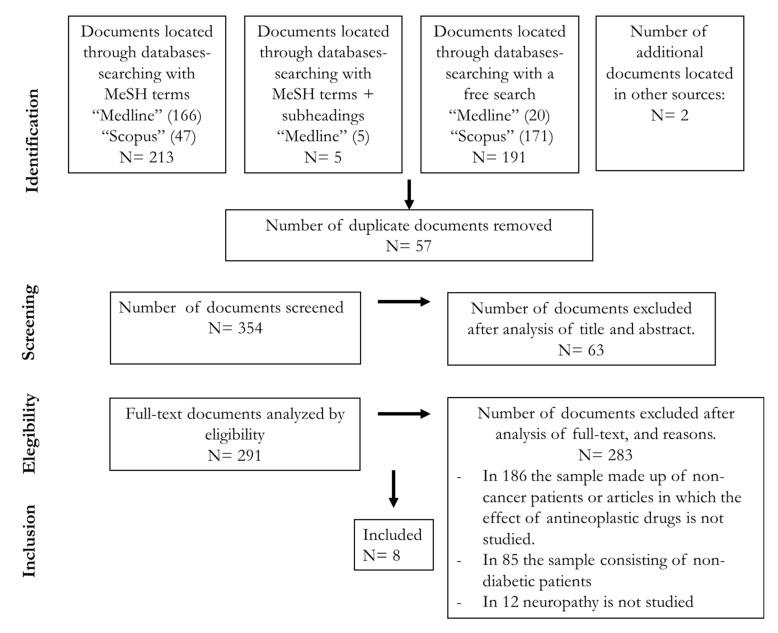
Although cancer and diabetes are common diseases, the relationship between diabetes, neuropathy and the risk of developing peripheral sensory neuropathy while or after receiving chemotherapy is uncertain. In this review, we highlight the effects of chemotherapy on the onset or progression of neuropathy in diabetic patients. We searched the literature in Medline and Scopus, covering all entries until 31 January 2021. The inclusion and exclusion criteria were: (1) original article (2) full text published in English or Spanish; (3) neuropathy was specifically assessed (4) the authors separately analyzed the outcomes in diabetic patients. A total of 259 papers were retrieved. Finally, eight articles fulfilled the criteria, and four more articles were retrieved from the references of the selected articles. The analysis of the studies covered the information about neuropathy recorded in 768 cancer patients with diabetes and 5247 control cases (non-diabetic patients). The drugs investigated are chemotherapy drugs with high potential to induce neuropathy, such as platinum derivatives and taxanes, which are currently the mainstay of treatment of various cancers. The predisposing effect of co-morbid diabetes on chemotherapy-induced peripheral neuropathy depends on the type of symptoms and drug used, but manifest at any drug regimen dosage, although greater neuropathic signs are also observed at higher dosages in diabetic patients. The deleterious effects of chemotherapy on diabetic patients seem to last longer, since peripheral neuropathy persisted in a higher proportion of diabetic patients than non-diabetic patients for up to two years after treatment. Future studies investigating the risk of developing peripheral neuropathy in cancer patients with comorbid diabetes need to consider the duration of diabetes, cancer-induced neuropathic effects per se (prior chemotherapy administration), and the effects of previous cancer management strategies such as radiotherapy and surgery.
尽管癌症和糖尿病较为常见,但糖尿病、神经病变与接受化疗期间或之后发生外周感觉神经病变风险之间的关系尚不确定。在这篇综述中,我们重点阐述了化疗对糖尿病患者神经病变发生或进展的影响。我们在 Medline 和 Scopus 中检索了文献,涵盖截至 2021 年 1 月 31 日的所有条目。纳入和排除标准为:(1)原始文章;(2)全文以英文或西班牙语发表;(3)专门评估神经病变;(4)作者分别分析糖尿病患者的结局。共检索到 259 篇论文。最终,有 8 篇文章符合标准,并从选定文章的参考文献中检索到另外 4 篇文章。研究分析涵盖了在 768 例患有糖尿病的癌症患者和 5247 例对照病例(非糖尿病患者)中记录的神经病变信息。所研究的药物是具有高度诱发神经病变潜力的化疗药物,如铂衍生物和紫杉烷类药物,这些药物目前是治疗各种癌症的主要药物。合并糖尿病对化疗引起的周围神经病变的易感性取决于症状类型和所用药物,但在任何药物治疗方案剂量下都会表现出来,尽管在糖尿病患者中更高的剂量也会观察到更大的神经病变迹象。化疗对糖尿病患者的有害影响似乎持续时间更长,因为在治疗后长达两年的时间里,糖尿病患者的外周神经病变持续存在的比例高于非糖尿病患者。未来研究需要考虑糖尿病的持续时间、癌症本身引起的神经病变效应(先前的化疗给药)以及先前癌症管理策略(如放疗和手术)对癌症合并糖尿病患者发生周围神经病变风险的影响。
 Zotero 插件