
纳米材料的绿色合成
Green Synthesis of Nanomaterials.
作者信息
Huston Matthew, DeBella Melissa, DiBella Maria, Gupta Anisha
机构信息
Internal Medicine-Infectious Disease, University of Michigan, Ann Arbor, MI 48109, USA.
Department of Pharmaceutical Sciences, University of Saint Joseph, Hartford, CT 06117, USA.
出版信息
Nanomaterials (Basel). 2021 Aug 21;11(8):2130. doi: 10.3390/nano11082130.
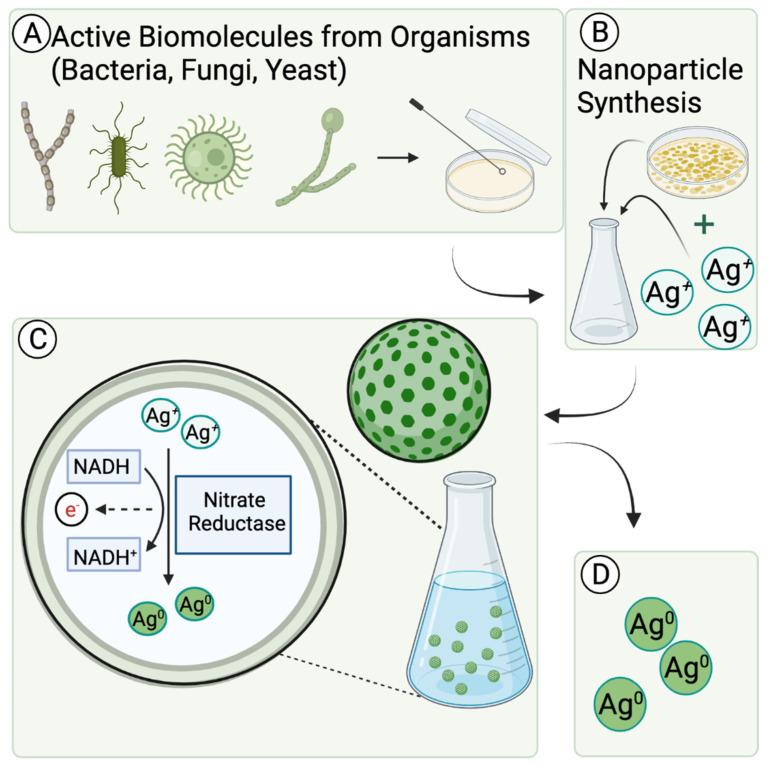
Nanotechnology is considered one of the paramount forefronts in science over the last decade. Its versatile implementations and fast-growing demand have paved the way for innovative measures for the synthesis of higher quality nanomaterials. In the early stages, traditional synthesis methods were utilized, and they relied on both carcinogenic chemicals and high energy input for production of nano-sized material. The pollution produced as a result of traditional synthesis methods induces a need for environmentally safer synthesis methods. As the downfalls of climate change become more abundant, the scientific community is persistently seeking solutions to combat the devastation caused by toxic production methods. Green methods for nanomaterial synthesis apply natural biological systems to nanomaterial production. The present review highlights the history of nanoparticle synthesis, starting with traditional methods and progressing towards green methods. Green synthesis is a method just as effective, if not more so, than traditional synthesis; it provides a sustainable approach to nanomaterial manufacturing by using naturally sourced starting materials and relying on low energy processes. The recent use of active molecules in natural biological systems such as bacteria, yeast, algae and fungi report successful results in the synthesis of various nanoparticle systems. Thus, the integration of green synthesis in scientific research and mass production provides a potential solution to the limitations of traditional synthesis methods.
在过去十年中,纳米技术被视为科学领域最重要的前沿领域之一。其广泛的应用和快速增长的需求为合成更高质量纳米材料的创新方法铺平了道路。在早期阶段,人们采用传统的合成方法,这些方法依赖致癌化学物质和高能量输入来生产纳米尺寸的材料。传统合成方法产生的污染促使人们需要更环保的合成方法。随着气候变化的负面影响日益增多,科学界一直在寻求解决方案,以应对有毒生产方法造成的破坏。纳米材料合成的绿色方法将天然生物系统应用于纳米材料生产。本综述重点介绍了纳米颗粒合成的历史,从传统方法开始,逐步发展到绿色方法。绿色合成是一种与传统合成同样有效甚至更有效的方法;它通过使用天然来源的起始材料并依靠低能量过程,为纳米材料制造提供了一种可持续的方法。最近在细菌、酵母、藻类和真菌等天然生物系统中使用活性分子,在合成各种纳米颗粒系统方面取得了成功。因此,将绿色合成整合到科学研究和大规模生产中,为传统合成方法的局限性提供了一个潜在的解决方案。



 Zotero 插件