
全基因组关联分析 NHLBI TOPMed 计划中睡眠呼吸紊乱表型。
Whole-genome association analyses of sleep-disordered breathing phenotypes in the NHLBI TOPMed program.
机构信息
Division of Sleep and Circadian Disorders, Brigham and Women's Hospital, Harvard Medical School, 221 Longwood Avenue, Boston, MA, 02115, USA.
Division of Sleep Medicine, Harvard Medical School, Boston, MA, 02115, USA.
出版信息
Genome Med. 2021 Aug 26;13(1):136. doi: 10.1186/s13073-021-00917-8.
BACKGROUND
Sleep-disordered breathing is a common disorder associated with significant morbidity. The genetic architecture of sleep-disordered breathing remains poorly understood. Through the NHLBI Trans-Omics for Precision Medicine (TOPMed) program, we performed the first whole-genome sequence analysis of sleep-disordered breathing.
METHODS
The study sample was comprised of 7988 individuals of diverse ancestry. Common-variant and pathway analyses included an additional 13,257 individuals. We examined five complementary traits describing different aspects of sleep-disordered breathing: the apnea-hypopnea index, average oxyhemoglobin desaturation per event, average and minimum oxyhemoglobin saturation across the sleep episode, and the percentage of sleep with oxyhemoglobin saturation < 90%. We adjusted for age, sex, BMI, study, and family structure using MMSKAT and EMMAX mixed linear model approaches. Additional bioinformatics analyses were performed with MetaXcan, GIGSEA, and ReMap.
RESULTS
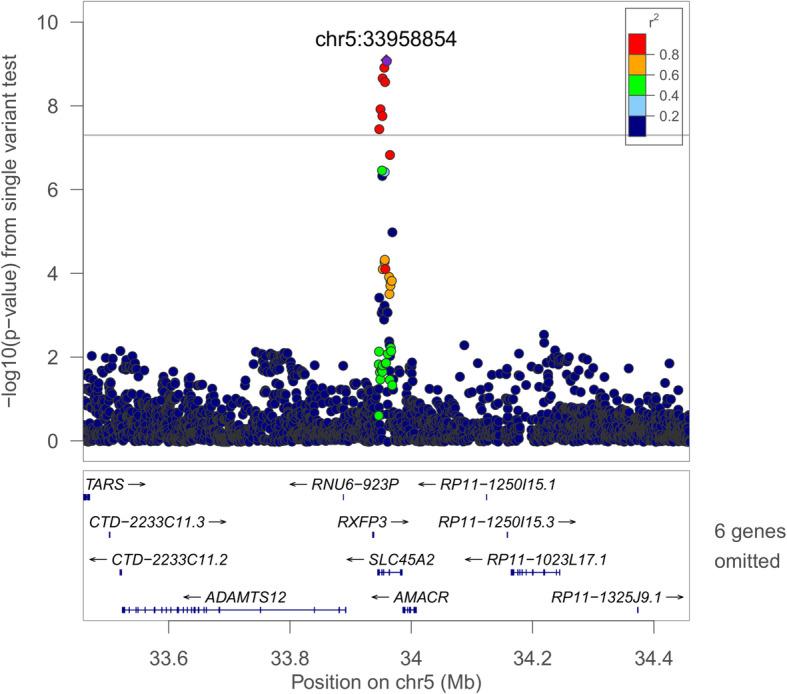
We identified a multi-ethnic set-based rare-variant association (p = 3.48 × 10) on chromosome X with ARMCX3. Additional rare-variant associations include ARMCX3-AS1, MRPS33, and C16orf90. Novel common-variant loci were identified in the NRG1 and SLC45A2 regions, and previously associated loci in the IL18RAP and ATP2B4 regions were associated with novel phenotypes. Transcription factor binding site enrichment identified associations with genes implicated with respiratory and craniofacial traits. Additional analyses identified significantly associated pathways.
CONCLUSIONS
We have identified the first gene-based rare-variant associations with objectively measured sleep-disordered breathing traits. Our results increase the understanding of the genetic architecture of sleep-disordered breathing and highlight associations in genes that modulate lung development, inflammation, respiratory rhythmogenesis, and HIF1A-mediated hypoxic response.
背景
睡眠呼吸障碍是一种常见的疾病,与显著的发病率有关。睡眠呼吸障碍的遗传结构仍知之甚少。通过 NHLBI 转化精准医学(TOPMed)计划,我们对睡眠呼吸障碍进行了首次全基因组序列分析。
方法
研究样本由来自不同种族的 7988 人组成。常见变体和途径分析包括另外 13257 人。我们检查了五个描述睡眠呼吸障碍不同方面的互补特征:呼吸暂停-低通气指数、每事件平均氧合血红蛋白去饱和量、整个睡眠过程中的平均和最小氧合血红蛋白饱和度,以及氧合血红蛋白饱和度<90%的睡眠时间百分比。我们使用 MMSKAT 和 EMMAX 混合线性模型方法,根据年龄、性别、BMI、研究和家庭结构进行了调整。使用 MetaXcan、GIGSEA 和 ReMap 进行了额外的生物信息学分析。
结果
我们在 X 染色体上发现了一个多民族基于集合的罕见变异关联(p = 3.48 × 10),与 ARMCX3 相关。额外的罕见变异关联包括 ARMCX3-AS1、MRPS33 和 C16orf90。NRG1 和 SLC45A2 区域中发现了新的常见变异位点,IL18RAP 和 ATP2B4 区域中先前与相关的位点与新的表型相关。转录因子结合位点富集鉴定出与呼吸和颅面特征相关的基因的关联。额外的分析确定了显著相关的途径。
结论
我们已经确定了与客观测量的睡眠呼吸障碍特征相关的第一个基于基因的罕见变异关联。我们的结果增加了对睡眠呼吸障碍遗传结构的理解,并强调了调节肺发育、炎症、呼吸节律生成和 HIF1A 介导的缺氧反应的基因的关联。

 Zotero 插件