
膝关节骨关节炎关节腔内注射透明质酸、皮质类固醇和富血小板血浆的当前临床实践指南的系统评价:国际视角
A Systematic Review of Current Clinical Practice Guidelines on Intra-articular Hyaluronic Acid, Corticosteroid, and Platelet-Rich Plasma Injection for Knee Osteoarthritis: An International Perspective.
作者信息
Phillips Mark, Bhandari Mohit, Grant John, Bedi Asheesh, Trojian Thomas, Johnson Aaron, Schemitsch Emil
机构信息
Department of Health Research Methods, Evidence and Impact, McMaster University, Hamilton, Ontario, Canada.
Division of Orthopaedic Surgery, McMaster University, Hamilton, Ontario, Canada.
出版信息
Orthop J Sports Med. 2021 Aug 31;9(8):23259671211030272. doi: 10.1177/23259671211030272. eCollection 2021 Aug.
BACKGROUND
There are many clinical practice guidelines (CPGs) for the prevention, diagnosis, and treatment of knee osteoarthritis (OA). They differ by region, considering local health care systems, along with cultural and economic factors. Currently, there are conflicting CPG recommendations across the various publications, which makes it difficult for clinicians to fully understand the optimal treatment decisions for knee OA management.
PURPOSE
To summarize the current published CPG recommendations for the role of injections in the nonoperative management of knee OA, specifically with the use of intra-articular hyaluronic acid (IA-HA), intra-articular corticosteroids (IA-CS), and platelet-rich plasma (PRP).
STUDY DESIGN
Systematic review.
METHODS
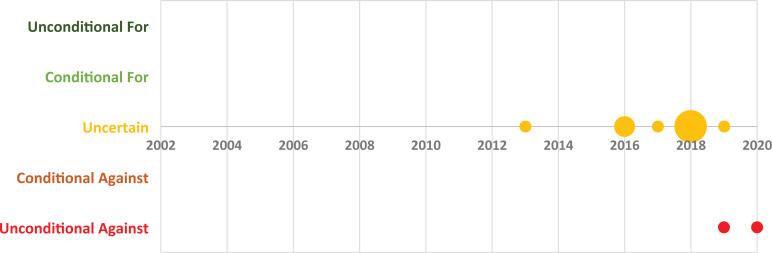
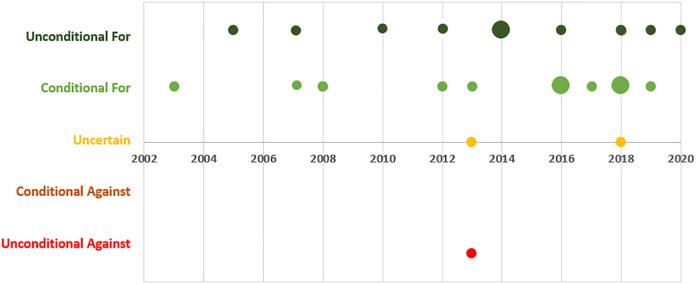
A comprehensive search identified all nonoperative knee OA CPGs within the ECRI (formerly Emergency Care Research Institute) Guidelines Trust database, the Guidelines International Network database, Google Scholar, and the Trip (formerly Turning Research Into Practice) database. Guideline recommendations were categorized into strong, conditional, or uncertain recommendations for or against the use of IA-HA, IA-CS, or PRP. Guideline recommendations were summarized and depicted graphically to identify trends in recommendations over time.
RESULTS
The search strategy identified 27 CPGs that provided recommendations. There were 20 recommendations in favor of IA-HA use, 21 recommendations in favor of IA-CS use, and 9 recommendations that were uncertain or unable to make a formal recommendation for or against PRP use based on current evidence. Most recommendations considered IA-HA and IA-CS use for symptom relief when other nonoperative options are ineffective. IA-CS were noted to provide fast and short-acting symptom relief for acute episodes of disease exacerbation, while IA-HA may demonstrate a relatively delayed but prolonged effect in comparison. The CPGs concluded that PRP recommendations currently lack evidence to definitively recommend for or against use.
CONCLUSION
Available CPGs provide recommendations on injectables for knee OA treatment. General guidance from a global perspective concluded that IA-CS and IA-HA are favored for different needed responses and can be utilized within the knee OA treatment paradigm, while PRP currently has insufficient evidence to make a conclusive recommendation for or against its use.
背景
有许多关于膝关节骨关节炎(OA)预防、诊断和治疗的临床实践指南(CPG)。考虑到当地医疗保健系统以及文化和经济因素,这些指南因地区而异。目前,不同出版物中的CPG建议相互冲突,这使得临床医生难以全面理解膝关节OA管理的最佳治疗决策。
目的
总结当前已发表的CPG中关于注射在膝关节OA非手术治疗中的作用的建议,特别是关于关节内透明质酸(IA-HA)、关节内皮质类固醇(IA-CS)和富血小板血浆(PRP)的使用。
研究设计
系统评价。
方法
全面检索ECRI(原急诊护理研究所)指南信托数据库、指南国际网络数据库、谷歌学术和Trip(原将研究转化为实践)数据库中的所有膝关节OA非手术CPG。指南建议被分类为支持或反对使用IA-HA、IA-CS或PRP的强烈、有条件或不确定建议。对指南建议进行总结并以图形方式呈现,以确定建议随时间的趋势。
结果
检索策略确定了27个提供建议的CPG。有20条建议支持使用IA-HA,21条建议支持使用IA-CS,9条建议基于当前证据对PRP的使用不确定或无法做出正式建议。大多数建议认为,当其他非手术选择无效时,使用IA-HA和IA-CS可缓解症状。IA-CS被认为可为疾病急性加重发作提供快速且短效的症状缓解,而相比之下,IA-HA可能显示出相对延迟但持久的效果。CPG得出结论,目前PRP的建议缺乏明确支持或反对使用的证据。
结论
现有CPG为膝关节OA治疗的注射剂提供了建议。从全球角度得出的一般指导意见是,IA-CS和IA-HA因不同的需求反应而受到青睐,可在膝关节OA治疗模式中使用,而PRP目前没有足够的证据对其使用做出决定性建议。

 Zotero 插件